Carved Remembrance at Copp’s Hill Burying Ground
At Copp’s Hill Burying Ground, the carved gravestones preserve more than names and dates. Their shapes, lettering, and symbols reveal how earlier generations commemorated the dead and reminded the living of their own mortality. Looking closely at these markers introduces another part of Boston’s history: the work of stone carvers and the visual language their communities understood.
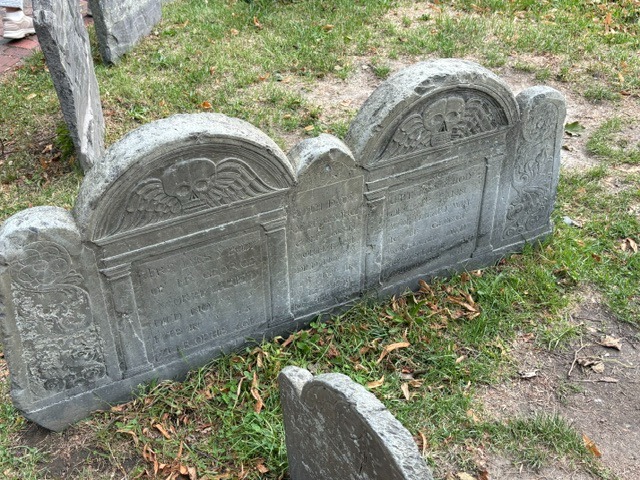
The paired marker shown here has two rounded sections, each crowned by a winged skull. Known as a death’s head, this design was common on early New England gravestones. Its message was direct: death was inevitable, and earthly life was temporary. The winged skull is the most frequently found carved symbol at Copp’s Hill, appearing in many variations throughout the grounds.
The imagery can seem severe to a modern visitor, but it belonged to a culture in which reminders of death were familiar. Boston’s early Puritans generally avoided religious images in their meetinghouses and on their gravestones. The death’s head served as an emblem of mortality rather than a depiction of a sacred figure. Its presence encouraged reflection on the brevity of life.
Around the inscriptions, decorative borders show the care devoted to the marker’s design. Gravestone carving was a skilled craft, requiring control of tools, an understanding of stone, and the ability to arrange lettering and ornament within a limited surface. Even when carvers repeated familiar symbols, differences in faces, wings, borders, and lettering gave individual stones their own character.
Over time, the imagery changed. Winged faces, often called cherubs or soul effigies, became more common during the eighteenth century. Later, urns and mourning willows appeared. These changing designs reflected broader shifts in artistic taste and the ways communities expressed death, remembrance, and hope.
Weathering has softened parts of this marker, but its carved skulls and borders remain distinct. They preserve the effort someone made to give lasting form to remembrance. At Copp’s Hill, even a stone whose inscription requires patient study can still communicate through the craftsmanship that survives.
Read More From Nancy
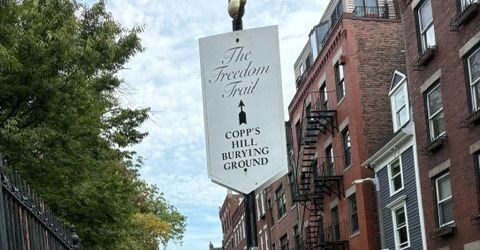
Copp’s Hill Burying Ground
Following the Freedom Trail through Boston’s North End brought us to Copp’s Hill Burying Ground. Beyond the surrounding streets and brick residences, its trees and gravestones preserve a different view of the neighborhood, one shaped by the people who lived and worked here long before the city took its present form. Established in 1659, Copp’s […]

The Mirroscope
Among the objects that caught my attention while visiting the Gibson House Museum in Boston was this unusual piece of photographic equipment. At first glance, with its large projecting lens and boxlike body, I assumed it was an early camera. Looking more closely, however, I discovered that it worked in exactly the opposite direction. It […]
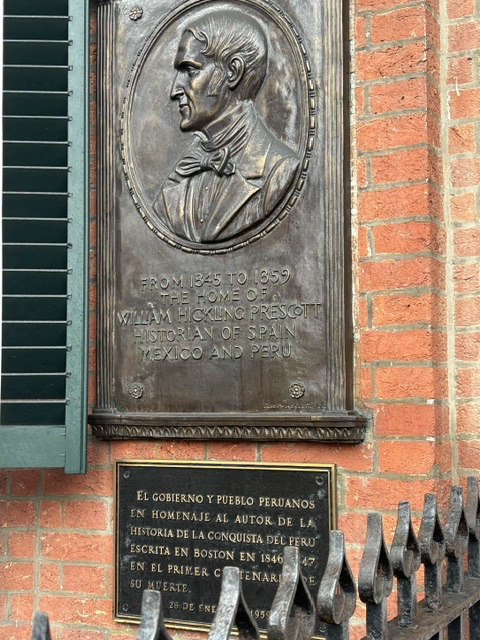
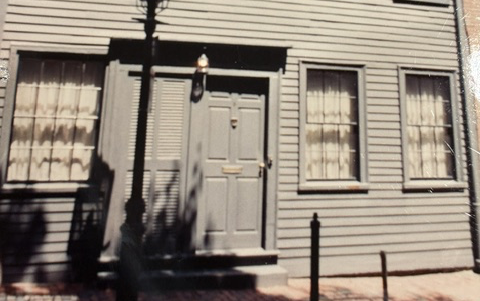
William Hickling Prescott
Walking through Boston’s Beacon Hill, it is easy to admire the elegant brick homes and historic streets without realizing how many remarkable people once lived behind these doors. One of those homes belonged to William Hickling Prescott, one of the nineteenth century’s most celebrated American historians. From 1845 until his death in 1859, Prescott lived […]

