John Singleton Copley
Walking through Boston, I came across this plaque marking the site where the home of John Singleton Copley once stood. The house itself is gone, but the plaque preserves the connection between this location and one of the most important artists of colonial America.
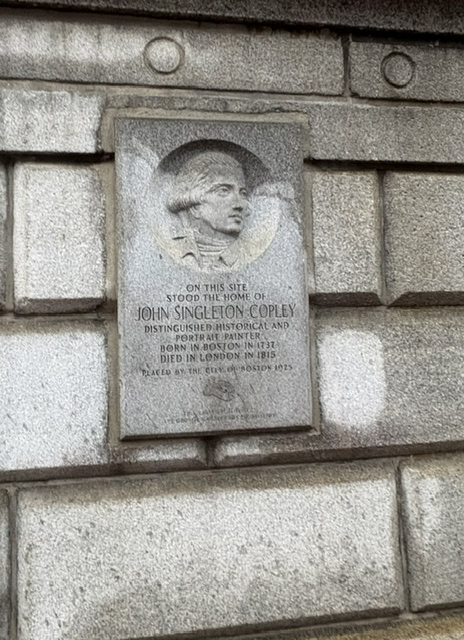
Copley was born in Boston in 1738, although the plaque gives the traditional date of 1737. He developed largely as a self-taught artist and became extraordinarily successful painting portraits of the merchants, politicians and families of colonial New England.
His paintings provide something that written history cannot. Through Copley, we can actually look into the faces of people who inhabited Boston just before the American Revolution. His subjects included Samuel Adams, John Hancock and Paul Revere, along with wealthy merchants, women and children whose portraits reveal clothing, possessions and social status in remarkable detail.
One of his best-known American paintings is his portrait of Paul Revere. Rather than portraying Revere as the Revolutionary patriot we know from the midnight ride, Copley painted him as a working silversmith. Revere sits casually at a table, holding a silver teapot while his engraving tools lie nearby. The portrait was painted around 1768, years before the events that would make Revere famous.
Copley’s own relationship with the coming Revolution was complicated. He married Susanna Farnham Clarke, whose father, Richard Clarke, was a wealthy merchant and Loyalist. The Clarke family firm was one of the consignees whose tea became the target of the Boston Tea Party in 1773. Copley attempted unsuccessfully to mediate between the merchants and the increasingly angry Boston patriots.
In 1774, as political tensions intensified, Copley left Boston for Europe. He eventually settled permanently in London, where he reinvented himself as a painter of large historical scenes and became a member of the Royal Academy. He never returned to America.
There is no Copley house left to visit here, yet the marker identifies a place where an artist once lived and worked while colonial Boston was moving toward revolution. The people we usually encounter as names in history books walked through Copley’s studio and sat before him while he painted their portraits.
Read More From Nancy
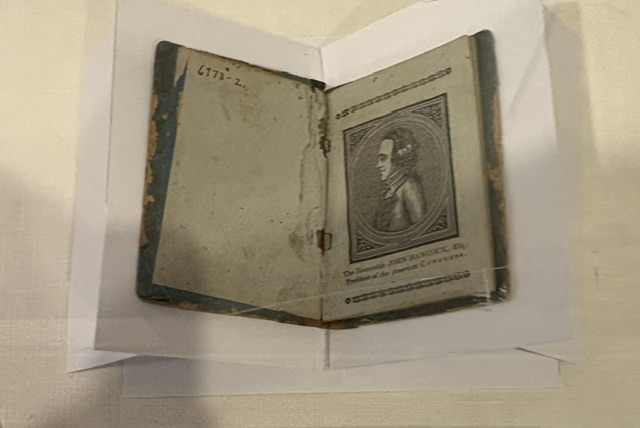
A 1777 Child’s Primer in Revolutionary
Inside Buckman Tavern in Lexington, I came across this remarkably small book. It is a children’s primer dating from 1777, only two years after the fighting at Lexington and Concord and just one year after the Declaration of Independence. On the first page, John Hancock is identified as a leader of the new nation. That […]
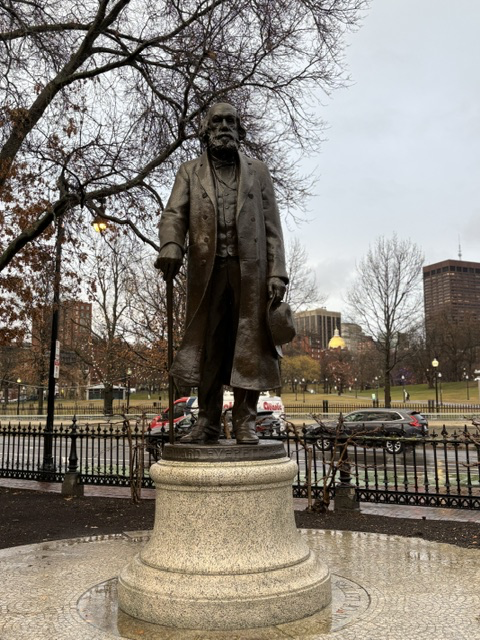
Edward Everett
Standing on Boston Common is a statue of a man whose name is no longer familiar to many Americans, yet during the nineteenth century he was one of the nation’s most admired public figures. This monument honors Edward Everett, a Massachusetts scholar, educator, diplomat, governor, U.S. senator, Secretary of State, and one of the greatest […]
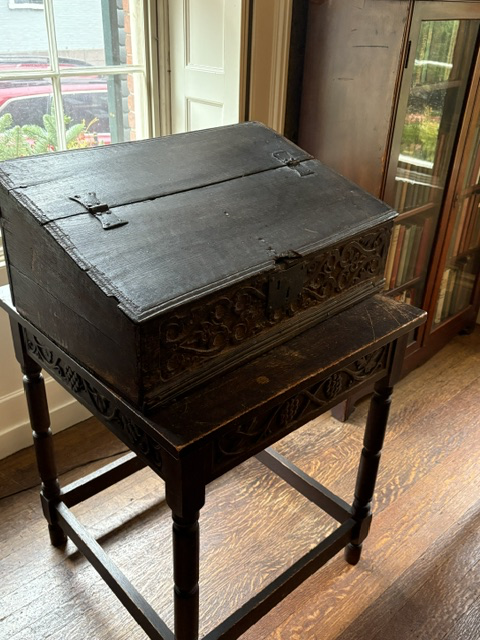
Bible Box
While touring the Nichols House Museum in Boston, one piece in Dr. Arthur Nichols’ office immediately caught my attention. Resting on its stand was a beautifully carved oak Bible box, a reminder that even a physician’s office could contain objects that reflected an appreciation for history and craftsmanship. Although often called a “Bible box,” this […]

