Torrent No. 4
Inside Plymouth’s historic courthouse, we found another remarkable piece of the town’s everyday history: Torrent No. 4, a hand-drawn suction fire engine built in Boston by Stephen Thayer in 1828. Long before motorized fire trucks and modern hydrants, equipment like this represented some of the best technology available to a community trying to protect its homes and businesses from fire.
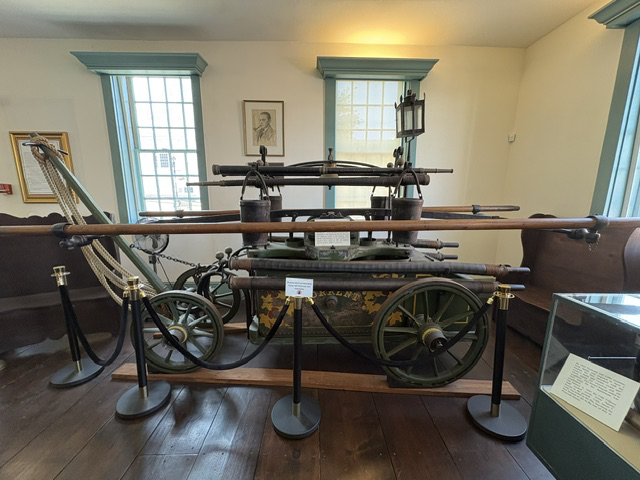
Plymouth purchased the engine by vote of Town Meeting for $400, a substantial investment at the time. The purchase included 700 feet of hose. Torrent No. 4 required between 18 and 20 volunteer firefighters to pull and operate it. Once at a fire, water was drawn into the engine and firefighters worked the long handles of the pump up and down, creating the pressure necessary to send water through the hose. Looking at those long wooden arms today, it is easy to appreciate just how physically demanding firefighting would have been.
I find objects like this particularly valuable when exploring a town such as Plymouth. So much attention naturally goes to 1620, but Plymouth continued to grow and change for centuries afterward. By 1828 this was a well-established town whose citizens were voting at Town Meeting to purchase firefighting equipment and organizing volunteer companies to protect their community.

Read More From Nancy
The Eliot Bible
The 1685 Eliot Bible displayed at Pilgrim Hall Museum brings together the histories of religion, language, and printing in colonial Massachusetts. Printed in Cambridge by Samuel Green, it belongs to the second edition of a translation into the Massachusett language. The Reverend John Eliot undertook the project as part of his missionary work. His effort […]
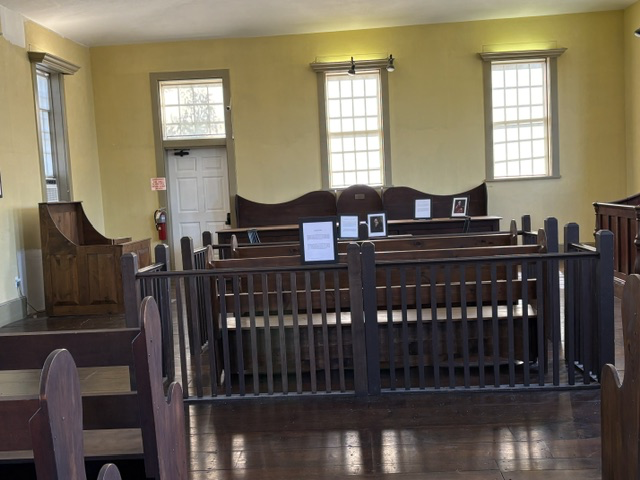
The Jury Box
The jury box in Plymouth’s 1749 Court House gives us another glimpse into how justice was administered in colonial Massachusetts. Enclosed by a wooden railing and positioned directly before the justices, this was where local citizens sat to listen to testimony, consider the evidence, and reach a verdict. Serving on a jury was considered an […]
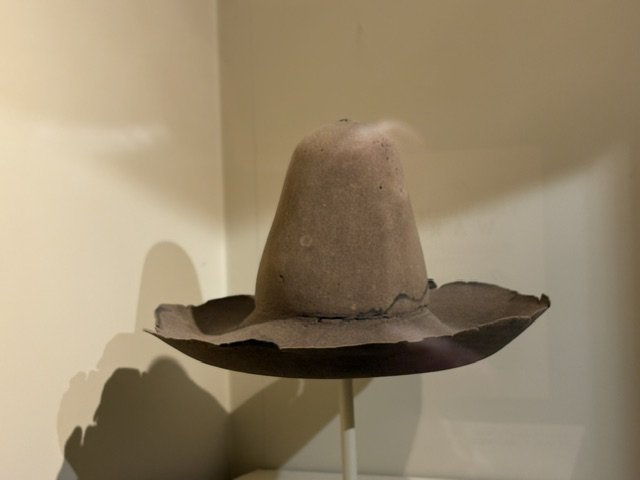
Constance Hopkins’s Beaver Hat
Among the objects we discovered in Plymouth was something remarkably personal: a beaver-felt hat associated with Constance Hopkins, a passenger on the Mayflower. Constance was only about fourteen years old when she crossed the Atlantic in 1620 with her father, Stephen Hopkins, her stepmother Elizabeth, and other members of their family. Unlike many objects displayed […]

