Constance Hopkins’s Beaver Hat
Among the objects we discovered in Plymouth was something remarkably personal: a beaver-felt hat associated with Constance Hopkins, a passenger on the Mayflower.
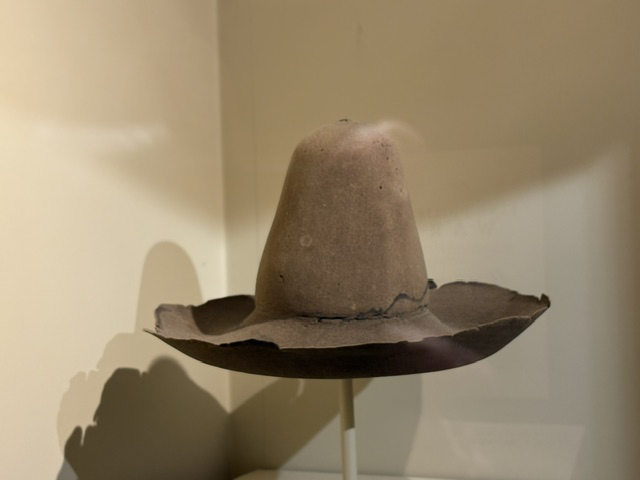
Constance was only about fourteen years old when she crossed the Atlantic in 1620 with her father, Stephen Hopkins, her stepmother Elizabeth, and other members of their family. Unlike many objects displayed from the colonial period, this hat is connected by family tradition directly to someone who experienced that voyage and the beginnings of Plymouth Colony.
The hat also tells a larger story about the economy of the new colony. Between 1615 and 1640, beaver hats were extremely fashionable in England and Europe. Their dense felt was durable, could be shaped into the high-crowned styles of the period, and became desirable enough that beaver pelts were valuable commodities.
For Plymouth, that demand mattered enormously. The colonists arrived deeply in debt to the investors who had financed their voyage and settlement. One of the commodities they could obtain in North America and sell profitably in England was beaver fur. The colonists traded with Native peoples for pelts, particularly through trading networks extending northward into what is now Maine. The furs were shipped across the Atlantic, where hatmakers removed the guard hairs and processed the soft underfur into felt.
So, this simple hat connects several worlds: Native hunting and trade networks, Plymouth’s struggle to establish an economically viable colony, transatlantic commerce, and European fashion.
Read More
Read More From Nancy
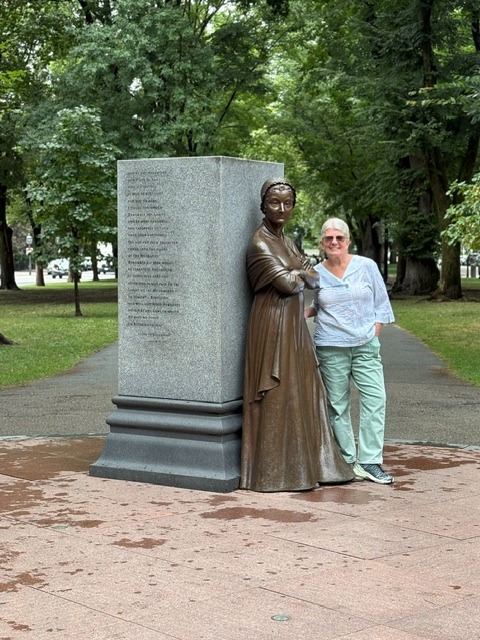
Abigail Adams: Wife of a President, Mother of Another
On Boston’s Commonwealth Avenue Mall, Abigail Adams stands beside a granite pedestal, her arms folded and her expression resolute. Part of the Boston Women’s Memorial, her figure honors a woman whose life connected the American Revolution with two generations of presidential leadership. She was the wife of John Adams, the second president of the United […]

Red Auerbach
This bronze statue honors Arnold “Red” Auerbach, the coach and executive who helped establish the Boston Celtics as one of the most successful franchises in professional sports. Auerbach coached the Celtics from 1950 through 1966, leading the team to nine NBA championships, including an unprecedented eight consecutive titles from 1959 through 1966. Auerbach’s influence extended […]

Glacial Potholes
At the base of Salmon Falls in Shelburne Falls, the Deerfield River flows through a landscape of smooth stone ledges and rounded hollows. Known as the Glacial Potholes, these formations reveal how moving water can gradually reshape even hard bedrock. Shelburne Falls is a village shared by the towns of Shelburne and Buckland. More than […]

