The Eliot Bible
The 1685 Eliot Bible displayed at Pilgrim Hall Museum brings together the histories of religion, language, and printing in colonial Massachusetts. Printed in Cambridge by Samuel Green, it belongs to the second edition of a translation into the Massachusett language.
The Reverend John Eliot undertook the project as part of his missionary work. His effort reflected the Protestant conviction that people should be able to read Scripture for themselves. The first complete edition appeared in 1663, becoming the first complete Bible printed in British North America.
Although the book bears Eliot’s name, its creation depended on Native translators and skilled workers. Job Nesutan helped with translation, while James Printer contributed linguistic knowledge, typesetting, and correction of the printed pages. Their participation was essential to producing a text that English printers could not independently understand.
Many copies of the first edition were lost during King Philip’s War in the 1670s. A revised edition followed in 1685. The volume preserved in Plymouth is identified by the museum as one of approximately two thousand copies produced for that edition.
This particular book also has a personal history. According to its exhibit label, it belonged to Josiah Neet of Duxbury, a Wampanoag man who assisted Eliot. That ownership connects the large undertaking of translation and publication with an individual who possessed and used the resulting work.
The surviving volume preserves evidence of both religious ambition and collaboration across languages. Its pages record the work of translators, printers, and readers whose contributions made it a significant artifact of seventeenth-century New England.
Read More From Nancy
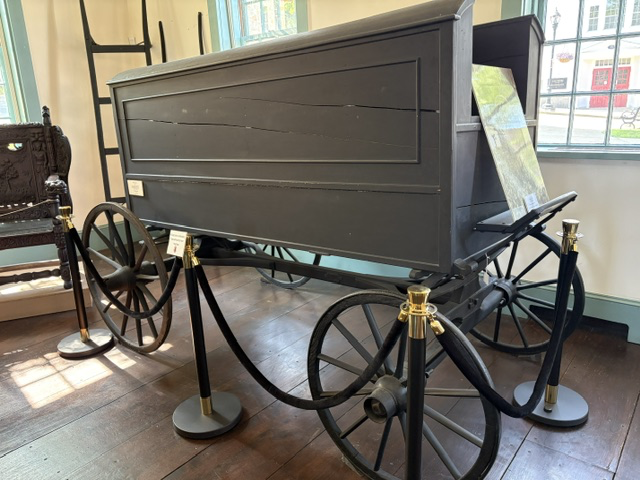
Oldest Hearse
Inside Plymouth’s historic courthouse, we came across an object that tells a very different kind of hometown story. This horse-drawn hearse dates to about 1820 and is believed to be the oldest surviving hearse in Plymouth. According to the exhibit, it was stored for many years in a small stone building behind First Church. The […]
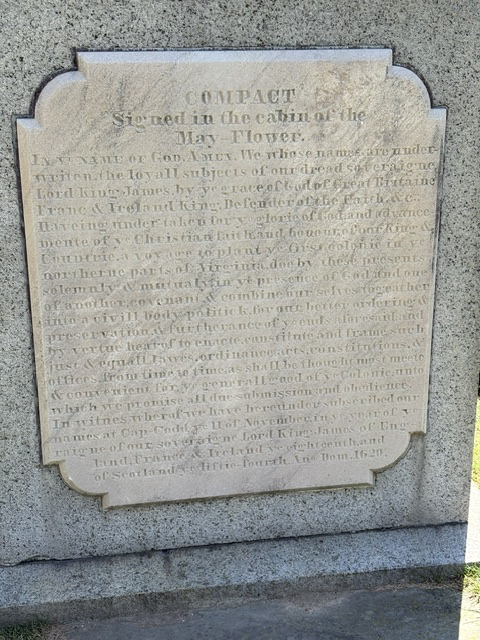
Mayflower Compact
Carved into this stone is the text of the Mayflower Compact, a remarkably short agreement created at an extraordinary moment. Long before there was a permanent settlement at Plymouth, before houses had been built or fields planted, the passengers aboard the Mayflower faced a fundamental question: how would they govern themselves once they went ashore? […]
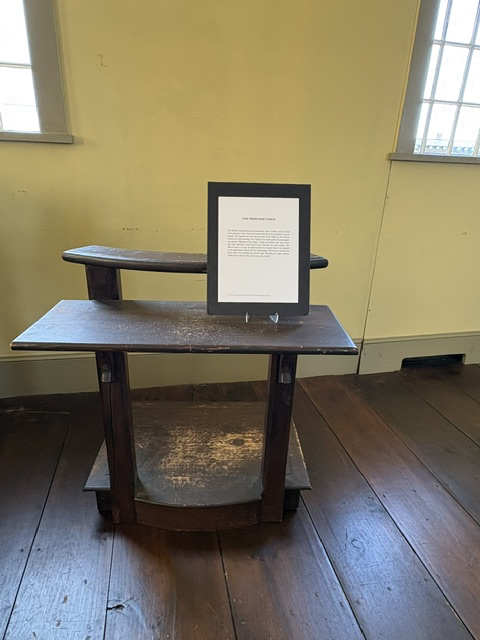
Prisoner Dock
One of the more sobering features inside Plymouth’s 1749 Court House is the prisoner’s dock. This small enclosed platform represents the place where an accused person would stand during court proceedings, physically separated from the judges, attorneys, witnesses, and spectators around them. According to the courthouse exhibit, the sheriff would bring the accused into the […]

