The Grand Union Flag
While exploring Plymouth’s 1749 Courthouse, I came across this flag. At first glance it seems almost contradictory: thirteen red and white stripes like an early American flag, but with the British Union flag occupying the canton. That contradiction is exactly what makes the Grand Union Flag so important.
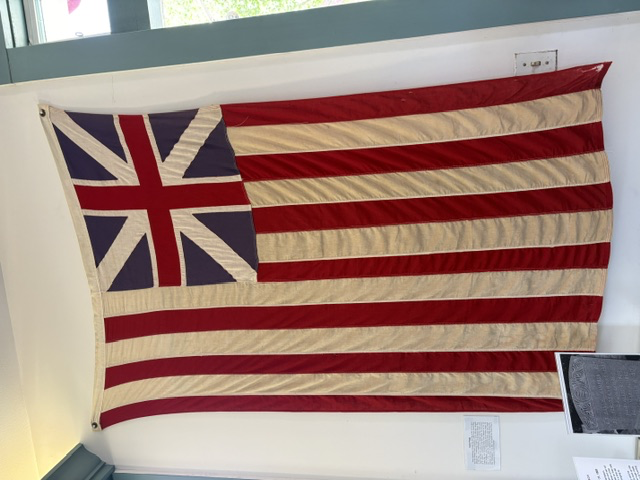
The thirteen stripes represented the thirteen American colonies, while the Union flag acknowledged that those colonies were still part of the British Empire. When this flag came into use in 1775, the Revolution had begun, but independence had not yet been declared. Many colonists were still fighting for their rights as British subjects rather than necessarily demanding the creation of an entirely separate nation.
The flag became associated with the newly organized Continental forces. On January 1, 1776, George Washington’s army raised the Grand Union Flag on Prospect Hill in what is now Somerville, Massachusetts, while the Continental Army was surrounding British-held Boston.
Only six months later, the Declaration of Independence fundamentally changed what an American flag needed to represent. The British Union in the corner no longer made sense for a people declaring themselves independent of Britain. In June 1777, the Continental Congress adopted a new national flag with thirteen stripes and thirteen stars.
That makes the Grand Union Flag a transitional flag. One belonging to a very narrow but enormously important moment in American history. It represents Americans who had already taken up arms against British authority but had not yet taken the final step of declaring themselves a separate nation.
Read More From Nancy

Samuel Lucas – Thomas Howland House
Standing at 36 North Street, the Samuel Lucas–Thomas Howland House does not immediately reveal its extraordinary age. Its white clapboard exterior, regularly spaced windows, and later additions give it the appearance of a traditional New England home. Hidden within that familiar exterior, however, is a structure believed to date from about 1637–1640, placing it among […]
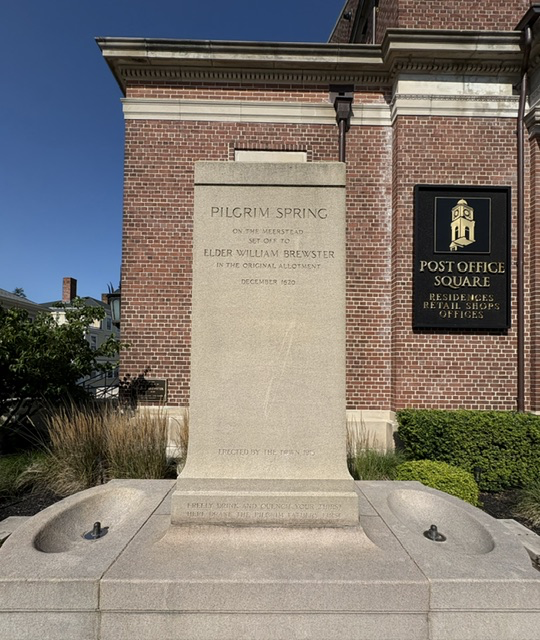
Pilgrim Spring
This monument in Plymouth marks Pilgrim Spring, identified on the stone as being “on the same land set off to Elder William Brewster in the original allotment, December 1620”. For the newly arrived Mayflower passengers, finding a dependable source of fresh water was essential. After weeks aboard ship and their explorations of Cape Cod, the […]
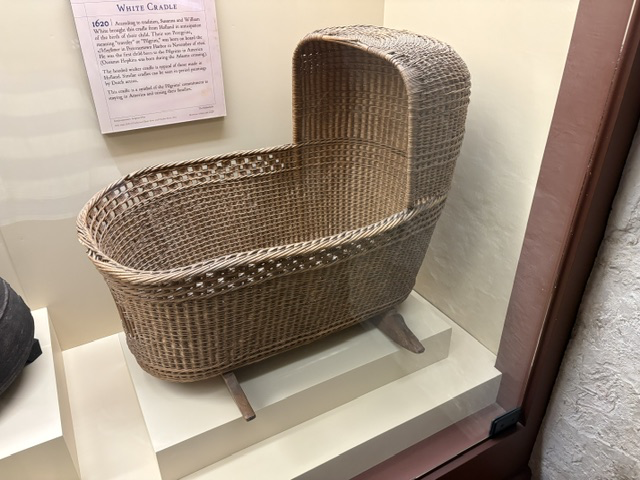
The White Cradle
Among the objects we encountered while exploring Plymouth was this simple wicker cradle. According to tradition, it belonged to Susanna and William White and was brought with them from Holland when they sailed aboard the Mayflower in 1620. Susanna White was pregnant during the Atlantic crossing. The Mayflower left Plymouth, England, in September with more […]

