The Burial Hill Cannons
Near the summit of Burial Hill, a cannon and a series of bronze plaques mark the approximate location of Plymouth’s first fort. The settlers chose the hill because its height provided a broad view of the harbor and the settlement below. Their fort, completed in the early 1620s, had cannon mounted on its roof and also served as the community’s meetinghouse.
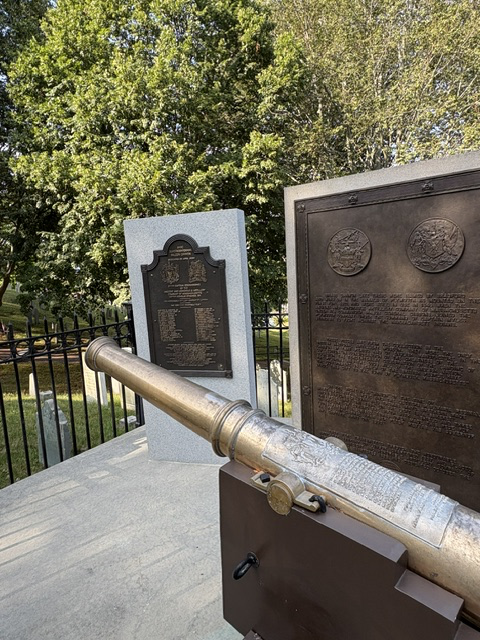
The memorial was created during Plymouth’s tercentenary celebration in 1921. Sponsored by the Ancient and Honorable Artillery Company of Massachusetts, it originally displayed two sixteenth-century English brass cannons presented to Plymouth by the British government. The gift was intended to commemorate the 300th anniversary of the colony and express the goodwill of the British people toward the United States.
The two weapons were considerably older than Plymouth Colony. One was a small cannon known as a minion, made in 1554 during the reign of Queen Mary I. The other, called a sakeret, was made in 1550 during the reign of Edward VI. Although neither cannon had been used at Plymouth, they were authentic English weapons from the period preceding the Mayflower voyage and resembled the type of artillery described in early accounts of the fort.
The plaques preserve the history of the fort, the cannons, and the organizations responsible for the memorial. After remaining outdoors for more than sixty years, the original cannons were removed in 1985 to protect them from further weathering. One was returned to Britain, while the other was placed in the collection of Pilgrim Hall Museum. The cannon now displayed at Burial Hill is a replica, installed in 2025 to restore the memorial’s connection to the fort that once stood on the hill.
The memorial links two very different moments in Plymouth’s history. It recalls the uncertainty faced by the small settlement in the 1620s, while also preserving the story of how that beginning was commemorated three centuries later through a gesture of friendship between Britain and the United States.
Read More From Nancy
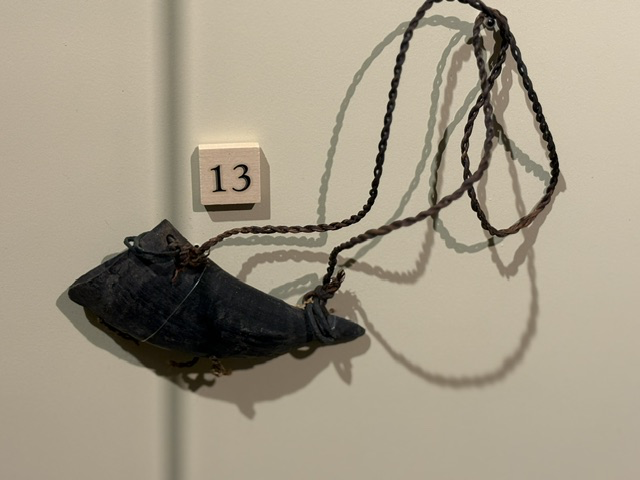
A Grease Horn
Among all the objects that survive from Plymouth’s earliest years, some of the most interesting are not the rare or elaborate possessions, but the simple tools people used in their daily lives. This small grease horn dates from approximately 1635–1665 and is identified as coming from Plymouth. A grease horn was a practical container, usually […]
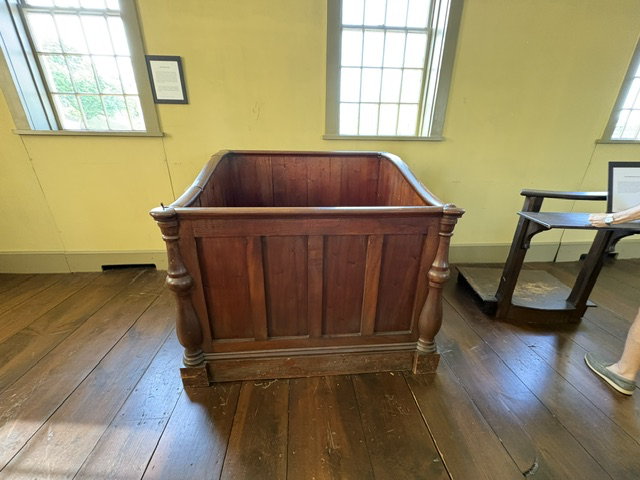
Sheriff Box
Another distinctive feature inside Plymouth’s 1749 Court House is the sheriff’s box. Its position within the courtroom reflected the important role the sheriff played in keeping the court functioning and maintaining order while the justices conducted the business of the day. The sheriff was responsible for much more than simply guarding the courtroom. He brought […]
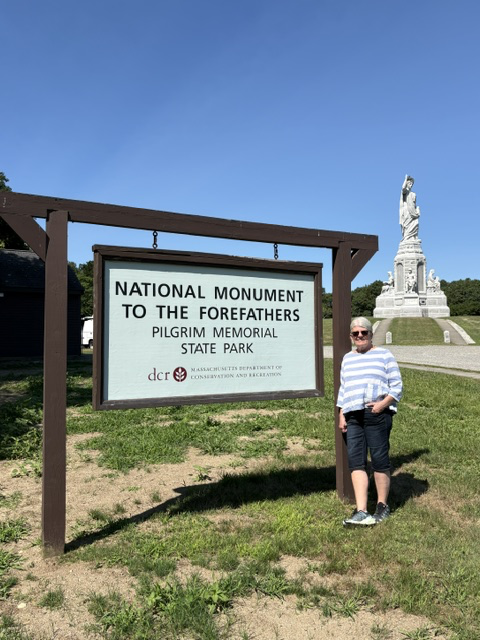
National Monument to the Forefathers
We have visited Plymouth many times over the years, so I am still amazed that it took us this long to discover the National Monument to the Forefathers. When we finally visited this year, I found it almost mind-blowing. Rising more than 80 feet above us, the monument is enormous, intricately sculpted, and filled with […]

