The Bartlett Fireback
Dated 1660, the Bartlett fireback at Pilgrim Hall Museum preserves a substantial piece of an early Plymouth household. Its raised decoration and prominent numerals made it both a useful fireplace fitting and an ornament within the home.
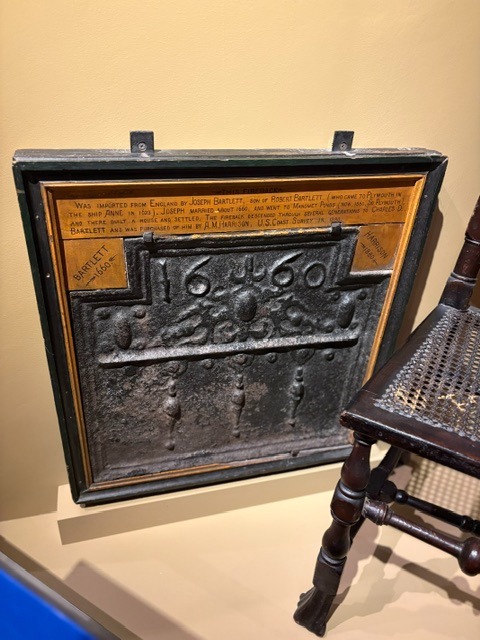
A fireback stood against the rear wall of a fireplace, protecting the masonry from direct heat and reflecting some warmth into the room. In a household dependent on wood fires, this heavy iron plate served a practical purpose through repeated seasons of use.
The museum’s fireback came from the home of Joseph Bartlett in Manomet, now part of Plymouth. Joseph was the son of Robert Bartlett, who arrived aboard the Anne in 1623, and Mary Warren Bartlett, whose father, Richard Warren, had traveled on the Mayflower.
An older inscription mounted around the object describes it as an English import. Later scholarship attributes it to the Saugus Iron Works in Massachusetts. That distinction changes its significance: the fireback offers evidence of skilled iron production within seventeenth-century New England.
Its decoration also connects metalworking with other household crafts. Raised rounded forms and spindle-like ornaments resemble details applied to wooden furniture of the period. Such patterns could be transferred into a sand mold and reproduced in cast iron.
The date places the object within the lives of Plymouth’s second generation, forty years after the Mayflower’s arrival. By then, families were establishing households whose furnishings combined everyday needs with craftsmanship and personal taste.
Preserved beyond the hearth it once served, the Bartlett fireback connects family history with domestic life and early industry. Its survival allows an ordinary household necessity to tell a broader story about the community taking shape around it.
Read More From Nancy
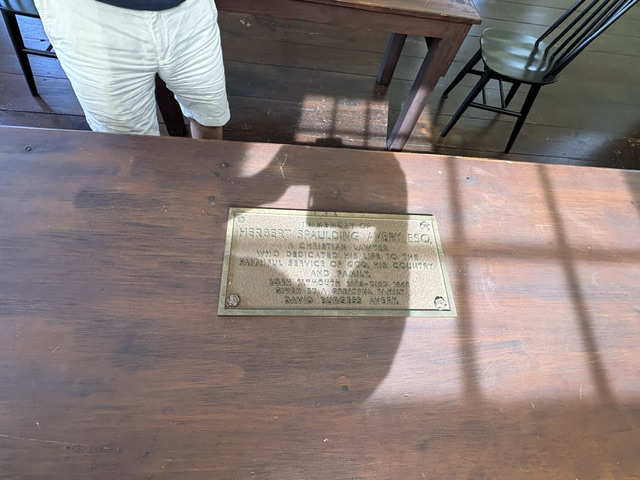
Mercy Otis Warren’s Table
Among the furnishings inside Plymouth’s 1749 Court House is this table associated with Mercy Otis Warren, one of the most remarkable women of Revolutionary-era Massachusetts. At first it appears to be simply another piece of old courtroom furniture, but the small brass plaque reveals its connection to a woman whose writing helped shape the political […]
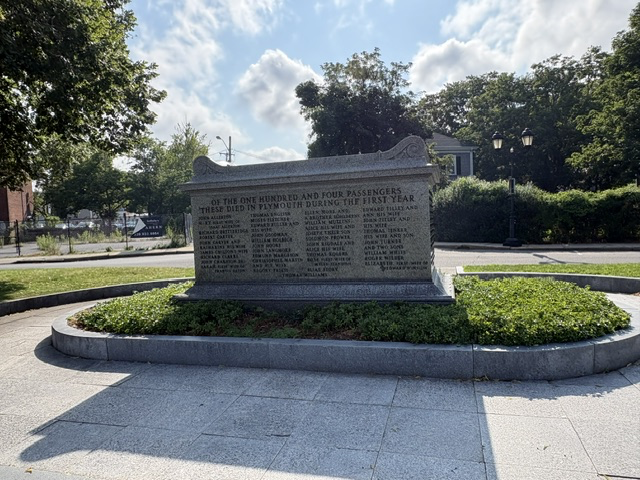
Pilgrim Sarcophagus
On Cole’s Hill, overlooking the harbor, stands this large granite monument containing the remains of some of the Mayflower passengers who died during Plymouth Colony’s devastating first winter. It is known as the Pilgrim Sarcophagus, and it marks the site of the colony’s first burial ground. The winter of 1620–1621 was catastrophic. Of the 102 […]
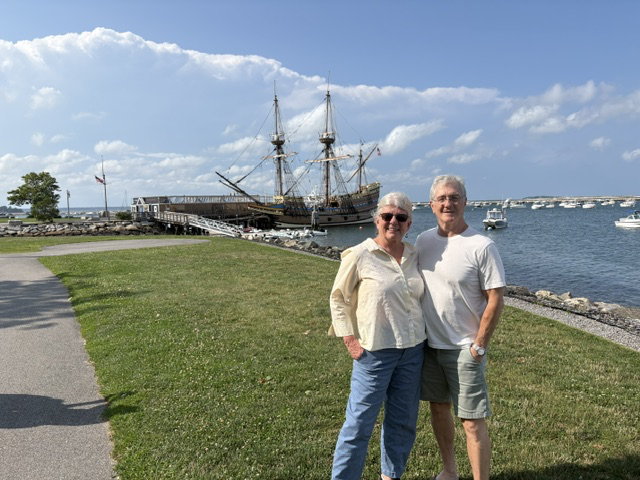
The Mayflower
Standing along the Plymouth waterfront, Mayflower II immediately connects the town to the story that has defined it for more than four centuries. The ship behind us is not the original Mayflower, but a full-scale reproduction built in England and sailed across the Atlantic in 1957 as a symbol of friendship between the United States […]

