Sheriff Box
Another distinctive feature inside Plymouth’s 1749 Court House is the sheriff’s box. Its position within the courtroom reflected the important role the sheriff played in keeping the court functioning and maintaining order while the justices conducted the business of the day.
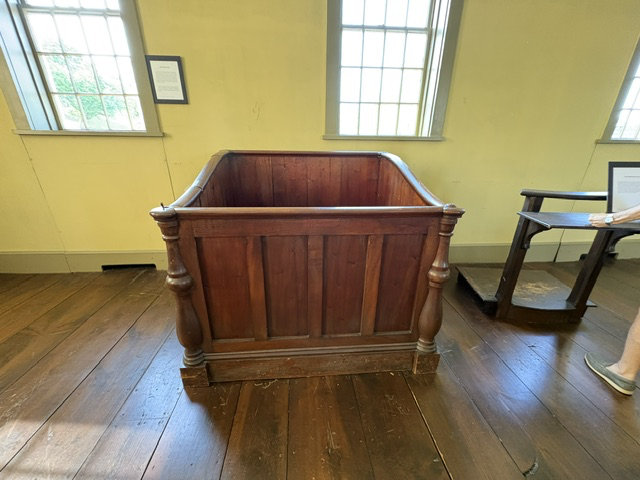
The sheriff was responsible for much more than simply guarding the courtroom. He brought accused prisoners before the court, supervised them during the proceedings, summoned jurors and witnesses, and carried out orders issued by the justices. When someone was sentenced, it was also the sheriff’s responsibility to see that the judgment of the court was enforced.
The sheriff was a particularly important official in colonial Massachusetts. With nothing resembling a modern police department, many responsibilities for maintaining public order fell to sheriffs, constables, and other local officials. The sheriff also served the court by delivering legal documents and assisting with the collection of fines and other judgments.
The placement of this box within the courtroom makes sense when we consider those responsibilities. From here, the sheriff could observe the prisoner’s dock, the justices, and the people gathered in the room. If a prisoner needed to be brought forward, order restored, or one of the court’s instructions carried out, the sheriff was close at hand.
As I looked around this courtroom, I began to appreciate how deliberately every person had been given a place. The justices sat elevated behind their bench, the accused stood confined within the prisoner’s dock, spectators watched the proceedings, the court crier called the room to order, and here sat the sheriff. This simple wooden box helps us picture not just what an 18th-century courtroom looked like, but how it actually worked.
Read More From Nancy
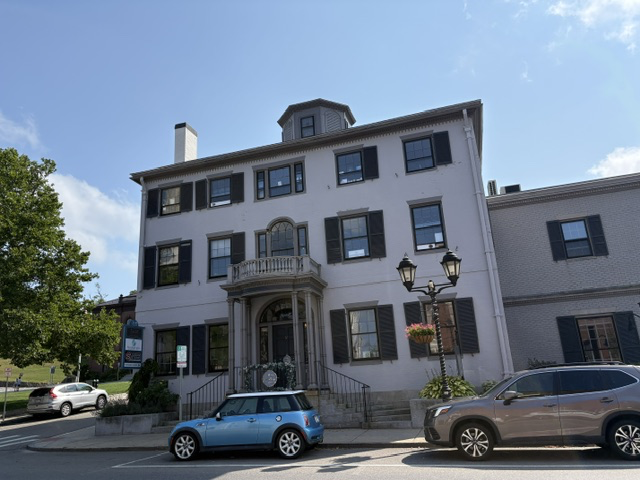
The Bartlett–Russell–Hedge House
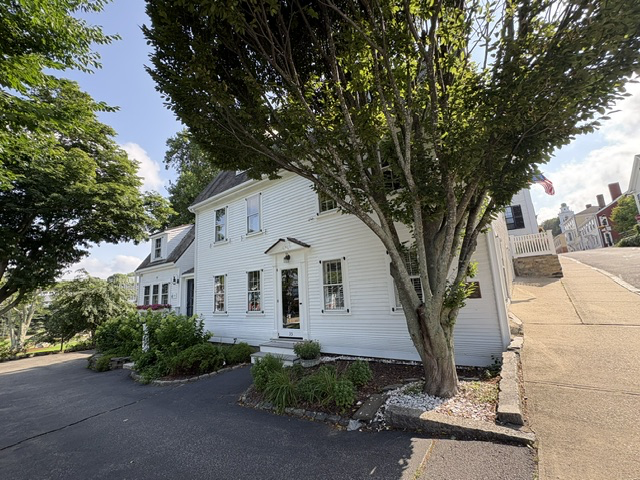
Standing prominently on Court Street, the Bartlett–Russell–Hedge House is one of Plymouth’s finest examples of Federal-style architecture. Its symmetrical façade, Palladian window, entrance balcony, and rooftop cupola distinguish it from the surrounding commercial buildings. The house was constructed in 1803 for Joseph Bartlett, a Plymouth Sea captain. Its design has been attributed to Charles Bulfinch, […]
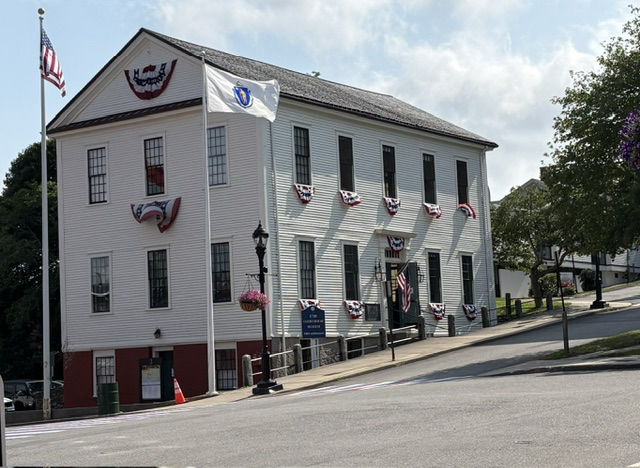
1749 Court House
Standing at the top of Town Square is Plymouth’s historic 1749 Court House, a building that has witnessed nearly three centuries of the town’s civic life. Erected in 1749, when Plymouth was still part of the Province of Massachusetts Bay under British rule, it served as the courthouse for Plymouth County and is believed to […]
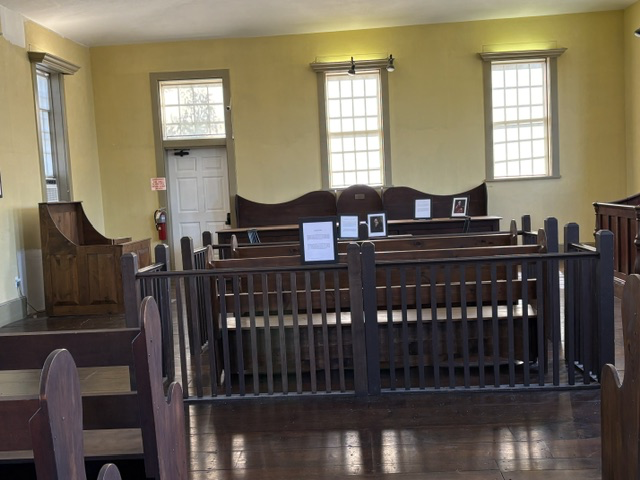
The Jury Box
The jury box in Plymouth’s 1749 Court House gives us another glimpse into how justice was administered in colonial Massachusetts. Enclosed by a wooden railing and positioned directly before the justices, this was where local citizens sat to listen to testimony, consider the evidence, and reach a verdict. Serving on a jury was considered an […]

