Old West Church
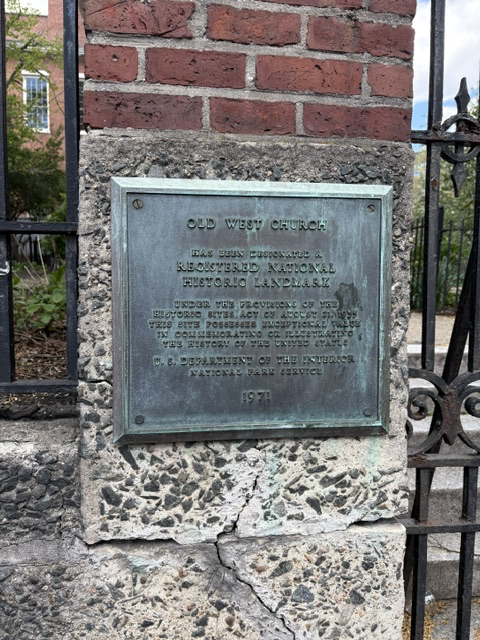
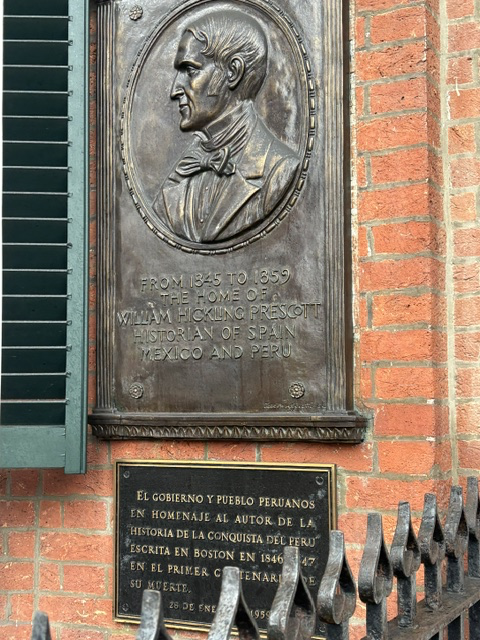
Walking through the streets around Massachusetts General Hospital, Marty and I kept stopping to photograph buildings that caught our attention. Old West Church was one of them. Behind an iron fence on Cambridge Street stands this handsome red-brick church with its tall arched windows, clock tower and white steeple. The plaques along the fence revealed that the history of this site reaches back much farther than the building we were looking at.
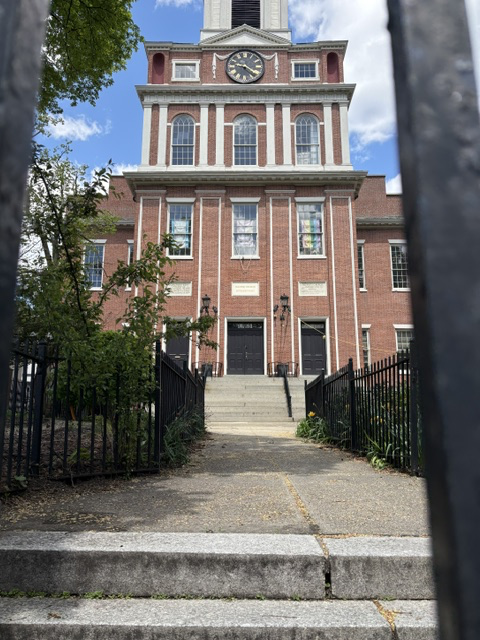
The first West Church meetinghouse was erected here in 1737, when this was near the western edge of colonial Boston. The congregation’s history soon became intertwined with the political tensions that eventually led to the American Revolution. Its most famous early minister was Jonathan Mayhew, who became known for sermons defending civil and religious liberty and challenging the idea that people were obligated to submit unquestioningly to unjust authority.
Mayhew’s words reached well beyond his congregation. His 1750 sermon on resistance to tyranny became particularly influential, and John Adams later remembered Mayhew as one of the important voices that helped prepare New England intellectually for resistance to British rule. Long before fighting began at Lexington and Concord, ideas that would become central to the Revolution were being discussed and preached from this corner of Boston.
The physical location of the church also gave it strategic importance. Its steeple provided a commanding view across the Charles River toward Cambridge and the surrounding countryside. When British forces occupied Boston, they apparently recognized that the steeple could potentially be used for signaling. In 1775, the British tore it down because they feared colonial forces might use it to communicate across the river. The meetinghouse itself was then used as barracks by British troops.
The congregation survived the Revolution, but the original building did not survive indefinitely. The present Old West Church was constructed in 1806–1807 on the same site. Designed by noted architect Asher Benjamin, it is an important example of early nineteenth-century Federal architecture. Its symmetrical brick façade, tall arched windows and classical detailing gave the new church a very different appearance from the colonial meetinghouse it replaced.
The neighborhood around it continued to change. During the nineteenth century, Boston expanded dramatically and the West End became increasingly urban and densely populated. Waves of immigrants settled in the surrounding streets, transforming what had once been the outskirts of colonial Boston into one of the city’s most diverse neighborhoods.
Eventually, the building itself took on an entirely different role. The congregation declined as the neighborhood changed, and in 1894 the City of Boston acquired the church. For decades, the former sanctuary served as a branch of the Boston Public Library. In the twentieth century, the building was returned to religious use, allowing it to continue a tradition on this site that had begun more than two centuries earlier.
This is one of the things I love about Boston. A church that initially catches your attention because of its architecture can turn out to stand on ground connected with the ideas, conflicts and people that helped shape the nation.
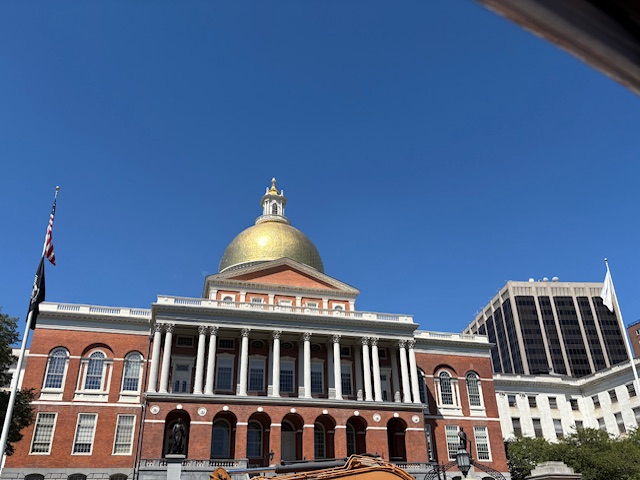
Read More From Nancy
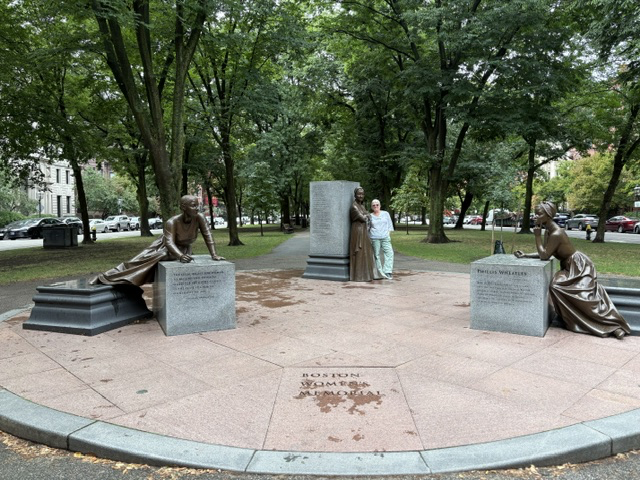
Boston Women’s Memorial
Located on the Commonwealth Avenue Mall, the Boston Women’s Memorial honors Abigail Adams, Lucy Stone and Phillis Wheatley, three women whose words challenged the political, social and intellectual boundaries of their times. Created by sculptor Meredith Bergmann, the bronze-and-granite memorial was dedicated by the City of Boston on October 25, 2003. The idea for the […]
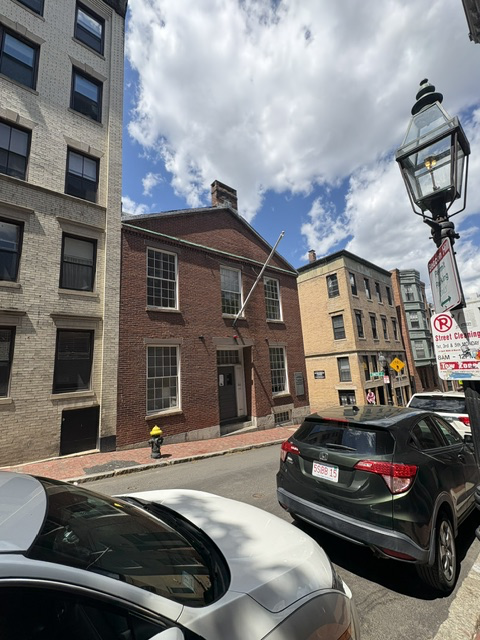
The Abiel Smith School
As Marty and I walked through the streets of Boston with no particular destination, we came across this brick building on the north slope of Beacon Hill. It is the Abiel Smith School, and behind its relatively simple exterior is an important and complicated story about education, segregation, and Boston’s nineteenth-century Black community. The school […]
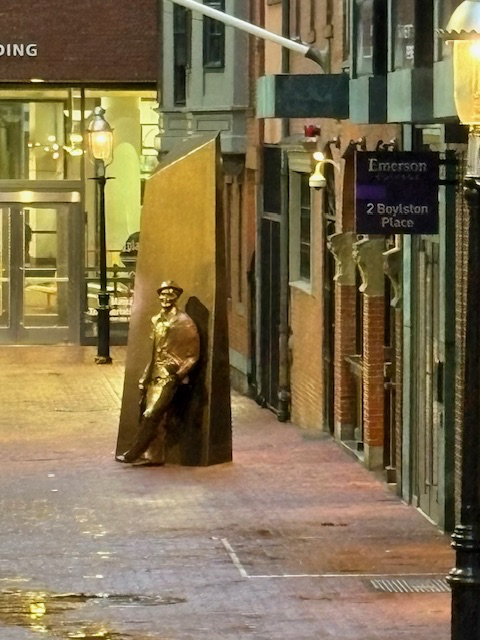
Norman Lear Statue
Heading back to our car, I stopped to grab this photo in the alley near Emerson College. It is one of those narrow Boston passageways that I might have easily walked past without a thought but tucked into this space is something special: a life-size bronze statue of Norman Lear. Lear attended Emerson in the early 1940s, enrolling […]

