Monument to Columbus
On the Common in Waltham, there is a granite stone set quietly among the other memorials that mark the town’s history. It does not rise high but if you stop and read it, the inscription reads:
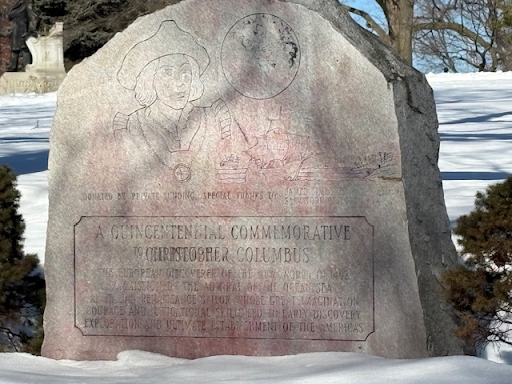
“A Quincentennial Commemorative to Christopher Columbus. The European discoverer of the New World in 1492…….” The wording continues in a traditional historical tone, recognizing Columbus as the “Admiral of the Ocean Sea” and honoring his role in opening the way for exploration of the Americas.
The stone was placed on the Common in 1992, marking the 500th anniversary of the 1492 voyage. It was commissioned by members of Walthams’ Italian-American community, a group that has long held Christopher Columbus as an important historical and cultural figure. For them this memorial was a way to recognize both a milestone in history and their own heritage within the town.
For many of these families, whose roots in Waltham go back generations to the early immigrant years, this monument represents more than a historical reference. It reflects a sense of pride in where they came from and the lives they built here. Placing this stone on the Common was a way of ensuring that their history, and the figure they associated with it, would be recognized alongside the broader story of Waltham,
Unlike many of the older monuments on the Common, which date back to the 19th and early 29th centuries, this is a more recent addition. Its design is simple, a solid granite maker with a carved inscription. It is meant to mark a specific anniversary and to take its place among the other historical markers that define the Common.
This stone was placed to remember a well-known moment in history and to acknowledge the people who chose to honor it here in Waltham.
Read More From Nancy
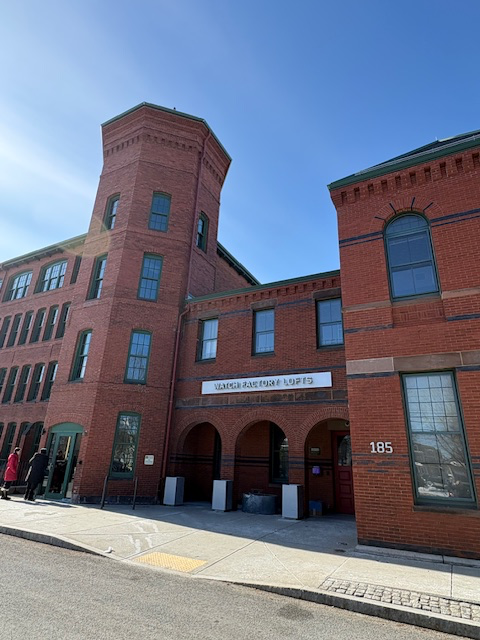
Waltham Watch Company
The great brick factory along the Charles River was once the heart of the Waltham Watch Company, founded in 1850 as the American Horologe Company. It became the first company in the United States to successfully manufacture watches using interchangeable parts, pioneering precision mass production and helping launch the American Industrial Revolution. At its height in […]
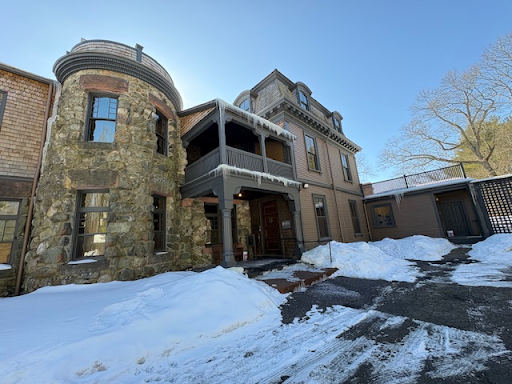
Stonehurst: The Robert Treat Paine Estate
Tucked away in Waltham, Massachusetts, Stonehurst is one of the region’s architectural treasures. The estate was created between 1883 and 1888 for Robert Treat Paine Jr., a prominent Boston lawyer and philanthropist whose father had helped found the Museum of Fine Arts, Boston. Paine envisioned the property not simply as a house, but as a […]
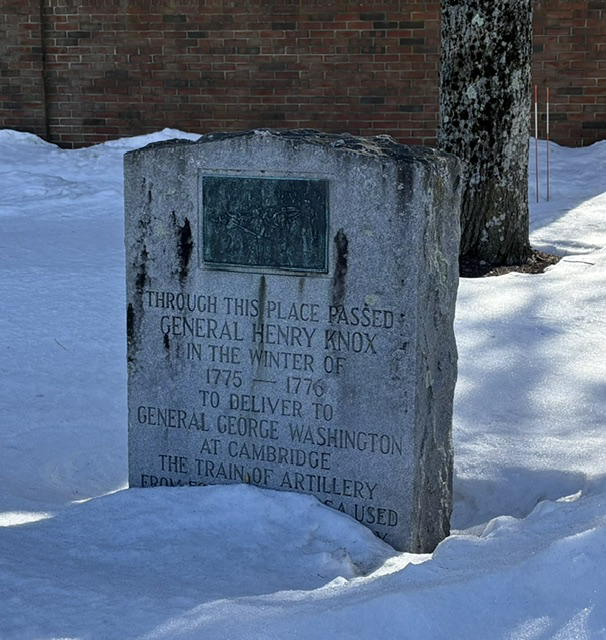
Henry Knox Marker
I have written about General Henry Knox and his remarkable journey across Massachusetts with the “Noble Train of Artillery.” Whenever I come across one of the historical markers commemorating this expedition, I make it a point to stop and photograph it. Although each marker tells the same story, each represents another community that played a […]

