The 1917 Allies Flag
This unusual silk flag, preserved by the Needham History Center & Museum, tells a story not only about World War I, but about how Americans were encouraged to understand the nation’s entry into the conflict.
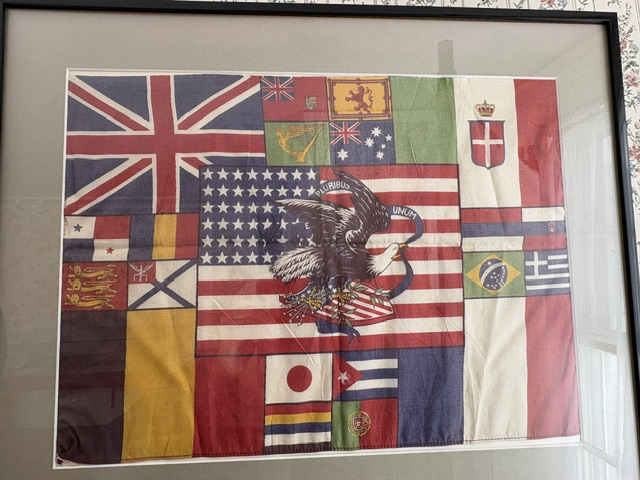
By 1917, Europe had already been at war for nearly three years. The United States had remained officially neutral, but Germany’s return to unrestricted submarine warfare, along with other events including the Zimmermann Telegram, helped push the country toward intervention. The United States declared war on Germany on April 6, 1917.
Flags like this one began appearing as Americans were asked to see themselves as part of a much larger Allied cause. At the center is the American flag, surrounded by the flags of nations fighting against the Central Powers. Great Britain, France, Belgium, Italy, Russia, Japan, Brazil, Greece and several other Allied nations are represented. The arrangement turned a collection of national flags into a single patriotic image: the United States had joined an international struggle.
Across the American flag is an eagle clutching arrows and a shield, with the familiar motto “E Pluribus Unum”. The symbolism was unmistakable. America was now at war. The eagle printed over the American flag apparently created a legal problem. At the time, altering or placing another design over the United States flag was prohibited. According to the museum, the banners were recalled and reprinted without the eagle. Surviving examples with the eagle are consequently considered quite rare.
That makes this small piece of silk more than a collection of old flags. It captures a very specific moment in 1917, when the United States was making the enormous transition from neutrality to participation in a world war. More than a century later, this little flag remains in Needham, preserving the imagery used to tell Americans in 1917 that their country was no longer standing apart from the war.

Read More From Nancy
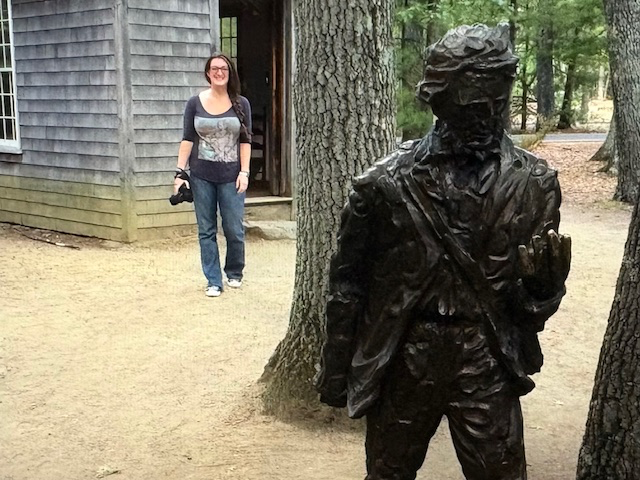
Replica of David Thoreau’s Cabin
Just outside the replica of Henry David Thoreau’s cabin at Walden Pond stands this bronze statue of Thoreau, depicting him much as we might imagine him during his years here. He is simply dressed and seemingly caught in the act of walking through the landscape he observed so carefully. Thoreau came to Walden Pond in […]
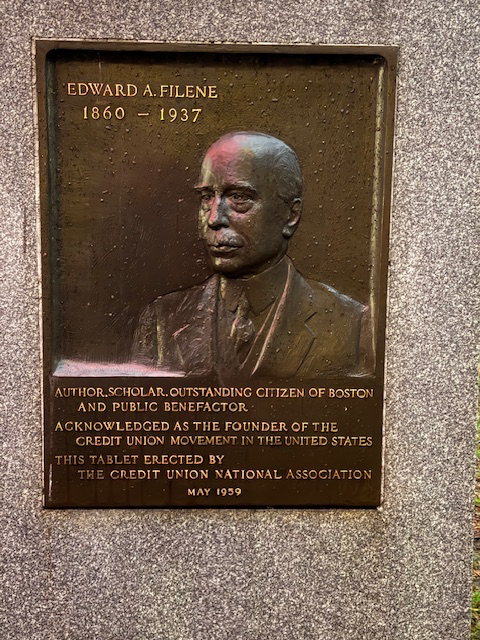
Edward A. Filene Plague
Walking along the fence surrounding the Boston Common, I came across this bronze plaque honoring Edward A. Filene. While many people recognize the Filene name from the famous Boston department store, few realize the tremendous influence he had beyond retail. Filene believed that ordinary working families deserved access to affordable credit and financial opportunity. His […]
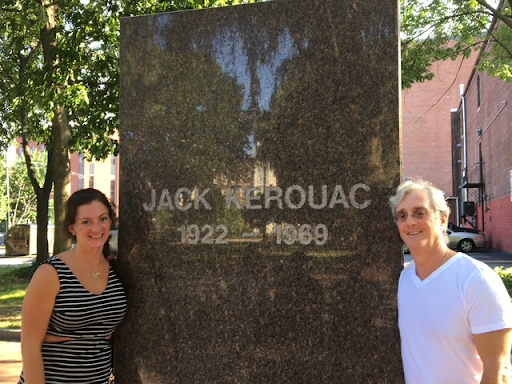
Jack Kerouac Memorial
Born in Lowell in 1922, Jean-Louis Lebris de Kérouac was the son of French-Canadian immigrants and grew up speaking French before learning English. His working-class upbringing and the close-knit ethnic neighborhoods of Lowell would later appear throughout his writings. Although he became famous for his travels across America, he never lost his During a visit to […]

