John Brown’s Family Bible
Among the objects preserved at Harpers Ferry, John Brown’s family Bible provides a particularly personal connection to the man whose actions here became part of the national struggle over slavery. Unlike a weapon, military artifact or political document, this was an object connected to Brown’s family life and to the religious beliefs that profoundly influenced him.
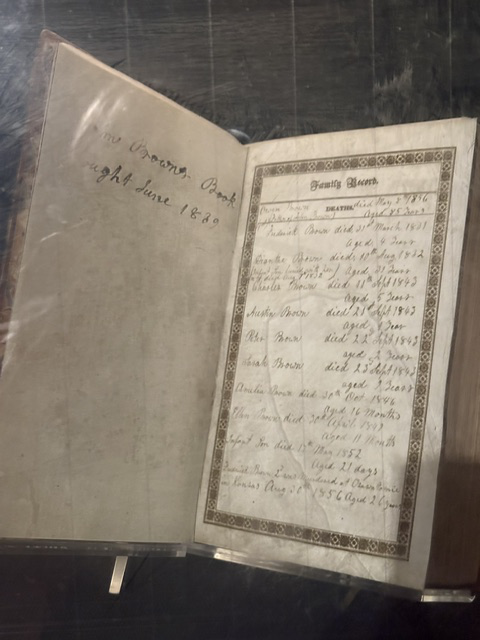
Brown was a deeply religious man whose Calvinist faith shaped much of his adult life. Although he was not formally affiliated with a particular church, he read the Bible daily and marked passages in both the Old and New Testaments that held special meaning for him. He came to believe that slavery was fundamentally incompatible with Christian teaching, particularly the Golden Rule: treating others as one would wish to be treated.
His interpretation of those beliefs went much further. Brown became convinced that opposing slavery was a religious obligation and that violence could be justified in confronting what he considered a profound moral evil. Understanding this does not require us to agree with his methods, but it helps explain how Brown himself understood the course his life eventually took.
The Bible is also a family record. The handwritten pages contain the names and dates of members of the Brown family, transforming it from simply a religious text into a record of births, deaths and relationships. The inscription identifies it with John Brown and includes the date June 1820.
That personal dimension is especially significant. We often encounter John Brown as a historical figure defined by the dramatic events at Harpers Ferry. Here, we encounter something different: a Bible held and read within a family, its pages marked and its family records written by hand.
For Brown, however, the personal and the historical were ultimately inseparable. His religious beliefs shaped his understanding of slavery, and that understanding helped determine the choices that eventually brought him and his followers to Harpers Ferry in October 1859.
Seeing his family Bible makes that story more tangible. It is a remarkably intimate artifact and one that connects John Brown the controversial abolitionist with John Brown the husband, father and deeply religious man whose interpretation of faith became one of the driving forces of his life.

Read More From Nancy
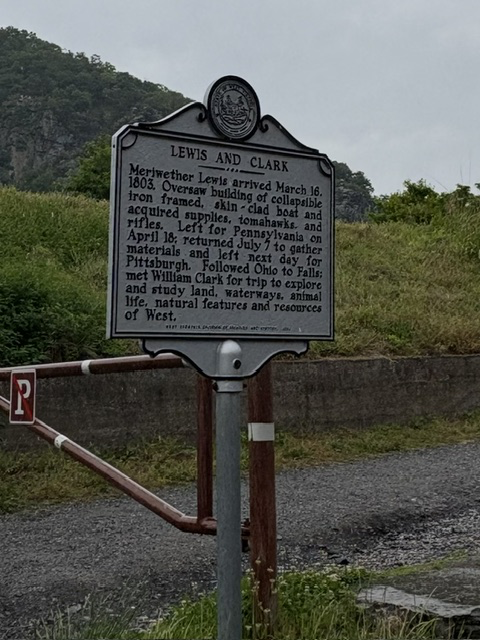
Harpers Ferry and the Lewis and Clark Expedition
This historical marker adds another piece to the Meriwether Lewis story in Harpers Ferry. Before the famous Lewis and Clark Expedition began its journey across the continent, Lewis spent several weeks here gathering equipment and working with the skilled craftsmen of the United States Armory. Meriwether Lewis arrived in Harpers Ferry on March 16, 1803. […]

The Remains of the Railroad Bridge
These stone piers standing in the Potomac are remnants of the long transportation history that made Harpers Ferry such an important crossroads. The narrow opening through the Blue Ridge created by the Potomac provided a natural route through the mountains, and in the nineteenth century the Baltimore & Ohio Railroad used that route as it […]
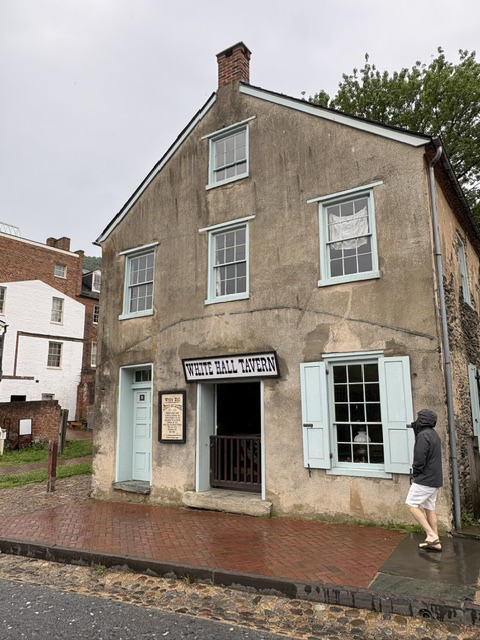
White Hall Tavern
Walking through the historic streets of Harpers Ferry, buildings like White Hall Tavern help tell another side of the town’s story. John Brown’s raid and the Civil War dominate the history here, but Harpers Ferry was also a working industrial community filled with ordinary people who needed places to eat, drink, gather and exchange news. […]

