The Harpers Ferry Armory in the Civil War
This sign stands near the remains of the United States Armory at Harpers Ferry and tells the story of what happened here when the Civil War began. The location of the armory had helped make Harpers Ferry an important industrial town, but the thousands of weapons stored here also made it a valuable military target.
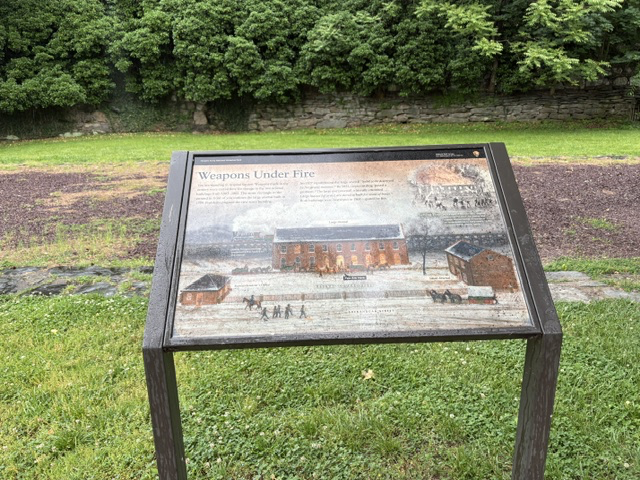
The federal armory had been established at Harpers Ferry in 1799, after President George Washington selected the area as one of two sites for national armories. Powered by the waters of the Potomac and Shenandoah and supported by skilled craftsmen, the complex grew into an important center for manufacturing and storing firearms for the United States government.
Everything changed in April 1861. Virginia voted to secede from the Union, and Virginia militia began moving toward Harpers Ferry to capture the federal arsenal and its weapons. The small group of U.S. soldiers stationed here knew they could not defend the complex.
Rather than allow the weapons and equipment to fall intact into Confederate hands, the federal troops set fire to the armory and arsenal buildings on the night of April 18, 1861. Much was destroyed, but residents and arriving Virginia forces managed to save thousands of firearms and valuable machinery.
The machinery proved particularly important. Confederate authorities removed much of the surviving gun-making equipment and transported it south, primarily to Richmond and Fayetteville, North Carolina, where it could be used to manufacture weapons for the Confederacy.
The armory never returned to its former role. Harpers Ferry’s position at the meeting of two rivers and along important railroad and transportation routes made the town strategically valuable throughout the Civil War, and Union and Confederate forces repeatedly occupied it.
Standing here today, there is remarkably little left of what was once a sprawling federal industrial complex. The foundations in the landscape and signs such as this one require us to imagine the workshops, machinery, workers and thousands of firearms that once occupied this ground.
This is one of those places where knowing what is no longer here is as important as seeing what remains. For more than sixty years, the Harpers Ferry Armory helped equip the United States military. Then, during a single night in April 1861, the country’s division reached Harpers Ferry, and the armory that had helped build the town was set on fire by the very government that had created it.
Read More From Nancy
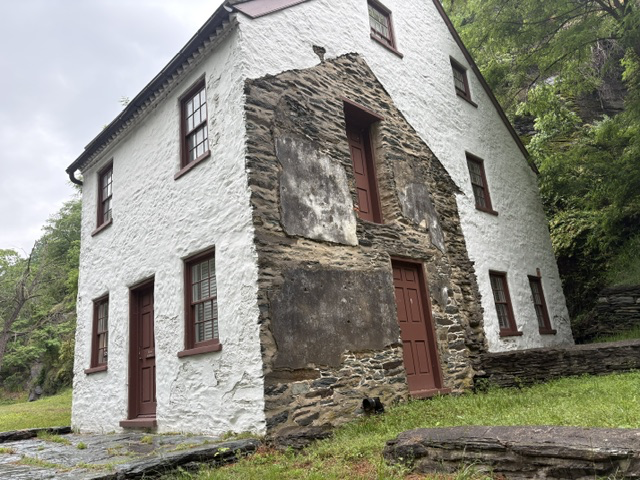
The Harper House
High above Lower Town stands the Harper House, the oldest surviving building in Harpers Ferry. Its story takes us back before the federal armory, the railroads and most of the historic events that would eventually make this little town nationally significant. Robert Harper began constructing this stone house in 1775. Harper had arrived in this […]
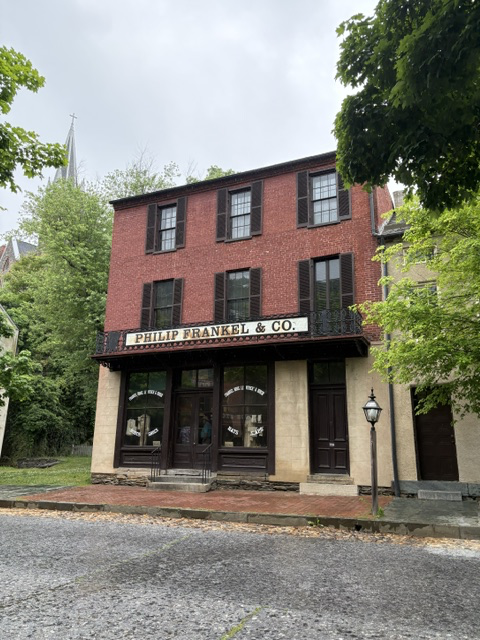
Philip Frankel & Co.
Among the restored buildings of Lower Town Harpers Ferry is Philip Frankel & Co. Philip Frankel was a German-born Jewish immigrant who came to the United States during the nineteenth century and eventually established himself as a merchant in Harpers Ferry. His story places him within the larger migration of German-speaking Jews who came to America […]
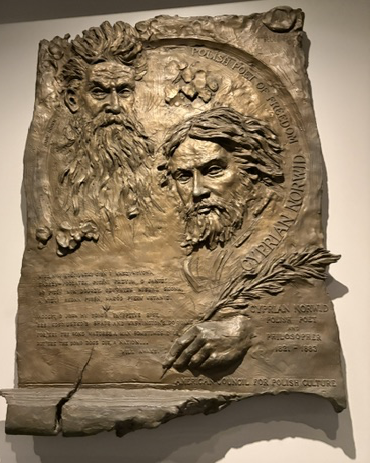
John Brown and Gerrit Smith Relief
This bronze relief brings together two men connected by the abolitionist movement but remembered for very different roles in the struggle against slavery: John Brown and Gerrit Smith. John Brown, shown at the upper left, became the militant abolitionist whose 1859 raid on Harpers Ferry was intended to seize federal weapons and help ignite a […]

