Mary Cooke Thompson Gravestone
Among the artifacts at Pilgrim Hall Museum is this early New England gravestone for Mary Cooke Thompson, a woman with a direct connection to one of the Mayflower families. Mary was the daughter of Mayflower passenger Francis Cooke and his wife, Hester Mahieu.
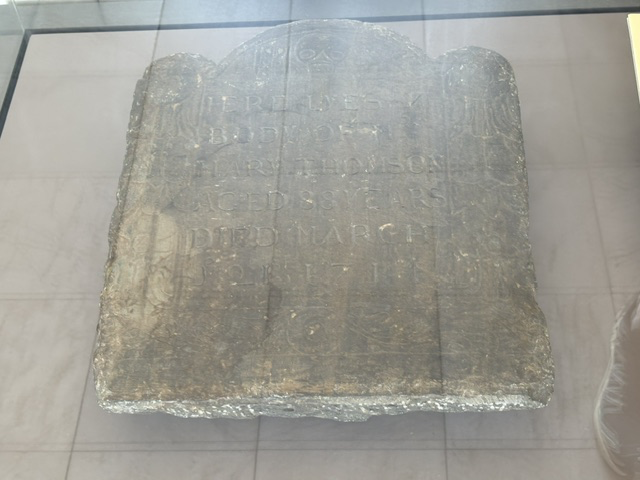
Mary was born in Leiden in the Netherlands, where the English Separatist community lived before the Mayflower voyage. Her father and brother John sailed for America aboard the Mayflower in 1620, while Mary remained behind with her mother and siblings. About three years later, the rest of the Cooke family crossed the Atlantic to join them in Plymouth.
The museum notes that Mary Cooke was among the first generation born into the Plymouth Colony families and that the first record of her appears in the 1627 division of land. On December 26, 1645, she married John Thompson in Plymouth. The couple eventually settled in Middleborough, where Mary lived into her late eighties. She died in 1714 at approximately 88 years old, having lived from the earliest years of Plymouth Colony into the 18th century.
But the story of her gravestone is almost as interesting as the woman it commemorates. The stone was not discovered standing over Mary’s grave. It was found beneath the timber-frame portion of an old house. At some point after the burial ground was no longer being maintained, her headstone had been removed and reused as building material.
That practice was apparently not unique. As the museum explains, old gravestones were sometimes repurposed by later generations for surprisingly practical uses including paving stones and even sewer covers. What had once marked an individual’s burial place could simply become a useful piece of stone.
Fortunately, Mary Cooke Thompson’s stone survived. Its inscription still gives us her name, her age, and the date of her death: March 21, 1714. More than three centuries later, this weathered piece of slate has become something its makers could never have anticipated, not simply a grave marker, but a surviving link to a woman whose family story stretched from Leiden to the Mayflower and then through nearly a century of life in colonial New England.
Read More From Nancy
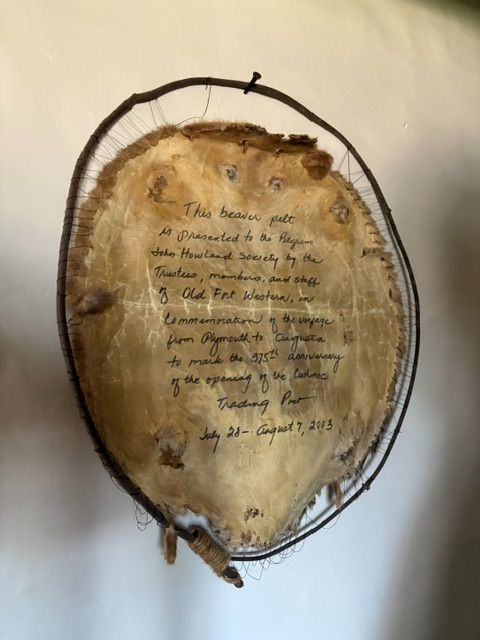
A Beaver Pelt
A beaver pelt stretched within a wooden frame commemorates a connection between Plymouth, Massachusetts, and Augusta, Maine. Its handwritten inscription records a voyage from Plymouth to Augusta in 2003, marking the 375th anniversary of the opening of the Cushnoc trading post. Presented to the Pilgrim John Howland Society by the trustees, members, and staff of […]
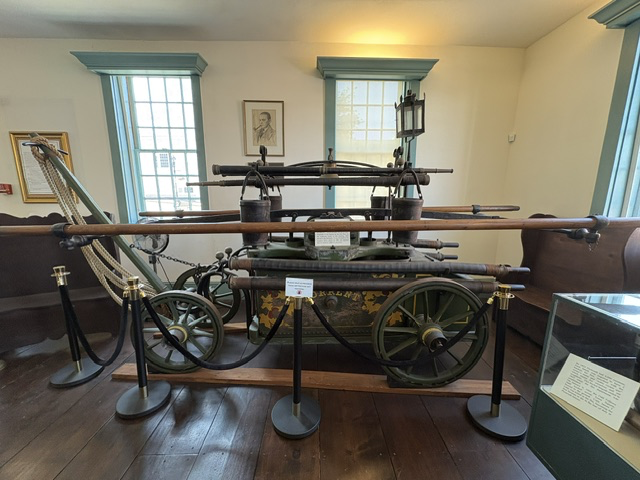
Torrent No. 4
Inside Plymouth’s historic courthouse, we found another remarkable piece of the town’s everyday history: Torrent No. 4, a hand-drawn suction fire engine built in Boston by Stephen Thayer in 1828. Long before motorized fire trucks and modern hydrants, equipment like this represented some of the best technology available to a community trying to protect its […]
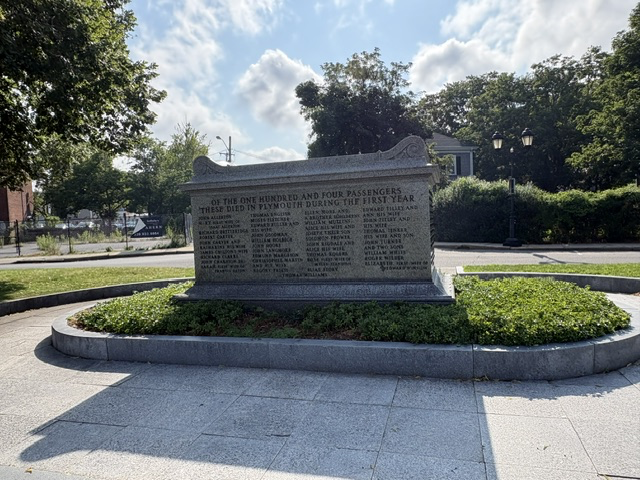
Pilgrim Sarcophagus
On Cole’s Hill, overlooking the harbor, stands this large granite monument containing the remains of some of the Mayflower passengers who died during Plymouth Colony’s devastating first winter. It is known as the Pilgrim Sarcophagus, and it marks the site of the colony’s first burial ground. The winter of 1620–1621 was catastrophic. Of the 102 […]

