Boston Women’s Memorial
Located on the Commonwealth Avenue Mall, the Boston Women’s Memorial honors Abigail Adams, Lucy Stone and Phillis Wheatley, three women whose words challenged the political, social and intellectual boundaries of their times. Created by sculptor Meredith Bergmann, the bronze-and-granite memorial was dedicated by the City of Boston on October 25, 2003.
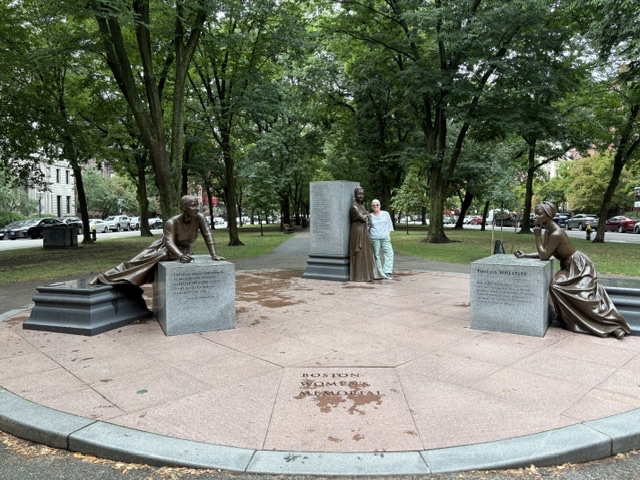
The idea for the memorial began in 1992 amid growing recognition that women were significantly underrepresented among Boston’s public monuments. The Boston Women’s Commission led a twelve-year public process that brought together civic organizations, historians and community members. Adams, Stone and Wheatley were selected not only for their importance to Massachusetts history but also for the lasting influence of their writing.
Bergmann departed from the traditional practice of placing historical figures high above the public. Each woman appears at ground level, while the pedestal becomes part of her activity. Their positions allow visitors to move among them and encounter them as individuals engaged in thought, writing and public work. Passages from their own writings are inscribed throughout the memorial, allowing their ideas to accompany their likenesses.
Abigail Adams was born in Weymouth, Massachusetts, in 1744. Although she received no formal schooling, she became a widely read and perceptive political thinker. During the Revolutionary period, she maintained an extensive correspondence with her husband, John Adams, offering observations on government, independence and the direction of the emerging nation.
Her best-known statement appeared in a letter written to John Adams on March 31, 1776, while he was serving in the Continental Congress. She urged him to “remember the ladies” as new laws were being created and warned against allowing husbands unlimited authority over their wives. Her words did not produce immediate legal reforms, but they became an enduring statement about the exclusion of women from the rights being debated during the American Revolution.
Lucy Stone, born in West Brookfield, Massachusetts, in 1818, devoted her life to the abolition of slavery and the advancement of women’s rights. After graduating from Oberlin College in 1847, she became a prominent lecturer at a time when women speaking before public audiences were often met with hostility. Her ability as an orator helped connect the antislavery movement with the growing campaign for women’s equality.
Stone challenged convention in both her public and private life. When she married Henry Browne Blackwell, she retained her own surname as an expression of personal and legal independence. In 1870, she helped establish the Woman’s Journal in Boston, which became one of the nation’s most influential publications advocating women’s suffrage. The memorial presents her using her pedestal as a working surface, emphasizing her role as an activist, editor and organizer.
Phillis Wheatley was born in West Africa around 1753 and was kidnapped and transported across the Atlantic as a child. She arrived in Boston in 1761 aboard the slave ship Phillis and was purchased by John and Susanna Wheatley. Recognizing her intellectual abilities, members of the household taught her to read and write. She soon began studying the Bible, classical literature, history and poetry.
In 1773, Wheatley published Poems on Various Subjects, Religious and Moral in London. The volume made her the first African American woman and one of the earliest American women to publish a book. Her achievements confronted assumptions about race, slavery, intellect and literary ability in colonial America. She was later emancipated, but freedom did not provide financial security, and she died in Boston in 1784 at approximately thirty-one years of age.
The Boston Women’s Memorial does more than place three women within the city’s commemorative landscape. By bringing them down from their pedestals and surrounding them with their own words, the memorial presents history as something that can be approached, questioned and continued. It recognizes three distinct lives while demonstrating how education, writing and determined public engagement can influence generations far beyond one’s own.

Read More From Nancy
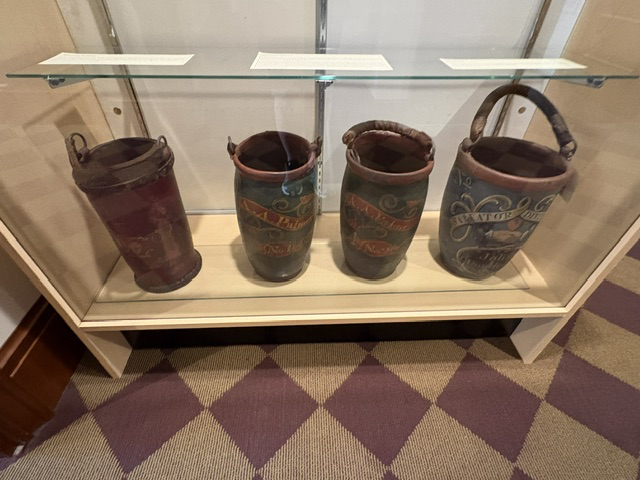
Fire Buckets
Among the interesting artifacts preserved in the Lancaster Library is a collection of leather fire buckets, reminders of a time when communities relied on cooperation rather than machinery to combat one of their greatest threats. Before organized fire departments and modern fire engines towns maintained leather buckets that were kept in homes, businesses, churches, and […]
The Canals of Lowell
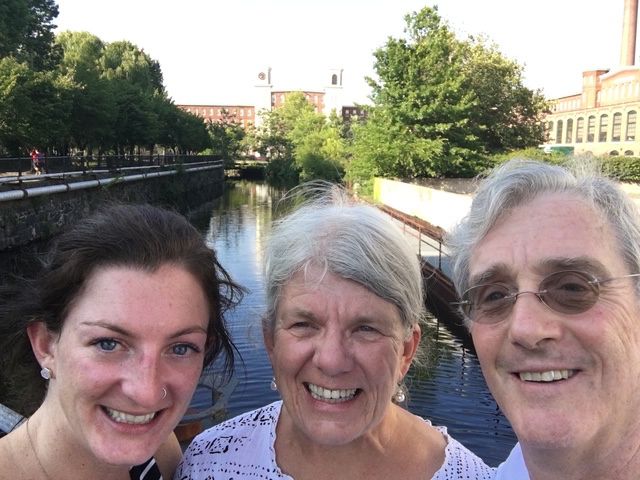
Walking through downtown Lowell, it is almost impossible not to encounter the canals. They pass beneath streets, alongside sidewalks and between the enormous brick mill buildings that still dominate parts of the city. On this day, we were simply walking through Lowell when we stopped along one of them for this photograph. The canals are […]
Life Savers and the Rise of American Board Games
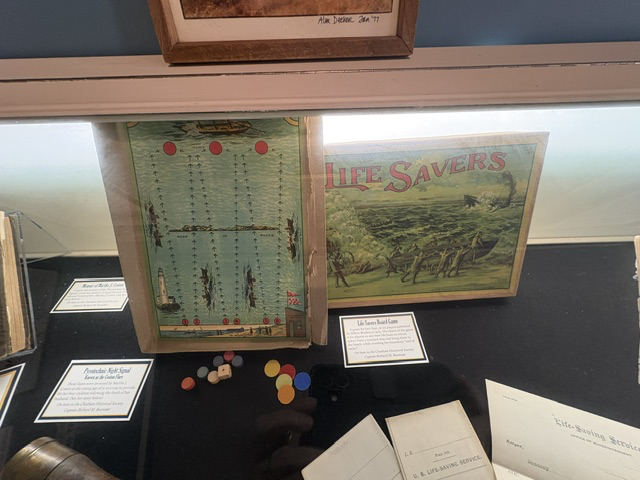
The game Life Savers transformed the dangers of a shipwreck into a contest of rescue. Produced by the Milton Bradley Company near the turn of the twentieth century, the game challenged players to send lifeboats to a wrecked vessel, rescue its sailors, and return them safely to shore. Its illustrated cover, playing board, spinner, and colored pieces […]

