Thomas Eames Sign
Driving along a road in Framingham is this roadside sign that marks the location where the home of Thomas Eames once stood.
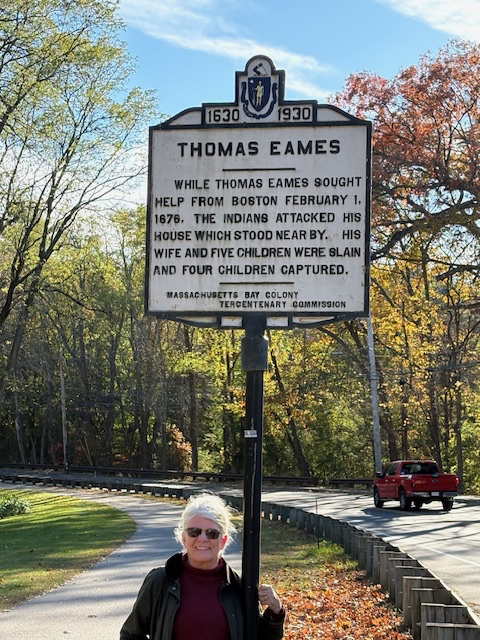
There is no remaining structure, only the sign indicating that this was the site of a 17th century homestead.
On February 1, 1676, during the King Philip’s War, the Eames house was attacked. At the time, Framingham was a sparsely settled frontier area, consisting of isolated farms carved from forest. During the war, Native forces carried out raids on outlying settlements throughout Massachusetts.
While Thomas Eames was away from home seeking assistance, his house was attacked. His wife and several of his children were killed. Other children were taken captive.
The event occurred during one of the most violent phases of King Philip’s War, a conflict between English colonists and Native tribes led by Metacom (known to the English as King Philip). The war resulted in heavy casualties on both sides and widespread destruction of frontier homes and towns across New England.
The Tercentenary Commission was established in the early 20th century to commemorate 300 years of Massachusetts settlement. As part of these efforts, markers were placed across towns to identify important 17th-century sites and events. The Thomas Eames sign is one of those historical reminders.
Read More From Nancy

Samuel Eliot Morison Memorial
Walking along the Commonwealth Avenue Mall reveals a series of monuments honoring people connected to Boston and the wider world. Among them is a particularly distinctive sculpture of Samuel Eliot Morison. Rather than placing him formally on his feet or astride a horse, sculptor Penelope Jencks portrayed him as a sailor seated on an enormous […]
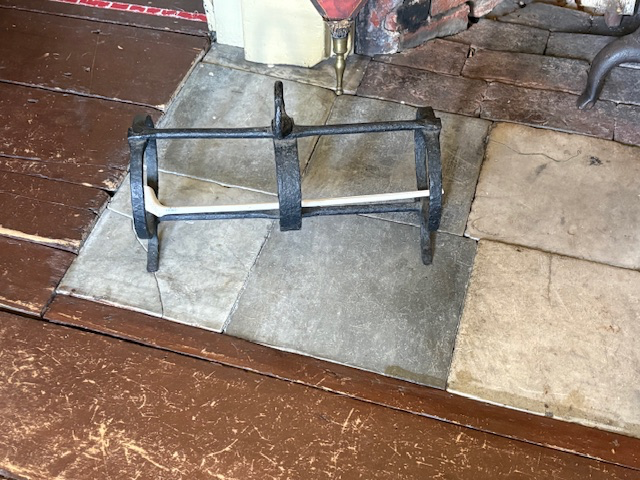
Clay Pipe Warmer
Resting on the hearth of a colonial tavern was this simple iron frame and without a pipe set across it, I would never have recognized it as a clay pipe warmer. As with every object, there is a history, and it is that curiosity that draws me in to learn more. Before matches were common and […]
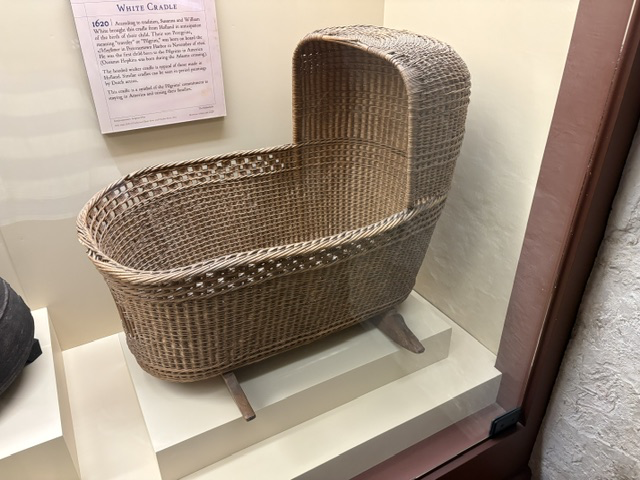
The White Cradle
Among the objects we encountered while exploring Plymouth was this simple wicker cradle. According to tradition, it belonged to Susanna and William White and was brought with them from Holland when they sailed aboard the Mayflower in 1620. Susanna White was pregnant during the Atlantic crossing. The Mayflower left Plymouth, England, in September with more […]

