The Vilna Shul
Tucked into the north slope of Beacon Hill is a building that preserves a part of Boston history that has almost completely disappeared. The Vilna Shul is the last surviving purpose-built immigrant-era synagogue in downtown Boston and a reminder of the once-thriving Jewish community of the West End.
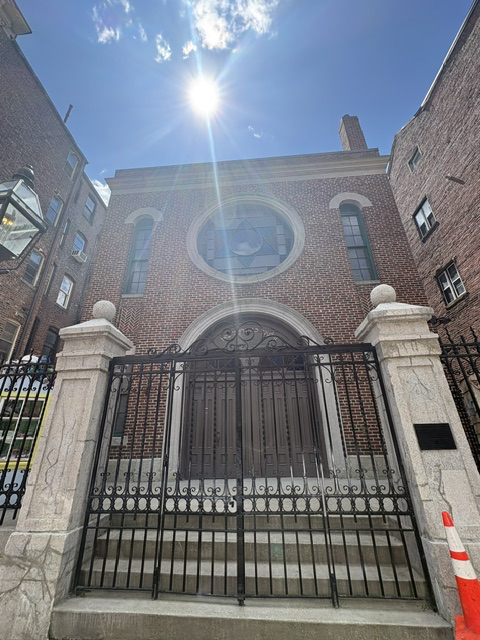
The congregation was founded in 1893 by Jewish immigrants primarily from Vilna, today Vilnius, Lithuania, who had settled in Boston’s West End. Like many immigrant congregations, it began without a permanent home. The congregation moved to the north slope of Beacon Hill in 1906 and eventually constructed this synagogue at 18 Phillips Street, completing it in 1919.
During the late nineteenth and early twentieth centuries, the West End was one of Boston’s great immigrant neighborhoods. Jewish families from Eastern Europe settled alongside Irish, Italian and other immigrant communities. Synagogues, schools, shops, social organizations and small businesses filled the neighborhood. By the early twentieth century, dozens of Jewish congregations could be found in the West End and surrounding streets. The Vilna Shul was one of them.
The building itself reflects the resources of an immigrant congregation rather than the grandeur of some of America’s older urban synagogues. Yet that is precisely what makes it important. This was a neighborhood synagogue, a place where ordinary immigrant families worshipped, celebrated marriages and bar mitzvahs, mourned deaths, observed holidays and maintained traditions brought with them from Eastern Europe.
Its survival is particularly significant because much of the community around it disappeared.
Beginning in the late 1950s, Boston’s urban-renewal program demolished a large portion of the old West End. Hundreds of buildings were razed and thousands of residents displaced. The dense neighborhood that had surrounded the synagogue was dramatically transformed. At the same time, many Jewish families had already begun moving to communities such as Brookline, Newton and other Boston suburbs.
One by one, the old neighborhood synagogues closed or disappeared. The Vilna Shul survived.
By the 1980s the congregation had dwindled, and the building eventually closed as an active synagogue. Preservationists recognized, however, that this was no longer simply the story of one congregation. The building had become an important physical survivor of Boston’s immigrant Jewish history.
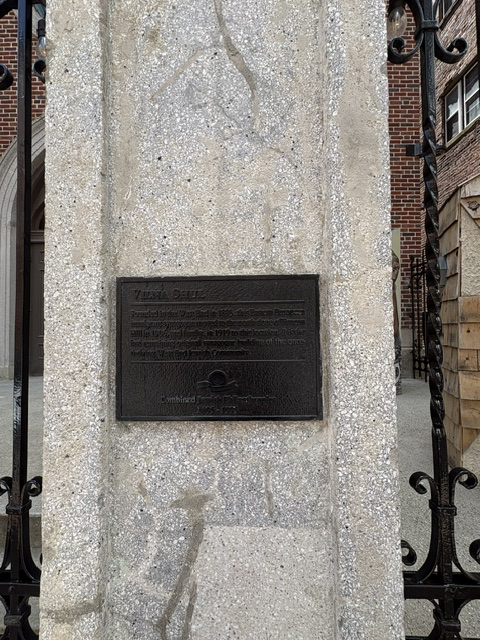
Today it is preserved as the Vilna Shul, Boston’s Center for Jewish Culture. Restoration work has uncovered layers of decorative painting and other details from the synagogue’s earlier years, allowing the building itself to become part of the historical record. The plaque outside summarizes why this relatively modest brick building matters: it is the last remaining original synagogue building from the once-thriving Jewish community of Boston’s West End.
Standing outside, surrounded by Beacon Hill today, it can be difficult to imagine the neighborhood that once existed here. But the Vilna Shul provides a tangible connection to it. Behind these doors generations of Eastern European immigrants created a community while adapting to a new country, preserving traditions and building new lives in Boston.
For me, places like this are especially important because they preserve the history of communities that have otherwise largely vanished from the landscape. The Vilna Shul is more than an old synagogue. It is one surviving piece of the Jewish West End and of the generations of immigrants who helped shape Boston.
Read More From Nancy
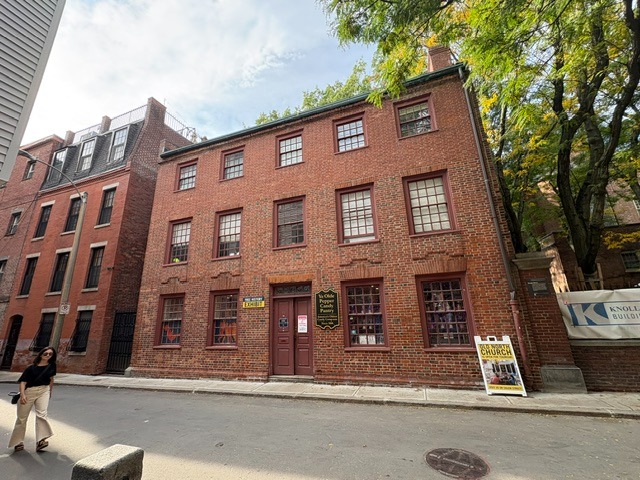
The Clough House
Walking through Boston’s North End, we stopped at the Clough House on Unity Street, behind Old North Church. Its brick exterior holds a history that reaches beyond colonial Boston into the lives of immigrant families who later made this neighborhood their home. Built around 1715, the house was the home of master bricklayer Ebenezer Clough, […]
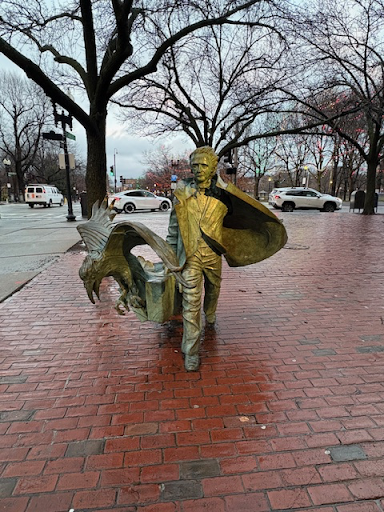
Edgar Allen Poe Statue
This is a statue of Edgar Allan Poe on the sidewalk along Boylston Street in Boston. He is caught in mid-stride, coat swirling with a raven perched atop a stack of books at his feet. The placement of this statue is intentional and rooted in Poe’s relationship with the city where his life began. Poe […]
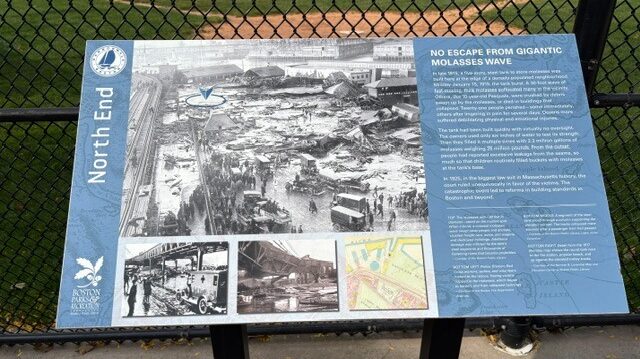
The Great Molasses Flood
Along Commercial Street in Boston’s North End, a waterfront marker recalls a disaster that can be difficult to imagine amid the neighborhood’s activity today. On January 15, 1919, a massive steel storage tank burst, releasing approximately 2.3 million gallons of molasses into the surrounding streets. Twenty-one people died, and roughly 150 were injured. The tank […]

