The Great Molasses Flood
Along Commercial Street in Boston’s North End, a waterfront marker recalls a disaster that can be difficult to imagine amid the neighborhood’s activity today. On January 15, 1919, a massive steel storage tank burst, releasing approximately 2.3 million gallons of molasses into the surrounding streets. Twenty-one people died, and roughly 150 were injured.
The tank had been built in 1915 for the Purity Distilling Company. Standing fifty feet tall, it dominated a waterfront where industry operated close to homes and neighborhood businesses. Ships delivered molasses to Copp’s Hill Wharf, where it was pumped into the tank before being transported by rail to distilleries for conversion into alcohol.
There had been warnings. The tank leaked from its seams, and neighborhood children collected the escaping molasses in buckets. Its construction had been rushed, with little oversight and inadequate testing. A structure holding millions of gallons of heavy liquid stood beside a densely populated neighborhood without the safeguards its enormous load required.
When the tank failed around lunchtime, the molasses swept through the waterfront with devastating force. Buildings were crushed or torn from their foundations. Wagons, automobiles, and freight cars were engulfed. Pieces of steel and broken rivets became dangerous projectiles, and a section of the tank struck a support column of the elevated railway, collapsing part of the structure just after a passenger train had passed.
Police, firefighters, Red Cross workers, sailors, and civilian volunteers rushed to help. Rescuers struggled through the sticky mass to reach people trapped beneath wreckage. Those killed included waterfront workers, a firefighter, and children. Cleanup brought its own difficulties: molasses coated buildings, vehicles, and debris, and crews eventually used saltwater pumped from the harbor to help wash it away.
The disaster also became a prolonged struggle for accountability. The tank’s owner, United States Industrial Alcohol Company, claimed that anarchists had caused the destruction through sabotage. After extensive testimony, court-appointed auditor Hugh W. Ogden concluded in 1925 that structural failure and inadequate attention to safety were responsible. His findings held the company liable and helped bring greater scrutiny to engineering and construction practices.
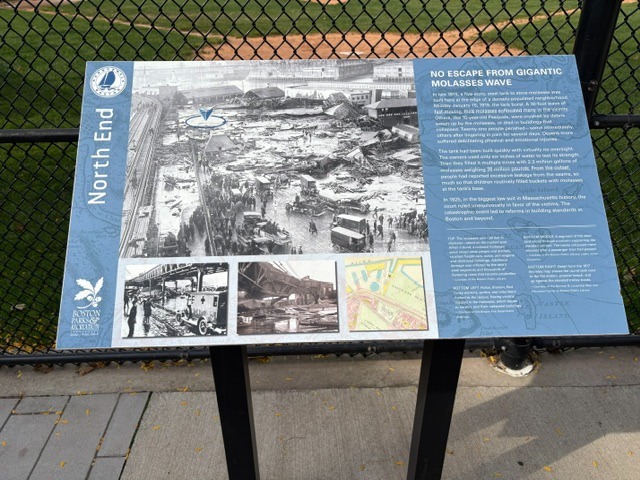
The Great Molasses Flood is remembered for its unusual circumstances, but its importance lies in the lives lost and the warnings that went unheeded. Stopping here brings another part of the North End into view: a working waterfront where families lived beside industry, and where failures in construction and responsibility could reach far beyond a company’s property.
Read More From Nancy
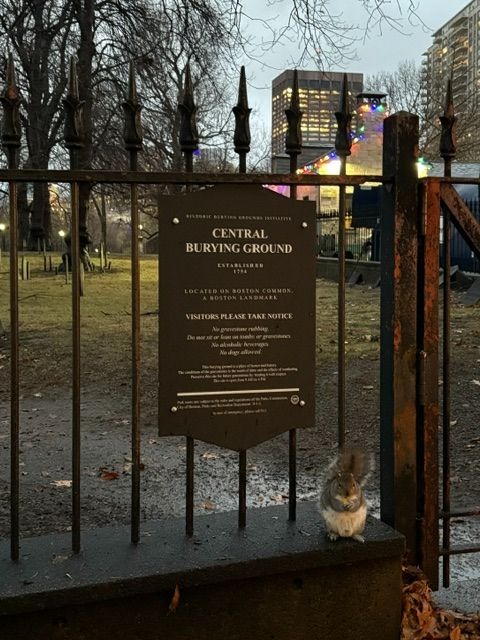
Central Burying Ground
Along the Boylston Street edge of Boston Common, Central Burying Ground preserves a quiet part of the city’s history. Established in 1756, it became a resting place for people whose lives connected Boston to commerce, the arts, and the upheaval of the American Revolution. Those buried here include British soldiers who died during the Revolutionary […]
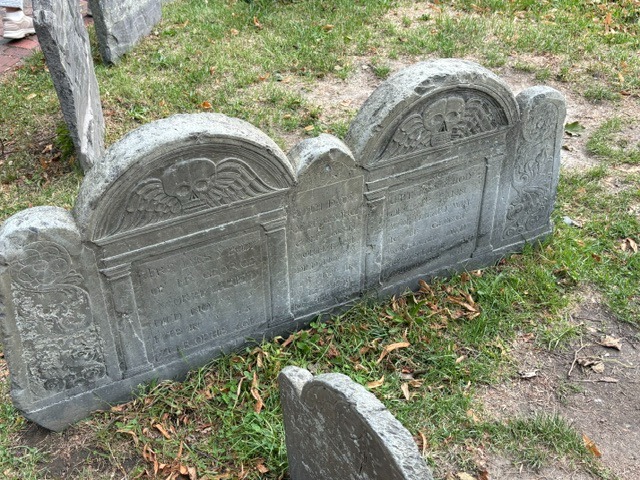
Carved Remembrance at Copp’s Hill Burying Ground
At Copp’s Hill Burying Ground, the carved gravestones preserve more than names and dates. Their shapes, lettering, and symbols reveal how earlier generations commemorated the dead and reminded the living of their own mortality. Looking closely at these markers introduces another part of Boston’s history: the work of stone carvers and the visual language their […]
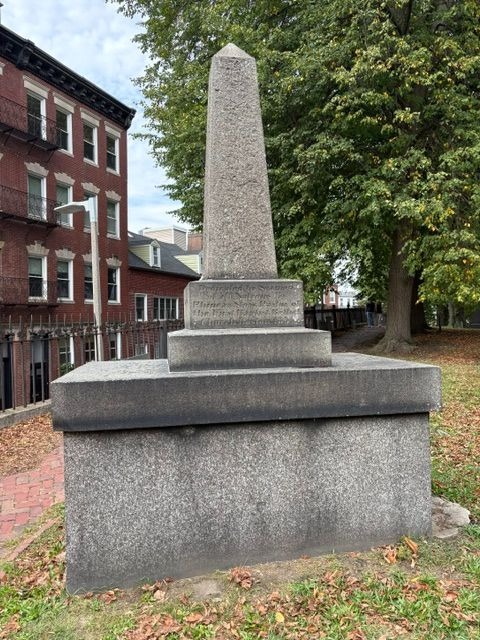
Edmund Hartt at Copp’s Hill Burying Ground
The monument to Edmund Hartt at Copp’s Hill Burying Ground connects this historic cemetery to Boston’s shipbuilding waterfront. Hartt owned the North End shipyard where the USS Constitution was built, helping provide the setting and skilled labor for one of the young United States Navy’s most ambitious projects. His memorial preserves the name of a […]

