The Founders Memorial
Standing on Boston Common, the Founders Memorial commemorates the beginning of Boston’s story. Dedicated in 1930 during the city’s 300th anniversary celebration, the monument marks the founding of Boston in 1630 and honors the people whose decisions transformed a small peninsula known as Shawmut into one of America’s most influential cities.
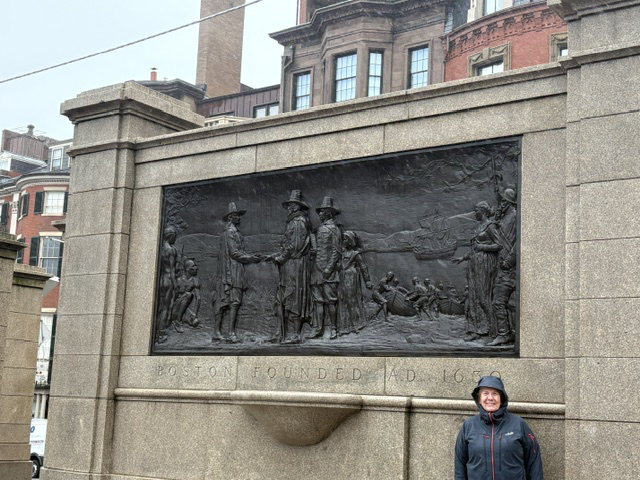
The centerpiece of the memorial is a large bronze relief depicting the symbolic meeting between Governor John Winthrop and the Reverend William Blackstone. Blackstone was the first permanent English settler to live on the Shawmut Peninsula. When the newly arrived, Puritan colonists established themselves across the Charles River in Charlestown, they soon discovered that fresh water was scarce. Blackstone invited them to settle on the peninsula where he lived, a decision that led directly to the founding of Boston.
The relief contains more than just these two men. Also represented are Ann Pollard, traditionally recognized as the first English woman to settle in Boston, Native Americans who had long inhabited the area before European settlement, and an allegorical figure representing the City of Boston. Together, these figures remind visitors that Boston’s history was shaped by many different people and cultures.
The monument was created by Boston sculptor John Francis Paramino, one of the city’s most accomplished twentieth-century artists. Local tradition holds that because no authentic portrait of William Blackstone survives, Paramino used the face of Boston Mayor James Michael Curley as the model for Blackstone. Whether entirely true or not, the story has become part of the monument’s own history and adds another layer to its connection with the city.
Boston Common provides a fitting location for this memorial. Established in 1634, it is the oldest public park in the United States and has witnessed nearly every chapter of Boston’s development. What began as common grazing land became a gathering place for militia, a site for public celebrations and protests, and today remains the heart of the city.
One of the things I enjoy most about exploring historic places is that they encourage us to pause and ask, “How did this all begin?” Standing in the heart of modern Boston, surrounded by thousands of people going about their day, it is almost impossible to imagine that this remarkable city started with a single settlement on a small peninsula. Every great story has a first chapter, and this monument reminds us never to overlook the importance of those first steps.
Read More From Nancy
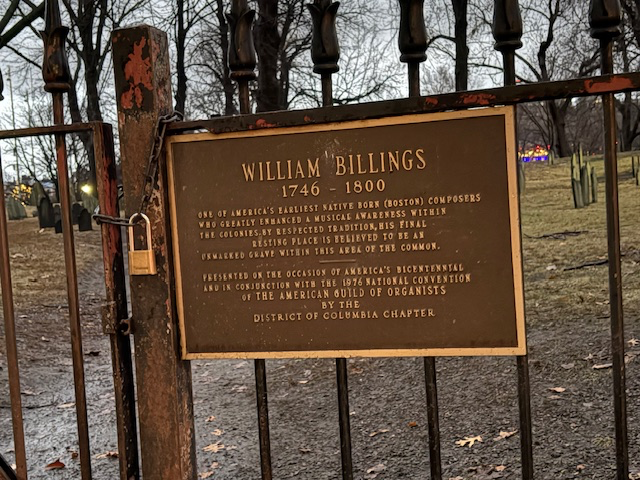
William Billings Plaque
Walking along the Boston Common, there are a number of plaques that quietly mark the lives of people who helped shape the early character of the city. One of them is for Willian Billings, listed as one of America’s earliest native-borncomposers. Billings was born and lived in Boston at a time when the country was just beginning to define its […]
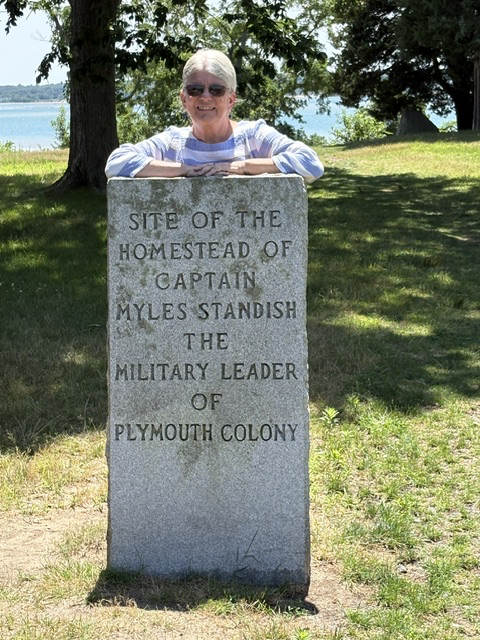
The Myles Standish Homestead
On our camping trip to Plymouth, we wanted to explore more of the Pilgrim story beyond the places we had visited in Plymouth itself. That brought us to nearby Duxbury and the homestead of Captain Myles Standish. Standish is closely associated with the founding of Duxbury, and this was the community where he established his […]
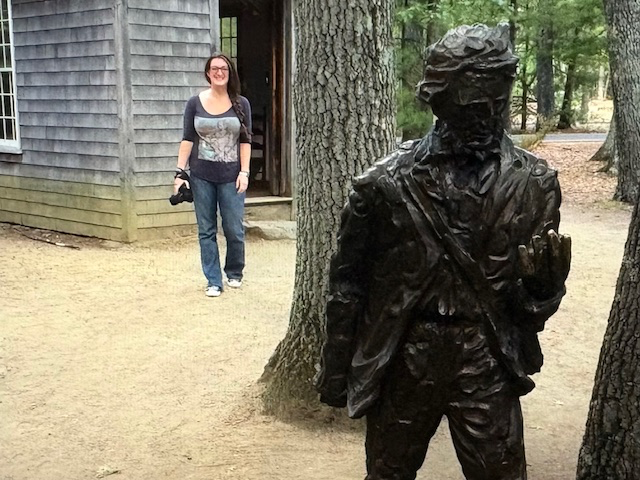
Replica of David Thoreau’s Cabin
Just outside the replica of Henry David Thoreau’s cabin at Walden Pond stands this bronze statue of Thoreau, depicting him much as we might imagine him during his years here. He is simply dressed and seemingly caught in the act of walking through the landscape he observed so carefully. Thoreau came to Walden Pond in […]

