The Standish Sampler – 1653
This is a remarkable survival from the earliest years of colonial New England. Made around 1653 by Loara Standish, the teenage daughter of Mayflower passenger Captain Myles Standish, it is considered the earliest surviving sampler embroidered in America.
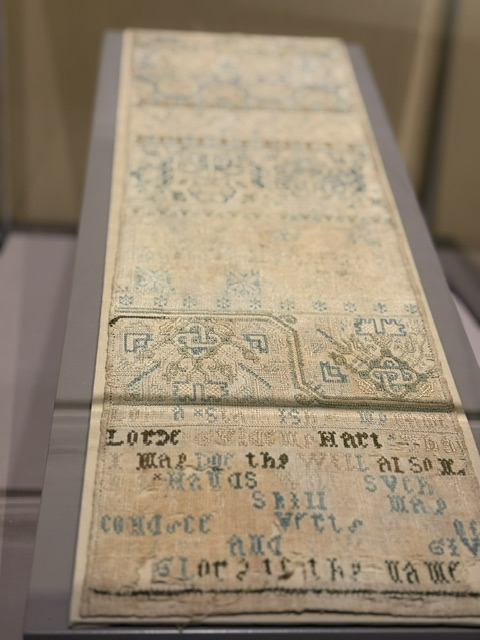
Loara grew up in Duxbury, Massachusetts, where the Standish family settled after the establishment of Plymouth Colony. Her father had arrived aboard the Mayflower in 1620 and became the colony’s military leader. Yet this object gives us an entirely different view of the Standish family, not warfare, politics or settlement, but the education and daily life of a young girl growing up in seventeenth-century Massachusetts.
Samplers were part of a girl’s education. They allowed her to practice the embroidery stitches and decorative patterns she would need throughout her life for marking household linens and producing clothing and other textiles. Loara’s sampler follows the English tradition: it is long and narrow, with decorative patterns arranged in horizontal bands. According to the exhibit, she used counted-thread embroidery on 50-count linen, extraordinarily fine work, especially considering that she was still a teenager.
She also stitched her name and a verse into the linen:
“Loara Standish is my name
Lorde guide my hart that
I may doe thy will also
My hands with such
Convenient skill as may
Conduce to virtue void of
Shame and I will give
The glory to thy name”
Those words make the sampler especially personal. Nearly four centuries later, we can still see Loara identifying herself by name and expressing the values expected of a young Puritan woman: faith, virtue, useful skill and devotion to God.
The sampler originally looked considerably different from what we see today. Centuries of exposure to light have faded its colors. The exhibit notes that the reverse retains brighter colors, providing evidence of how vibrant the embroidery once appeared. What I find most extraordinary is its survival. Textiles are fragile. They are used, washed, damaged, discarded and destroyed by light, moisture and insects. Yet this small piece of linen made by a teenage girl in Duxbury around 1653 survived for more than 370 years.

Read More From Nancy
A Beaver Pelt
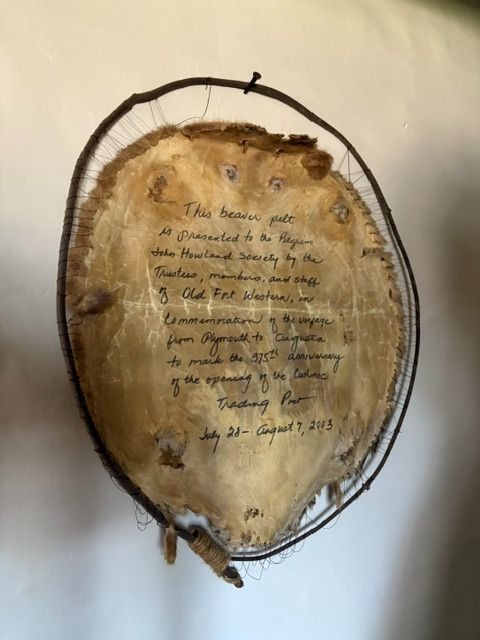
A beaver pelt stretched within a wooden frame commemorates a connection between Plymouth, Massachusetts, and Augusta, Maine. Its handwritten inscription records a voyage from Plymouth to Augusta in 2003, marking the 375th anniversary of the opening of the Cushnoc trading post. Presented to the Pilgrim John Howland Society by the trustees, members, and staff of […]
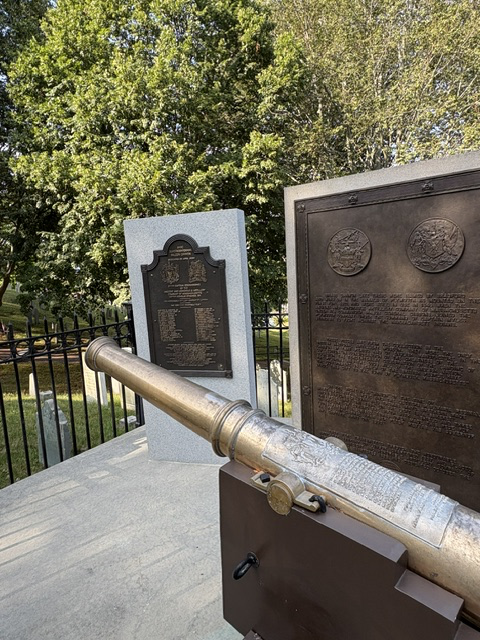
The Burial Hill Cannons
Near the summit of Burial Hill, a cannon and a series of bronze plaques mark the approximate location of Plymouth’s first fort. The settlers chose the hill because its height provided a broad view of the harbor and the settlement below. Their fort, completed in the early 1620s, had cannon mounted on its roof and […]
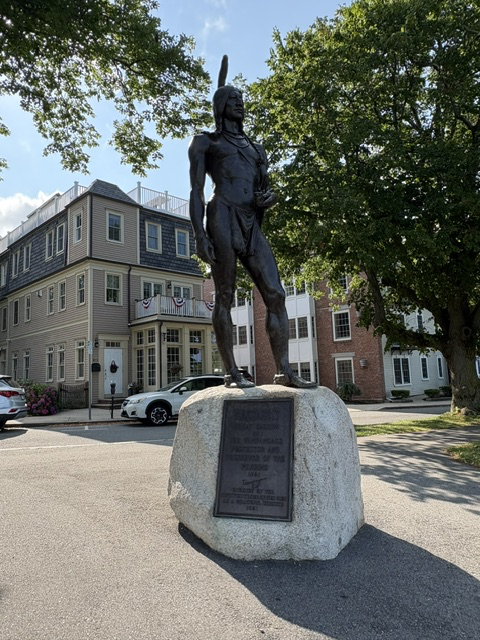
Massasoit Statue
Overlooking Plymouth Harbor from Cole’s Hill stands this bronze statue of Massasoit, also known as Ousamequin, the Pokanoket sachem whose leadership played an essential role in the survival of the newly established Plymouth Colony. He was not simply a figure who appeared in the Pilgrim story. He was the leader of a people who had […]

