The Sailor in Stone
Walking through Barcelona, I noticed a carved stone panel beside a storefront entrance. A sailor stood next to a large anchor, with the outline of a ship rising behind him and a star above. The relief was incorporated into the building itself, an architectural detail that could easily be overlooked while passing the shop windows.
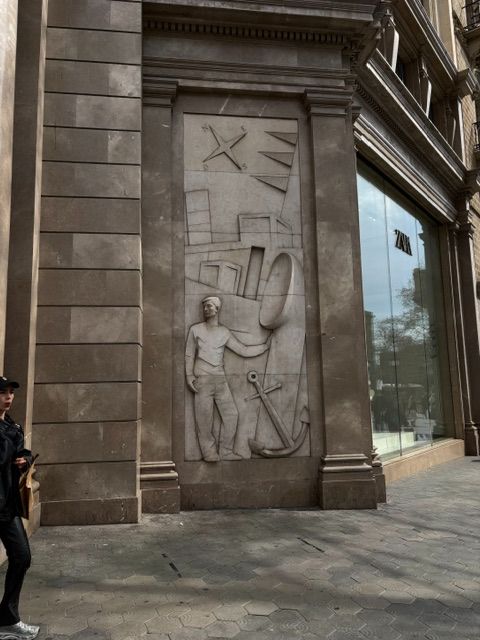
The panel is identified as a 1961 work by Catalan sculptor Eudald Serra. It decorated the entrance of the former Banco Rural y Mediterráneo building at Passeig de Gràcia and Gran Via. By the time of our visit, the storefront carried the Zara name, but the sailor remained beside its entrance, preserving a detail from the building’s earlier commercial life.
Serra arranged the composition within a tall, narrow rectangle. The sailor occupies the lower portion, while the vessel and star fill the space above. His figure is simplified, with little unnecessary detail. The anchor is immediately recognizable, and the ship is suggested through geometric shapes rather than a fully modeled scene. Together, these elements allow the subject to be understood quickly, even from the sidewalk.
The carving also uses different depths to create contrast. The sailor projects from the surface, while parts of the ship appear as outlines cut into the stone. Light and shadow help distinguish the figure from the surrounding forms. Seen closely, the panel becomes an exercise in how a sculptor can communicate a scene within the shallow space of a building’s wall.
What interested me most was its survival through a change of use. A sculpture commissioned for one business had become part of the entrance to another. The shop sign identified the present occupant, while the stonework retained a connection to the past.
Discoveries like this encourage me to examine the spaces around doorways as well as the buildings above them. Here, an ordinary shopping street held a small work of sculpture whose story began decades before the storefront we encountered. The sailor remained at his post, quietly carrying that earlier chapter into the life of the modern city.
Read More
Read More From Nancy
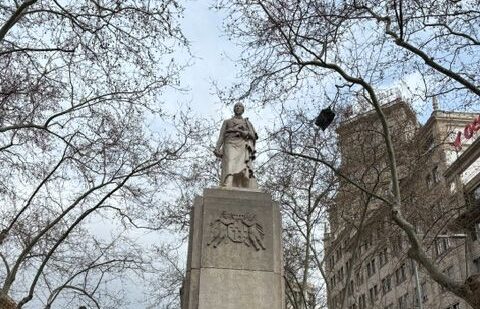
The Monument to Joan Güell i Ferrer
On a landscaped strip along Barcelona’s Gran Via, a stone figure stands above the surrounding traffic and pedestrians. Beneath him, carved figures and symbols decorate a tall pedestal. The monument honors Joan Güell i Ferrer, a nineteenth-century industrialist whose story connects Barcelona’s textile factories, political life, and one of its most familiar family names. Born […]
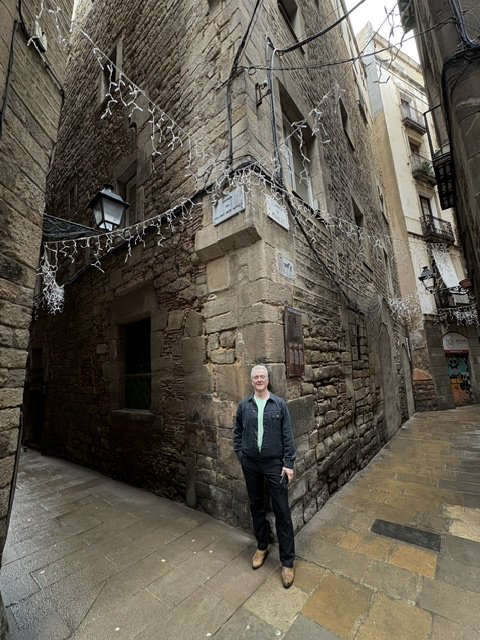
The Ancient Synagogue
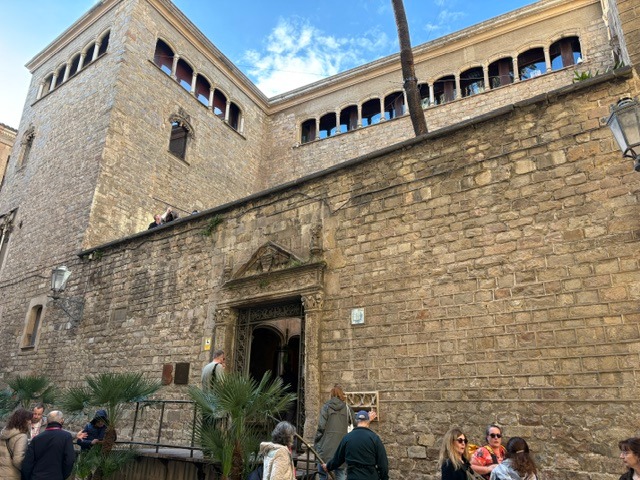
While exploring Barcelona, one of the places we specifically wanted to visit was the Ancient Synagogue in the heart of the city’s medieval Jewish Quarter. Tucked away on a narrow stone street in El Call, it is easy to miss if you don’t know it is there. Standing before this modest building, it is difficult […]
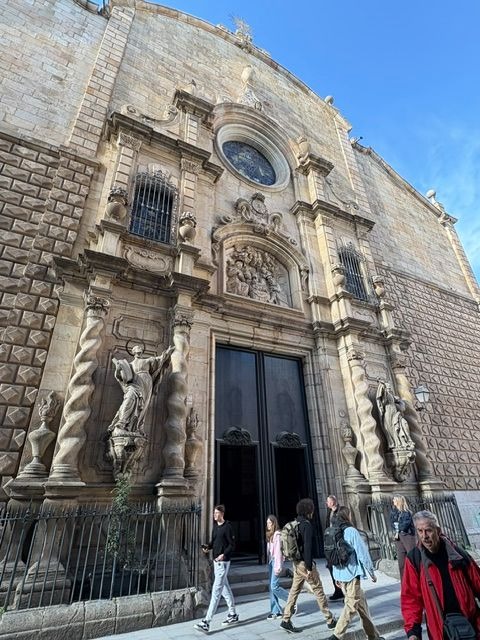
Church of Mare de Déu de Betlem
At the corner of La Rambla and Carrer del Carme, the Church of Mare de Déu de Betlem preserves an elaborate Baroque entrance amid one of Barcelona’s busiest areas. Twisting stone columns, sculpted saints, and a relief of the Nativity identify a church whose history includes two destructive fires and the expulsion of the religious […]

