The Ancient Synagogue
While exploring Barcelona, one of the places we specifically wanted to visit was the Ancient Synagogue in the heart of the city’s medieval Jewish Quarter. Tucked away on a narrow stone street in El Call, it is easy to miss if you don’t know it is there. Standing before this modest building, it is difficult to imagine that it is believed to be one of the oldest synagogues in Europe.
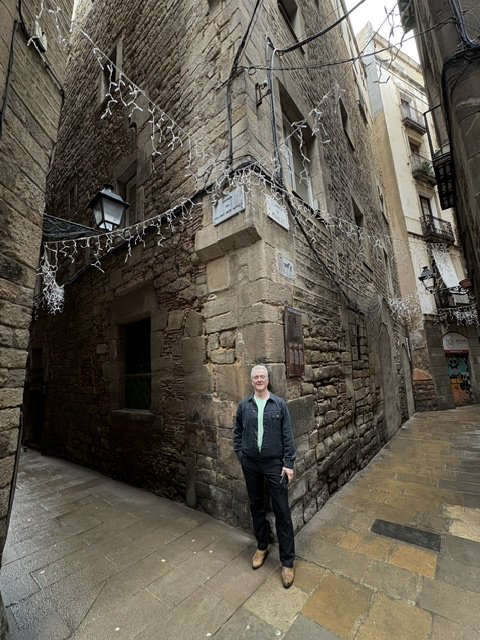
The Ancient Synagogue of Barcelona stands on foundations that date back to the Roman city of Barcino. Historians believe the building served as a synagogue by the thirteenth century, when Barcelona’s Jewish community was one of the largest and most influential in the western Mediterranean. It became a center of worship, learning, and community life during a period when El Call flourished as an important Jewish neighborhood.
During the Middle Ages, thousands of Jewish residents lived within these narrow streets. They were physicians, merchants, scholars, craftsmen, and advisers who contributed greatly to Barcelona’s intellectual and commercial success. Among the community’s most distinguished leaders was Rabbi Solomon ben Adret, one of medieval Europe’s greatest Jewish scholars, whose writings continue to be studied today.
That thriving community came to a tragic end in 1391 when anti-Jewish riots swept through Barcelona. Hundreds of Jews were killed, many others were forced to convert to Christianity, and the synagogue was confiscated. Over the centuries, the building was converted into homes, workshops, and storage spaces, and its identity as a synagogue gradually disappeared from memory.
It was not until the late twentieth century that historians and archaeologists carefully studied the building’s orientation, construction, and historical records, confirming its significance. Following restoration, the synagogue reopened as both a museum and a place of worship, preserving the history of Barcelona’s Jewish community for future generations.
Standing before this building, I was reminded that some of history’s most significant places are also its most unassuming. Unlike the great cathedrals and royal palaces that dominate Barcelona’s skyline, the Ancient Synagogue quietly tells the story of a community that helped shape the city’s history for centuries. Visiting it gave me a deeper appreciation for the rich and diverse cultures that have called Barcelona home and the importance of preserving their stories for generations to come.
Read More From Nancy
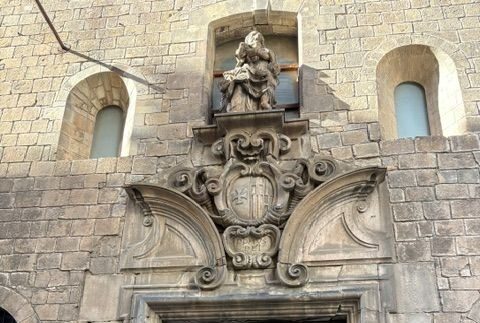
La Capella
Above the entrance to La Capella, a sculpted figure represents Charity. Created by Pere Costa in 1730, it recalls the building’s original role as the chapel of Barcelona’s Hospital de la Santa Creu. Today, the doorway opens into a space devoted to contemporary art. The chapel was completed in 1444, incorporating an earlier structure associated […]
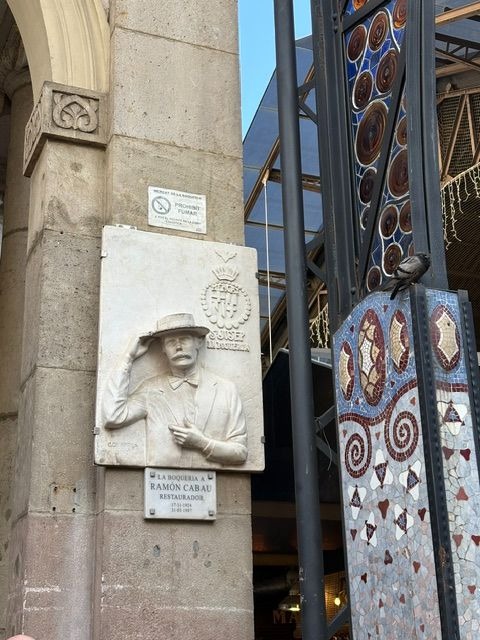
Ramon Cabau
At an entrance to Barcelona’s La Boqueria market, a sculpted relief depicts a man lifting his straw hat in greeting. The inscription identifies Ramon Cabau, a restaurateur whose close relationship with the market made him one of its memorable personalities. Born in 1924, Cabau became known through Agut d’Avinyó, a restaurant in Barcelona’s old city. […]
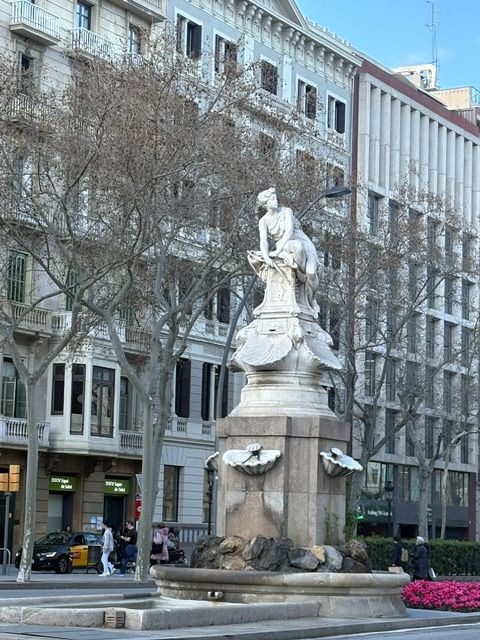
Diana Fountain
At the intersection of Gran Via de les Corts Catalanes and Carrer de Roger de Llúria, the Diana Fountain brings a figure from Roman mythology into Barcelona’s everyday streetscape. Seated above the fountain, the goddess holds the bow that identifies her as Diana, traditionally associated with hunting and the natural world. The sculpture is the […]

