The Pilgrim Mother Fountain
Standing near Plymouth’s waterfront, the Pilgrim Mother Fountain honors the women who crossed the Atlantic aboard the Mayflower and helped establish Plymouth Colony. While the colony’s governors, ministers, and military leaders are frequently remembered by name, this monument turns attention toward the women whose courage and endurance were equally essential to the settlement’s survival.
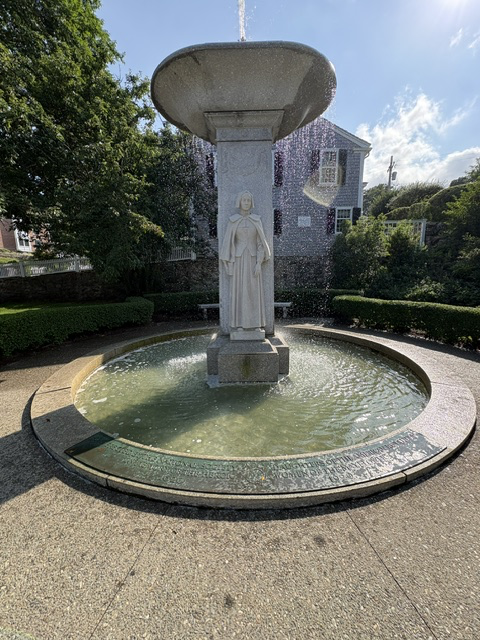
The Mayflower’s women endured the same crowded voyage, uncertain arrival, and desperate first winter as the men, while also caring for children, preparing food, nursing the sick, and attempting to create homes in an unfamiliar place. Their losses were devastating. Of the 18 adult women who arrived aboard the Mayflower, only five survived that first winter. Several continued caring for children whose own mothers had died.
The National Society Daughters of the American Revolution commissioned sculptor Carl Paul Jennewein to create the memorial for Plymouth’s 1921 tercentenary. Rather than portraying a young maiden, Jennewein created a mature woman whose calm expression and steady bearing were intended to suggest faith, devotion, gentleness, and strength. Her clothing was modeled on examples of seventeenth-century English dress then held by the Metropolitan Museum of Art.
The figure was carved from Knoxville marble, while the fountain’s column, bowl, and basin were made from granite quarried on Deer Island, Maine. Water rises above the broad upper bowl and falls around the figure into the circular pool below. The names of the Mayflower women known when the monument was created were inscribed on the fountain, preserving individual identities within a memorial dedicated to their shared experience.
Restored in preparation for the 400th anniversary of the Mayflower’s arrival, the Pilgrim Mother Fountain continues to recognize a part of Plymouth’s history that can easily be overshadowed. It reminds us that the survival of the colony depended not only upon its recognized leaders, but also upon women whose daily labor, sacrifice, and perseverance helped sustain their families and community through its most difficult beginning.
Read More From Nancy
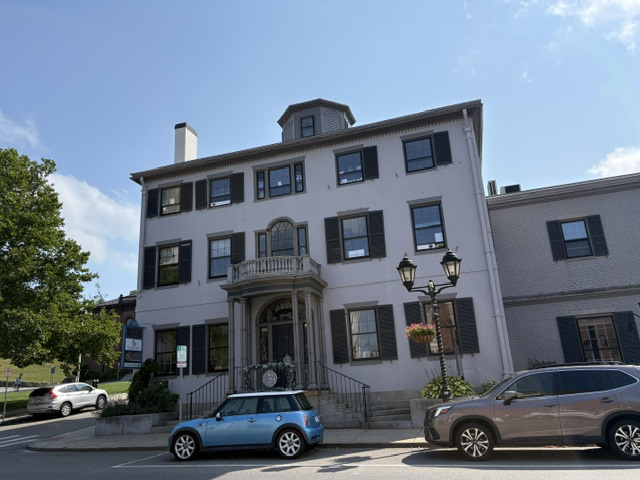
The Bartlett–Russell–Hedge House
Standing prominently on Court Street, the Bartlett–Russell–Hedge House is one of Plymouth’s finest examples of Federal-style architecture. Its symmetrical façade, Palladian window, entrance balcony, and rooftop cupola distinguish it from the surrounding commercial buildings. The house was constructed in 1803 for Joseph Bartlett, a Plymouth Sea captain. Its design has been attributed to Charles Bulfinch, […]
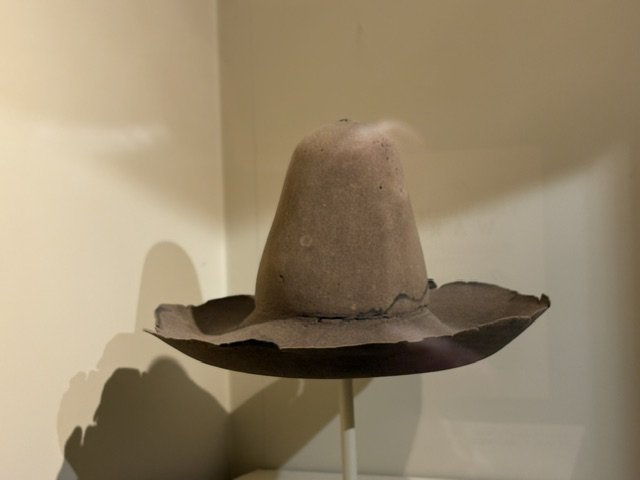
Constance Hopkins’s Beaver Hat
Among the objects we discovered in Plymouth was something remarkably personal: a beaver-felt hat associated with Constance Hopkins, a passenger on the Mayflower. Constance was only about fourteen years old when she crossed the Atlantic in 1620 with her father, Stephen Hopkins, her stepmother Elizabeth, and other members of their family. Unlike many objects displayed […]
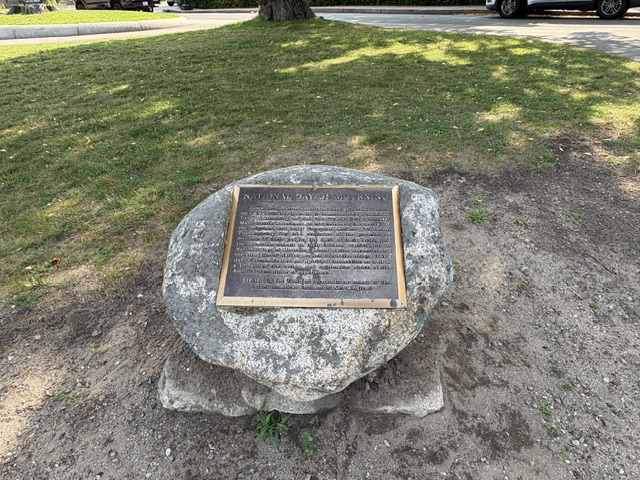
National Day of Mourning
Just a short distance from the statue of Massasoit on Cole’s Hill is this small marker recognizing the National Day of Mourning. It presents another part of Plymouth’s history and reminds us that the events of 1620 and 1621 have been remembered very differently by different people. The National Day of Mourning began in 1970, […]

