Revolutionary War Memorial
Though I have walked past this monument outside the Morse Institute Library more times than I can remember, I had never stopped to document it. The boulder and its bronze plaque had become part of the familiar surroundings. Taking this photograph gave me a reason to pause and learn how the memorial came to stand here, and how close Natick once came to losing it.
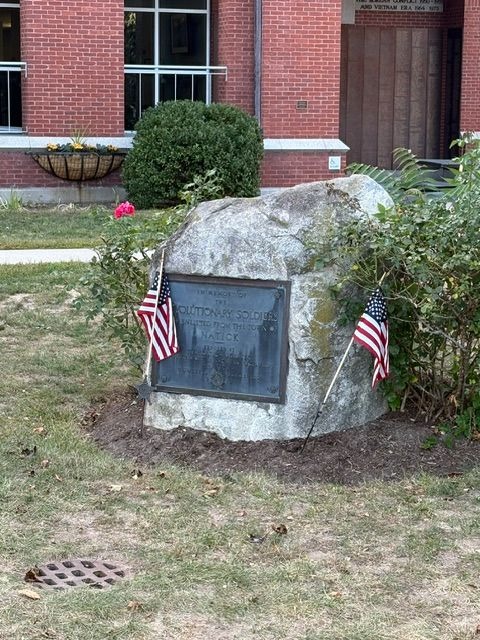
The memorial honors the Revolutionary War soldiers who served from Natick. Dedicated on June 17, 1913, by the Natick Daughters of the American Revolution, it consists of a bronze tablet mounted on an eight-ton boulder. The stone came from the farm of Thomas Broad and was donated by his great-granddaughter-in-law, giving the monument a physical connection to local land and family history.
Its inscription offers a collective remembrance rather than a list of individual names. That simplicity leaves much of the soldiers’ history untold. The Natick Historical Society’s recent research has identified 249 soldiers who served during the American Revolution, bringing individual identities to the community commemorated by this small tablet.
The monument acquired another chapter in September 1997, following the library’s renovation and expansion. A landscaping proposal called for removing the boulder and mounting its plaque on an exterior library wall. According to the local historical account, the stone itself was destined for a gravel pit.
The monument acquired another chapter in September 1997, following the library’s renovation and expansion. A landscaping proposal called for removing the boulder and mounting its plaque on an exterior library wall. According to the local historical account, the stone itself was destined for a gravel pit.
That effort to preserve the stone is now part of the memorial’s meaning. Residents recognized that the boulder itself belonged to the history of the monument, alongside the words attached to it.
For me, this is another example of history waiting within an ordinary walk through town. Something I had passed repeatedly held stories of Revolutionary service, a family’s donation, and a community’s determination to preserve a familiar landmark. Stopping to look turned that familiar stone into a place with a history I could carry forward.
Read More From Nancy
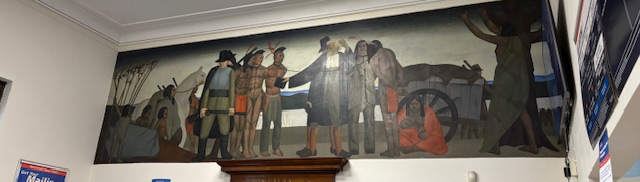
“John Eliot Speaks to the Natick Indians.”
One of the most thought-provoking works of art in my hometown hangs in an unexpected place—the downtown Natick Post Office. Painted in 1937 by Natick artist Hollis Howard Holbrook as part of the New Deal’s federal post office mural program, John Eliot Speaks to the Natick Indians depicts one of the most significant and tragic moments in […]
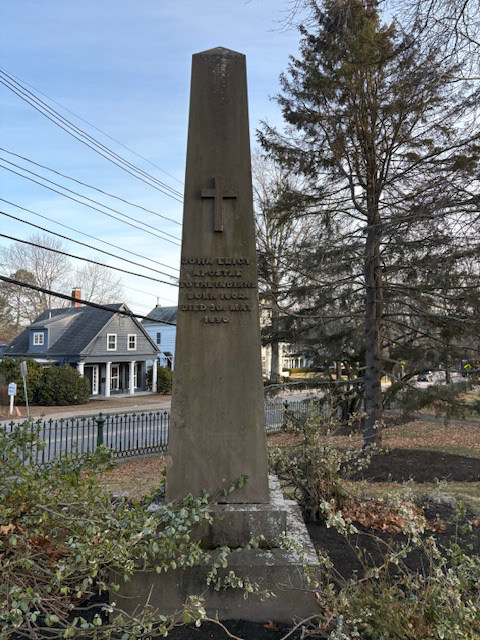
The John Eliot Monument
Standing quietly on a hill overlooking South Natick is this monument honoring John Eliot, the Puritan missionary often known as the “Apostle to the Indians.” Eliot devoted much of his life to working with the Native peoples of Massachusetts and is remembered for his efforts to share Christianity and establish communities known as “Praying Indian” towns. Arriving in […]
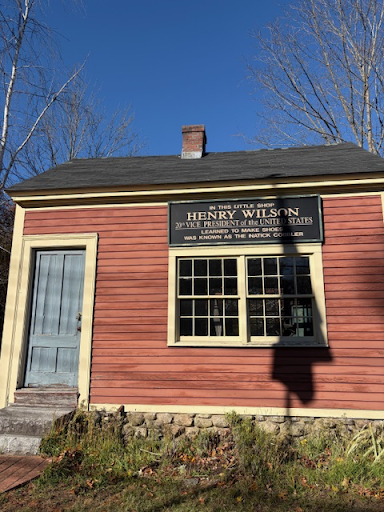
Henry Wilson House
In Natick, the small red cobbler shop where Henry Wilson once worked is modest considering the life he would go on to lead. Before he entered the Senate or became Vice President of the United States, Wilson was a cobbler, making and repairing shoes by hand. The long hours he spent at his bench were more […]

