Memorial to Lorenzo Bartolini at the Basilica of Santa Croce
The Basilica of Santa Croce contains the tombs and memorials of many individuals who shaped Italian history and culture. Among them is the monument honoring Lorenzo Bartolini, one of the most important Italian sculptors of the nineteenth century.
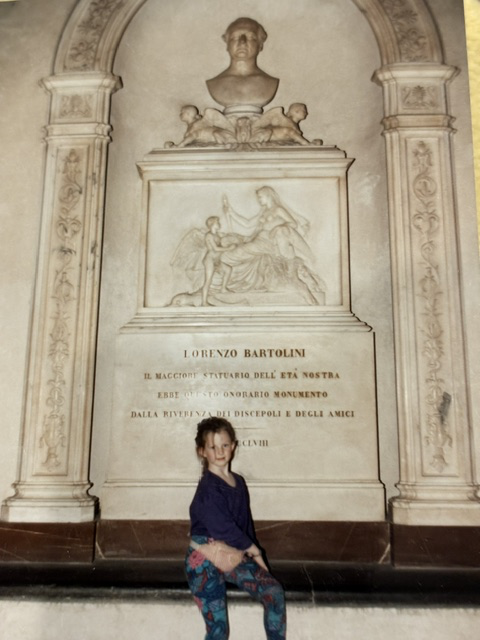
Bartolini was born near Prato in 1777 and studied at the Academy of Fine Arts in Florence before continuing his training in Paris. While there, he became associated with the artistic world surrounding Napoleon Bonaparte and developed a successful career as a sculptor and portrait artist.
After returning to Florence, Bartolini became a professor at the Academy of Fine Arts. At a time when many sculptors followed highly idealized classical models, he encouraged his students to study nature directly. His sculptures combined neoclassical form with more natural facial expressions, physical details and emotional qualities.
Bartolini created numerous portrait busts, religious sculptures and public monuments. His best-known works include Faith in God, The Nymph and the Scorpion and the monument to Prince Nicola Demidoff. His work influenced a generation of sculptors and helped introduce a more naturalistic approach to nineteenth-century Italian sculpture.
Bartolini died in Florence in 1850 and was buried in Santa Croce. His former student Pasquale Romanelli created this memorial in 1858. A portrait bust of Bartolini rises above a carved relief, while the inscription explains that the monument was dedicated by his devoted students and friends.
Our daughter paused beside the memorial during our family visit to Santa Croce. Among the grand monuments honoring figures such as Michelangelo, Galileo and Machiavelli, Bartolini’s memorial offered a quieter recognition of an artist whose influence was carried forward through his students.
The monument honors more than Bartolini’s individual achievements. Commissioned by those who had learned from him and worked beside him, it preserves the legacy of a teacher as well as a sculptor.
Read More From Nancy
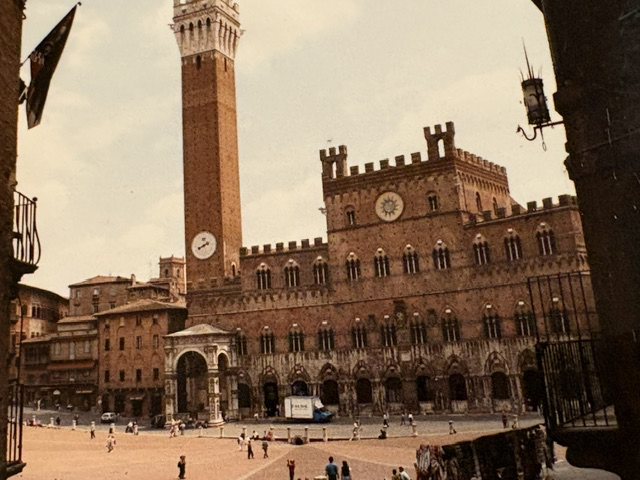
Piazza del Campo and Palazzo Pubblico
After walking through Siena’s narrow medieval streets, we emerged into the broad open space of the Piazza del Campo. The contrast was immediate. Confined passageways and closely grouped stone buildings suddenly gave way to a sweeping public square surrounded by centuries of civic architecture. The Piazza del Campo developed as the center of Siena’s political […]
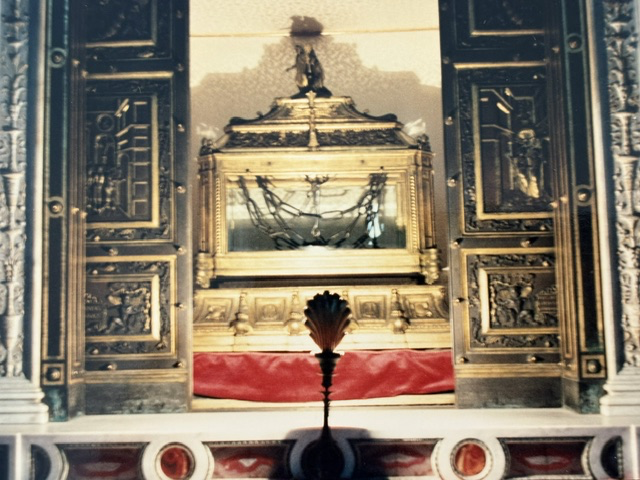
The Chains of Saint Peter
On our visits to Rome, we entered the Basilica of San Pietro in Vincoli, whose name literally means “Saint Peter in Chains”. The church is best known today by many visitors for Michelangelo’s magnificent statue of Moses, but beneath the main altar is something much older and even more connected to the earliest history of […]
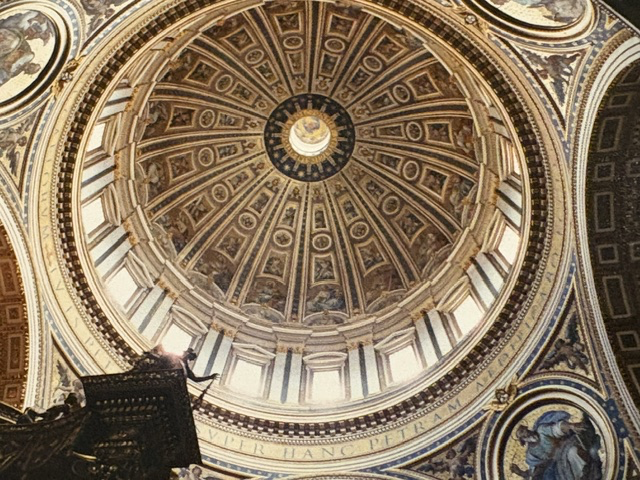
Dome of St. Peter’s Basilica
Looking upward inside St. Peter’s Basilica reveals one of the great architectural achievements of the Renaissance. The vast dome rises above the crossing of the church, directly over the papal altar and the traditional location of the tomb of Saint Peter. Michelangelo became the chief architect of St. Peter’s Basilica in 1546, when he was […]

