The Giants’ Staircase at the Doge’s Palace
The Giants’ Staircase stands within the courtyard of the Doge’s Palace, once the political and administrative center of the Republic of Venice. More than an entrance to the palace, the staircase formed part of a carefully designed ceremonial route leading from St. Mark’s Square into the heart of Venetian government.
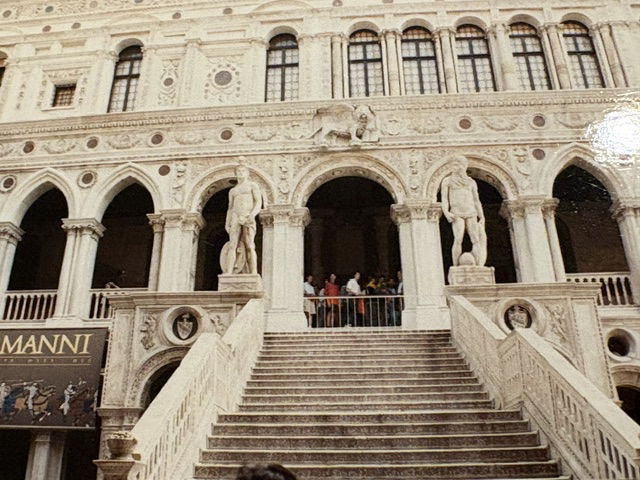
The staircase was designed by architect and sculptor Antonio Rizzo and constructed during the late fifteenth century. Its broad steps rise toward the Foscari Arch, an elaborately decorated passageway combining pale Istrian stone with reddish Verona marble. Carved columns, arches, medallions and reliefs transform the surrounding courtyard into an impressive display of Venetian craftsmanship.
At the top stand the two colossal statues that gave the staircase its name. Created by Jacopo Sansovino and installed during the sixteenth century, they represent Mars, the Roman god of war, and Neptune, the god of the sea. Together, the figures symbolized the military and maritime power upon which the Venetian Republic built its influence.
The winged Lion of Saint Mark appears above the central arch. The lion was the symbol of Venice and of its patron saint, Mark the Evangelist. Images of the lion appeared throughout the Republic on government buildings, public monuments, flags and official seals.
The staircase also served an important ceremonial purpose. Newly elected doges were formally crowned on its upper landing, placing them between the figures representing Venice’s power on land and at sea. Although the doge was the head of the Republic, his authority was limited by councils, laws and traditions intended to prevent any single ruler from becoming an absolute monarch.
Walking through the courtyard during our visit to the Doge’s Palace revealed how architecture was used to express the wealth, confidence and authority of the Venetian Republic. The Giants’ Staircase remains one of the palace’s most powerful symbols of the government that directed Venice for centuries
Read More From Nancy
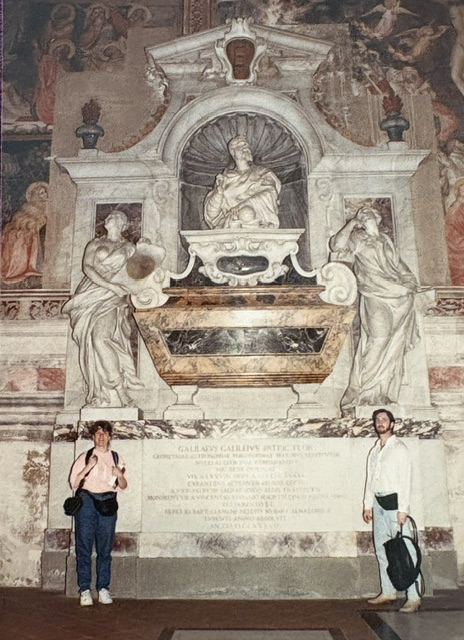
The Tomb of Galileo
During our family travels through Italy, we visited the Basilica of Santa Croce in Florence. Among the extraordinary monuments lining the interior is this elaborate tomb honoring Galileo Galilei, one of the most important figures in the history of science. Galileo was born in Pisa in 1564 and spent important years of his life in […]
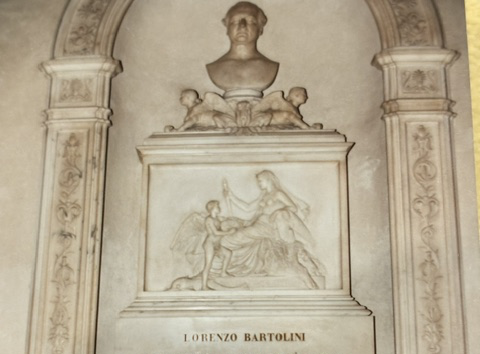
Memorial to Lorenzo Bartolini at the Basilica of Santa Croce
The Basilica of Santa Croce contains the tombs and memorials of many individuals who shaped Italian history and culture. Among them is the monument honoring Lorenzo Bartolini, one of the most important Italian sculptors of the nineteenth century. Bartolini was born near Prato in 1777 and studied at the Academy of Fine Arts in Florence […]
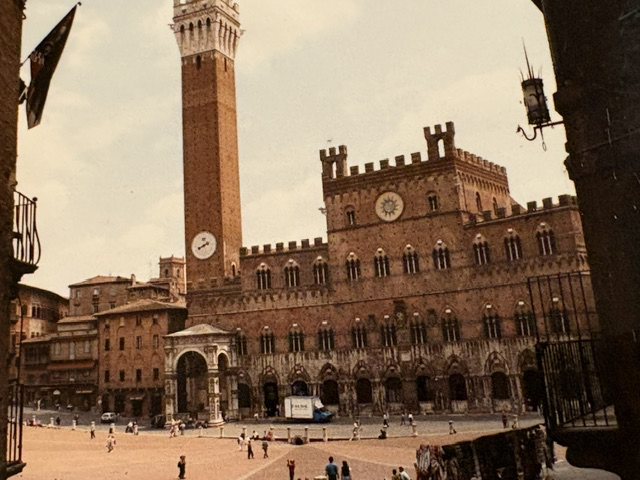
Piazza del Campo and Palazzo Pubblico
After walking through Siena’s narrow medieval streets, we emerged into the broad open space of the Piazza del Campo. The contrast was immediate. Confined passageways and closely grouped stone buildings suddenly gave way to a sweeping public square surrounded by centuries of civic architecture. The Piazza del Campo developed as the center of Siena’s political […]

