Piazza del Campo and Palazzo Pubblico
After walking through Siena’s narrow medieval streets, we emerged into the broad open space of the Piazza del Campo. The contrast was immediate. Confined passageways and closely grouped stone buildings suddenly gave way to a sweeping public square surrounded by centuries of civic architecture.
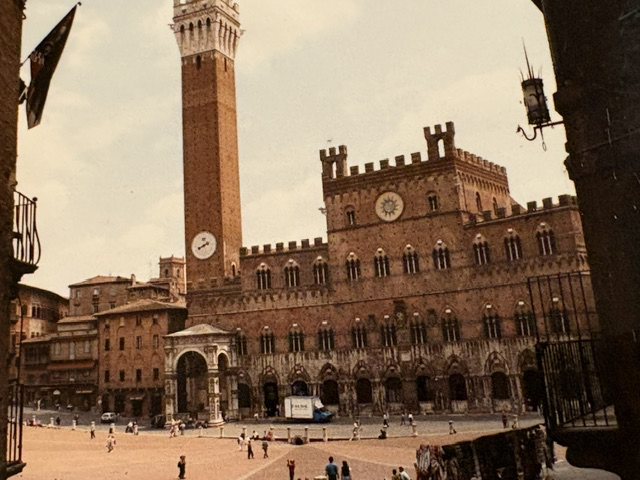
The Piazza del Campo developed as the center of Siena’s political and social life during the Middle Ages. Its unusual shell-shaped design follows the natural slope of the land, drawing the eye downward toward the Palazzo Pubblico. The paving is divided into nine sections, traditionally associated with the Council of Nine, the governing body that directed Siena during an important period of prosperity and artistic achievement.
Inside the palace are some of Siena’s most important works of art. The best known are Ambrogio Lorenzetti’s fourteenth-century frescoes known as the Allegory of Good and Bad Government. These scenes illustrate how responsible government could bring order and prosperity, while corruption and poor leadership could lead to fear, violence and decline.
Rising beside the palace is the Torre del Mangia, constructed during the fourteenth century as Siena’s civic bell tower. Its great height made it visible from across the city and demonstrated that civic authority could stand alongside religious power. The tower’s bells regulated public life, announced important events and warned residents of danger.
At the base of the tower stands the Cappella di Piazza. The marble chapel was erected after the Black Death devastated Siena in 1348. It expressed gratitude for the end of the epidemic and became a permanent reminder of one of the most destructive events in the city’s history.
The Piazza del Campo is also the setting for the Palio di Siena, the celebrated horse race held each summer. Riders representing Siena’s historic neighborhood districts race around the square while residents gather in support of their contrada. The tradition transforms the medieval civic center into a place of intense community identity and competition.
The Piazza del Campo brings together Siena’s government, architecture, art, public celebrations and neighborhood traditions. Emerging into the square after walking through the city’s narrow streets revealed the scale and importance of a place that has remained at the center of Sienese life for centuries.
Read More From Nancy
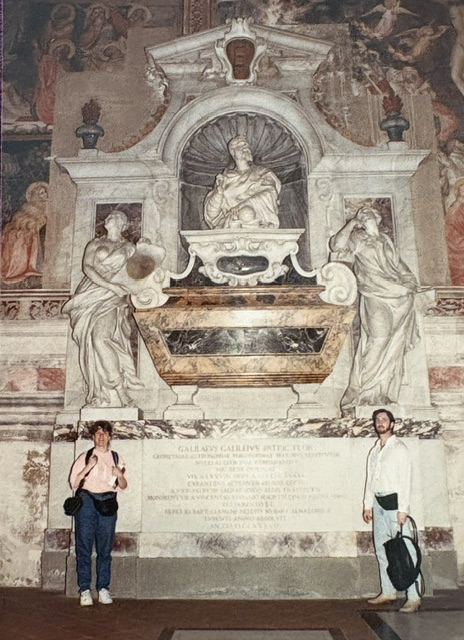
The Tomb of Galileo
During our family travels through Italy, we visited the Basilica of Santa Croce in Florence. Among the extraordinary monuments lining the interior is this elaborate tomb honoring Galileo Galilei, one of the most important figures in the history of science. Galileo was born in Pisa in 1564 and spent important years of his life in […]
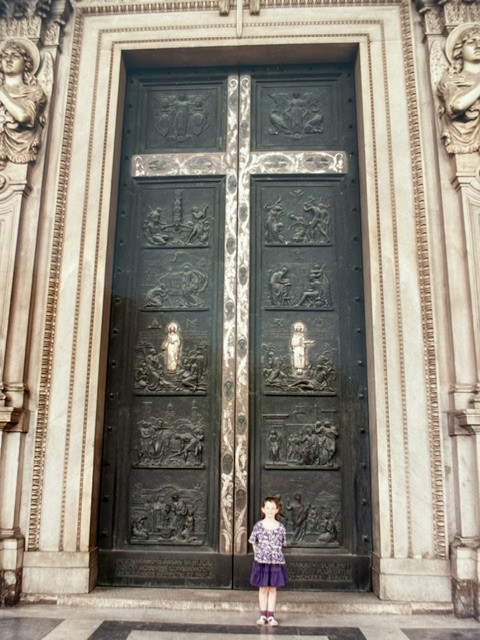
The Holy Door of St. Peter’s Basilica
On one of our family trips to Rome, we visited St. Peter’s Basilica, where this photograph of Erin was taken standing in front of the enormous bronze Holy Door. Known as the Porta Santa, it is one of the most significant entrances to St. Peter’s Basilica and has been associated with the Catholic Church’s Jubilee […]
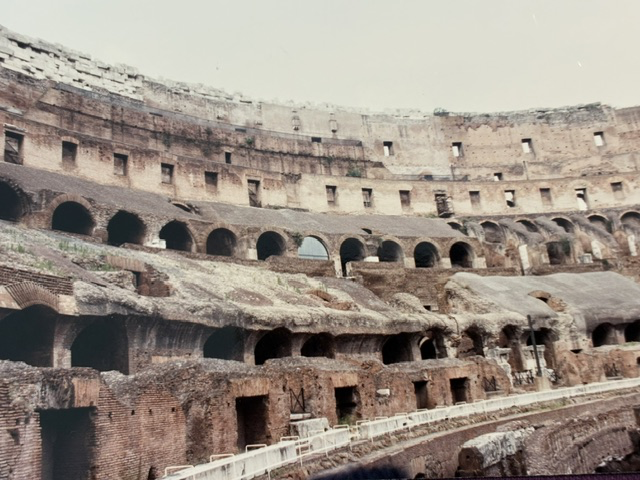
Inside the Colosseum
Touring the Colosseum was a high priority during our family trip to Italy. It was one of those historic places we had learned about long before we arrived in Rome, but entering the amphitheater allowed us to appreciate its enormous scale and understand how it once functioned. From inside, the remains of the seating levels […]

