Inside the Colosseum
Touring the Colosseum was a high priority during our family trip to Italy. It was one of those historic places we had learned about long before we arrived in Rome, but entering the amphitheater allowed us to appreciate its enormous scale and understand how it once functioned. From inside, the remains of the seating levels rise above the exposed passageways and chambers that were originally hidden beneath the arena floor.
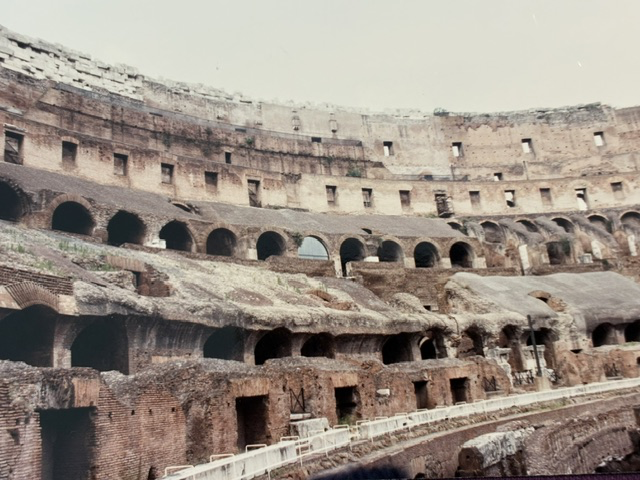
Originally known as the Flavian Amphitheatre, the Colosseum was begun during the reign of Emperor Vespasian around A.D. 72. It was completed and dedicated by his son Titus in A.D. 80, with further additions made by Titus’s brother Domitian. It was constructed on the site of an artificial lake that had been part of Emperor Nero’s private palace. By replacing Nero’s lake with an amphitheater that could be used by the public, the Flavian emperors symbolically returned this part of Rome to its people while also demonstrating their own authority and generosity.
The Colosseum was an extraordinary piece of Roman engineering. It could accommodate an estimated 50,000 spectators, who entered through numbered arches and followed assigned passageways and staircases to their seats. A massive retractable awning, operated by sailors from the Roman fleet, could be extended above much of the audience to provide shade. The organization of its entrances and corridors influenced the design of stadiums constructed many centuries later.
The open network of brick walls visible in our photograph is the hypogeum, the underground portion of the amphitheater. During Roman times, it was concealed beneath a wooden arena floor covered with sand. Its tunnels, cages, storage rooms, ramps, elevators, and trapdoors allowed gladiators, wild animals, and elaborate scenery to appear suddenly before the audience. Workers below operated the machinery while spectators watched gladiatorial contests, animal hunts, public executions, and dramatic presentations based upon Roman history and mythology.
The seating surrounding the arena reflected the strict divisions of Roman society. The emperor, senators, and Vestal Virgins occupied prominent positions close to the action. Wealthy citizens sat below the ordinary men, while women and poorer residents generally watched from the highest levels. Even while attending public entertainment, spectators were reminded of their place within the Roman social order.
The games gradually ended as the Roman Empire changed, but the Colosseum continued to be used. At different times, portions of it became homes, workshops, a fortress, and a religious site. Earthquakes damaged the structure, while generations of builders removed its stone and metal for use elsewhere in Rome. Much of the outer wall and original seating disappeared, leaving the hypogeum exposed to view.
Seeing the Colosseum together was an opportunity to move beyond its familiar image and examine the complicated reality of the building. It was an architectural achievement and a gathering place for enormous crowds, but it was also a setting in which violence and death became public entertainment. Looking across its interior allowed us to see what Roman spectators never could: the hidden world beneath the spectacle and the elaborate system that made it possible.
Read More From Nancy
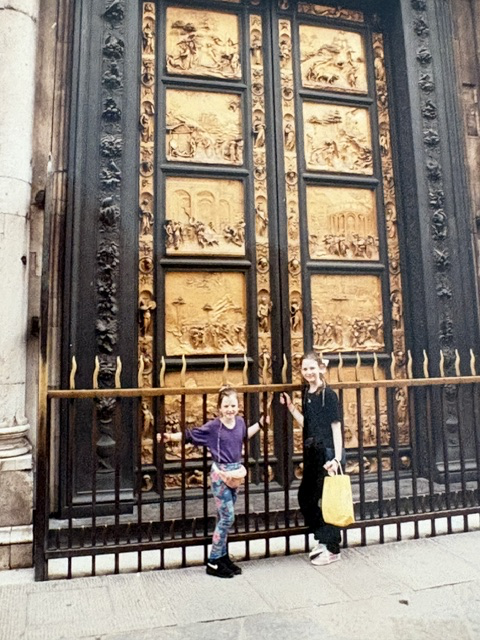
The Gates of Paradise
One of the highlights of our visit to Florence was seeing the magnificent bronze doors of the Baptistery of Saint John. As Emily and Erin stood before them, they were looking at one of the most celebrated masterpieces of the Italian Renaissance, a work that transformed bronze sculpture and influenced generations of artists. The east […]
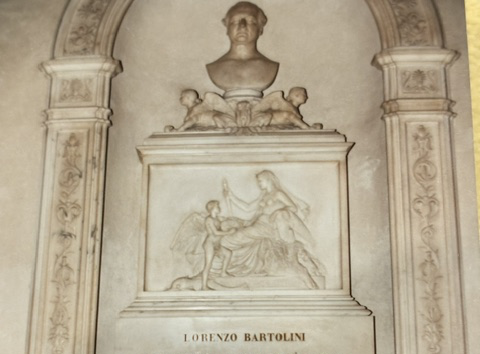
Memorial to Lorenzo Bartolini at the Basilica of Santa Croce
The Basilica of Santa Croce contains the tombs and memorials of many individuals who shaped Italian history and culture. Among them is the monument honoring Lorenzo Bartolini, one of the most important Italian sculptors of the nineteenth century. Bartolini was born near Prato in 1777 and studied at the Academy of Fine Arts in Florence […]
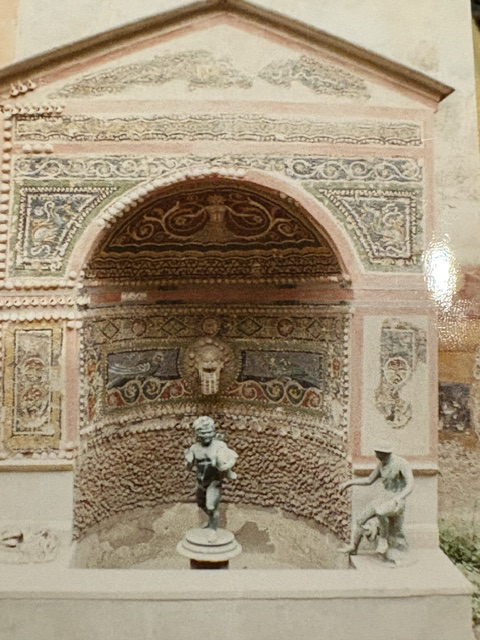
Mosaic Fountain at the House of the Small Fountain
The elaborate fountain at Pompeii’s House of the Small Fountain transformed an ordinary garden wall into a richly decorated water display. Constructed within an arched niche, it combined flowing water, colorful mosaics and small sculptures to create an artistic focal point within the private residence. The surface was decorated with glass tesserae, shells, pieces of […]

