Mary Cooke Thompson Gravestone
Among the artifacts at Pilgrim Hall Museum is this early New England gravestone for Mary Cooke Thompson, a woman with a direct connection to one of the Mayflower families. Mary was the daughter of Mayflower passenger Francis Cooke and his wife, Hester Mahieu.
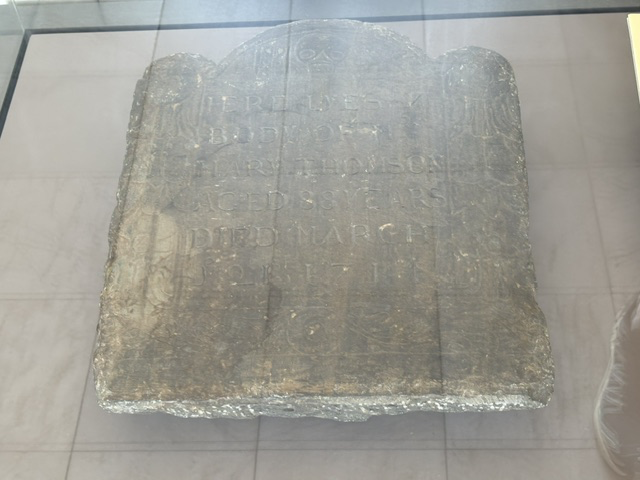
Mary was born in Leiden in the Netherlands, where the English Separatist community lived before the Mayflower voyage. Her father and brother John sailed for America aboard the Mayflower in 1620, while Mary remained behind with her mother and siblings. About three years later, the rest of the Cooke family crossed the Atlantic to join them in Plymouth.
The museum notes that Mary Cooke was among the first generation born into the Plymouth Colony families and that the first record of her appears in the 1627 division of land. On December 26, 1645, she married John Thompson in Plymouth. The couple eventually settled in Middleborough, where Mary lived into her late eighties. She died in 1714 at approximately 88 years old, having lived from the earliest years of Plymouth Colony into the 18th century.
But the story of her gravestone is almost as interesting as the woman it commemorates. The stone was not discovered standing over Mary’s grave. It was found beneath the timber-frame portion of an old house. At some point after the burial ground was no longer being maintained, her headstone had been removed and reused as building material.
That practice was apparently not unique. As the museum explains, old gravestones were sometimes repurposed by later generations for surprisingly practical uses including paving stones and even sewer covers. What had once marked an individual’s burial place could simply become a useful piece of stone.
Fortunately, Mary Cooke Thompson’s stone survived. Its inscription still gives us her name, her age, and the date of her death: March 21, 1714. More than three centuries later, this weathered piece of slate has become something its makers could never have anticipated, not simply a grave marker, but a surviving link to a woman whose family story stretched from Leiden to the Mayflower and then through nearly a century of life in colonial New England.
Read More From Nancy
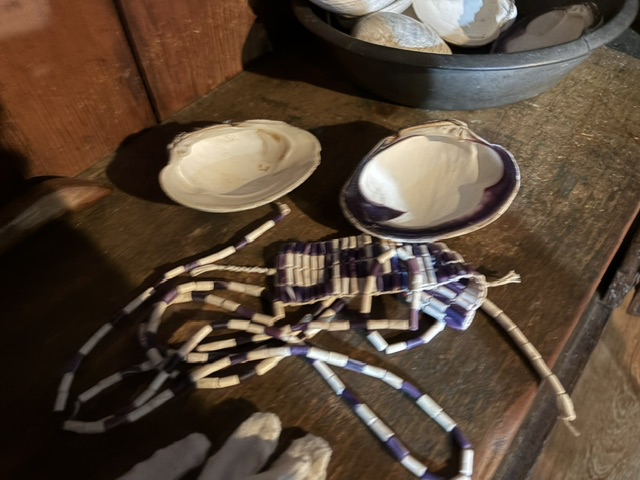
Wampum
Wampum consists of carefully shaped and polished beads traditionally made from shells found along the Atlantic coast. White beads were commonly fashioned from the inner spiral of the whelk shell, while purple beads came from the darker portion of the quahog shell. Because the purple section of the shell was limited, those beads were more […]
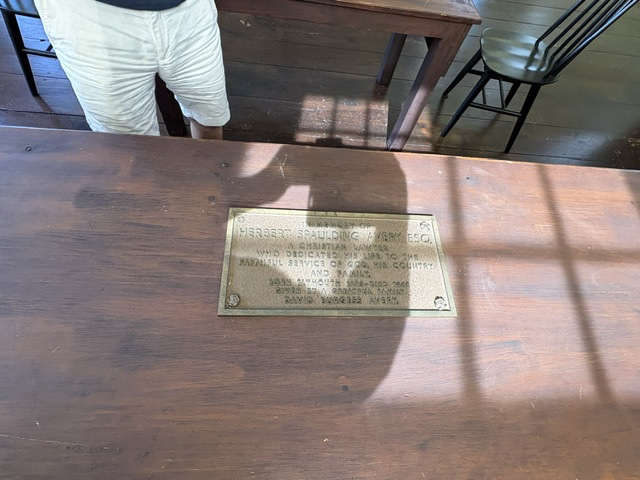
Mercy Otis Warren’s Table
Among the furnishings inside Plymouth’s 1749 Court House is this table associated with Mercy Otis Warren, one of the most remarkable women of Revolutionary-era Massachusetts. At first it appears to be simply another piece of old courtroom furniture, but the small brass plaque reveals its connection to a woman whose writing helped shape the political […]
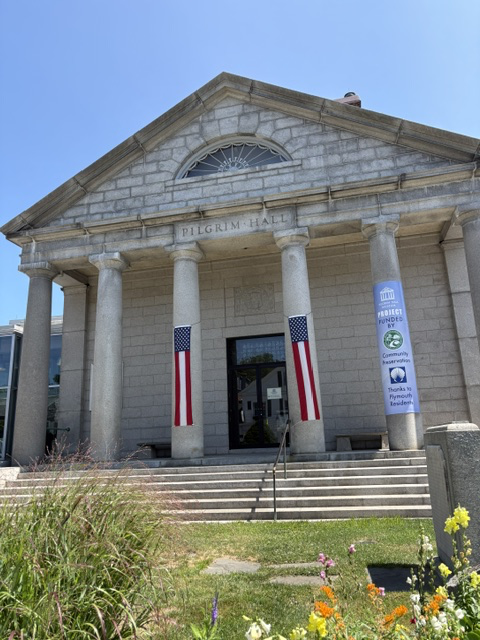
Pilgrim Hall Museum
Just a few blocks from the Plymouth waterfront stands Pilgrim Hall Museum, another place where the story of Plymouth becomes tangible. Founded by the Pilgrim Society in 1824 and opened the following year, it is the oldest continuously operating public museum in the United States. The imposing granite building was designed specifically to preserve the […]

