Franklin Savings Bank
Walking through downtown Greenfield, I was drawn to a granite building at the corner of Main and Federal Streets. Its tall arched windows, carefully framed entrance, and circular carvings gave it a distinctive presence among the neighboring storefronts. Learning that it had been a bank helped explain its substantial appearance. Looking more closely revealed an unexpected detail: those circular ornaments represented historic coins.
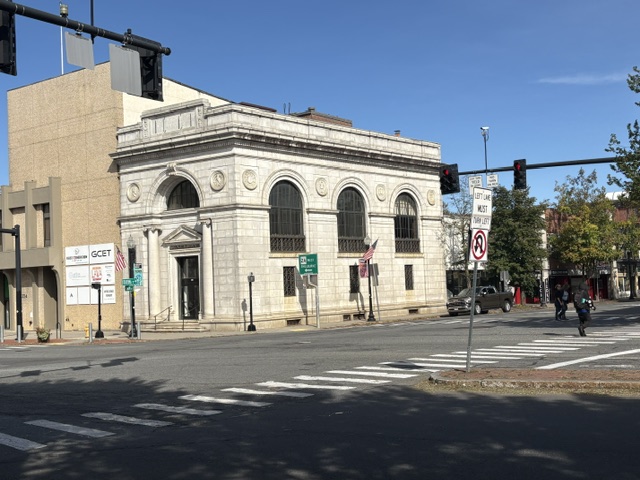
The building opened in 1911 as the home of the Franklin Savings Institution, which had been incorporated in 1834. By the time it moved into this granite headquarters, the institution had served the community for more than seventy-five years. Its new building expressed the importance and permanence that banks wanted their customers to associate with the safekeeping of their money.
That message was conveyed through both materials and design. The granite walls give the building a sense of weight, while the tall windows and carefully worked stone introduce elegance. At the entrance, Ionic columns and a classical pediment frame the doorway. The historic walking guide describes the architecture as Greek Revival modified by Victorian ideas, combining classical details with recessed arches and an elaborate projecting cornice.
Its most unusual features are the six hand-carved granite medallions depicting colonial coins. Two on the Federal Street side represent some of the earliest coins used in Massachusetts. These carvings connect the building’s purpose with the longer history of money in the colony and state. They also reward the pedestrian who takes time to look above the entrance and windows. A detail that might initially seem like ordinary ornament turns out to have a specific meaning.
The corner location allows the design to unfold along two streets. Large arched windows repeat across the walls, their dark glazing contrasting with the pale stone. Decorative bands and the cornice tie the façades together, giving the building a unified appearance from either direction. Its relatively modest size does little to diminish its presence; the craftsmanship makes it a landmark at the intersection.
What interested me most was how clearly the building communicates its original role. Even without knowing its name, the substantial stonework suggests an institution intended to inspire confidence. Once the carved coins are understood, the connection becomes more explicit.
Discoveries like this are part of what I enjoy about walking through an unfamiliar downtown. The larger history draws my attention, but it is often a small detail—a carving, an inscription, or an unusual window—that gives me a reason to learn more. Here, the story of a local savings institution remains written into the stone.
Read More From Nancy
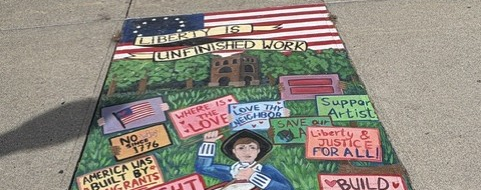
Liberty Is Unfinished Work
As I continued looking for Greenfield’s sidewalk murals, this one brought the past and present together in an unexpected way. A young Revolutionary War drummer stands among signs carrying messages familiar today: “Love Thy Neighbor,” “Support Artists,” “Build Kindness,” and “Liberty & Justice for All.” Above them, an American flag frames the words “Liberty Is […]
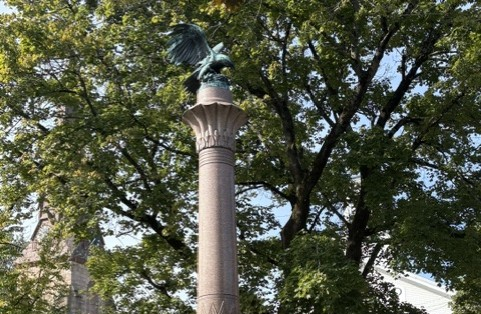
The Eagle Above the Common
Walking through downtown Greenfield, I noticed a tall reddish stone column rising above an iron fence, with a bronze eagle poised at its summit. Its height drew my attention first, but the sculpture above it held a story that was less obvious from the ground. This is Greenfield’s Soldiers’ Monument, dedicated to the town’s men […]
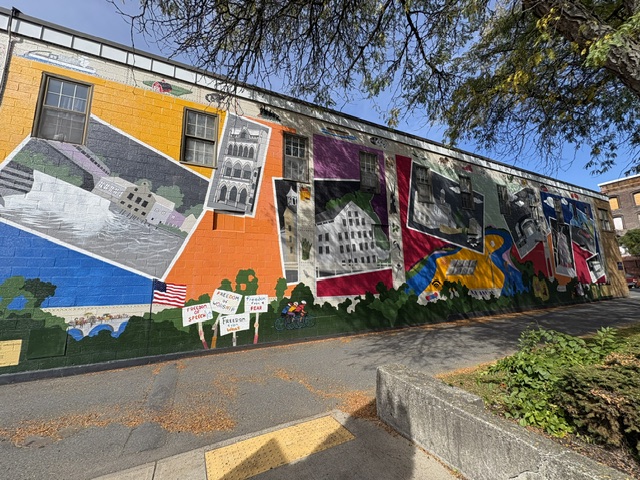
A Place for Remembrance
While walking through downtown Greenfield, I discovered a place where the activity of Main Street gives way to remembrance. Between the buildings, Veterans Mall brings together bronze sculpture, memorial plaques, benches, and a colorful mural. My curiosity drew me toward the details: the figures worked into the bronze, the names of local people who died […]

