A Place for Remembrance
While walking through downtown Greenfield, I discovered a place where the activity of Main Street gives way to remembrance. Between the buildings, Veterans Mall brings together bronze sculpture, memorial plaques, benches, and a colorful mural. My curiosity drew me toward the details: the figures worked into the bronze, the names of local people who died in war, and the community pictured along the neighboring wall.
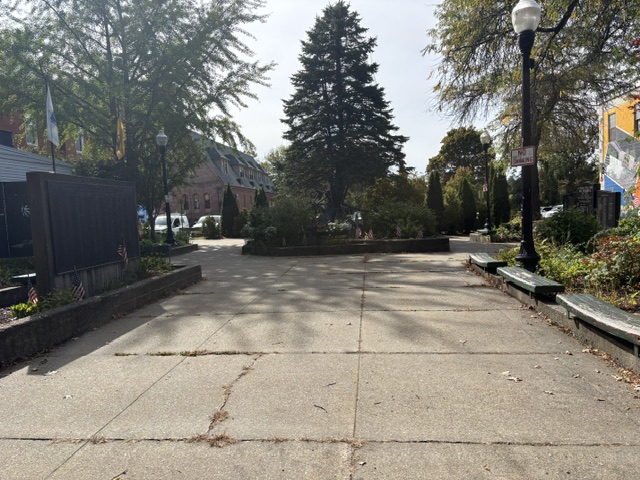
This small public space occupies ground that once served another important purpose in Greenfield’s life. Washington Hall, built in 1854, stood here for more than a century. It housed the town government and provided a gathering place for public events. After the building was demolished in 1964, the site became Veterans Memorial Mall, dedicated on November 11, 1965. A place where townspeople had gathered to conduct community business became a place to remember those who had served it.
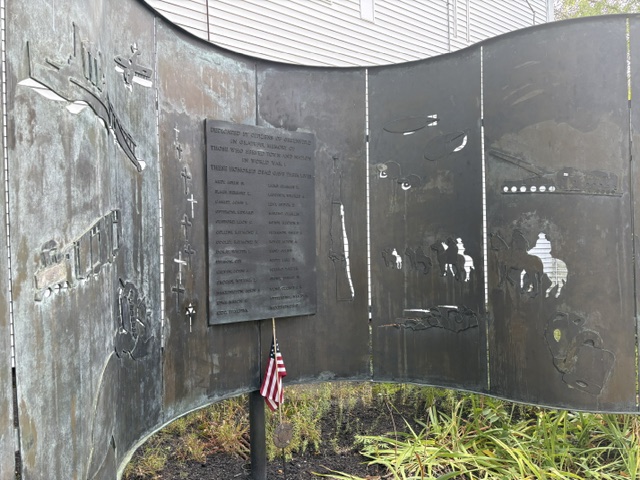
Greenfield sculptor Homer Gunn gave the memorial much of its distinctive character. His bronze Serpentine Wall curves through the space, its surface filled with figures and imagery associated with twentieth-century warfare. Soldiers, equipment, and the machinery of conflict form a sculptural backdrop to plaques naming Greenfield residents who lost their lives in World War I, World War II, Korea, and Vietnam. The names bring the broad history of these wars back to individual people and the families who knew them.
Gunn’s central sculpture introduces a different thought. Known as the Peace Symbol, it depicts an anvil with swords and spears being transformed into plowshares. Beside a wall recalling warfare, this ancient image expresses the hope that human effort can turn toward cultivation and rebuilding. Other plaques extend the memorial’s historical reach: one commemorates those who died in the Civil War, while the Gettysburg Address at the entrance recalls Lincoln’s appeal to the living to carry forward the unfinished work for which others had sacrificed their lives.
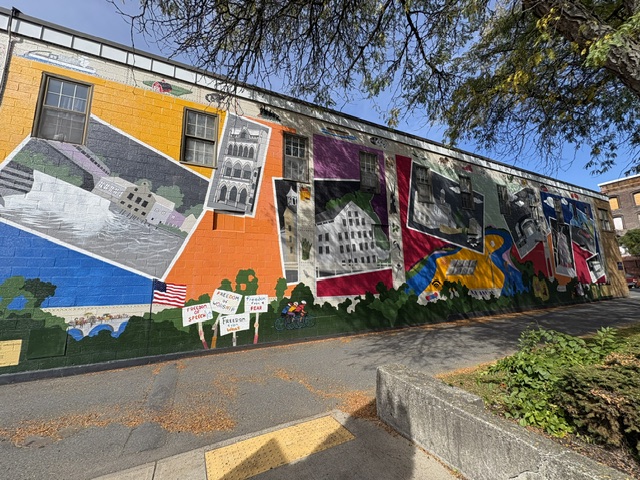
Alongside these memorials, a colorful mural celebrates Greenfield and the surrounding region. Buildings, a covered bridge, agricultural imagery, and scenes of community life fill the wall. Its presence gives the setting another dimension. Here are reminders of the homes, work, landscapes, and traditions that make a place familiar to the people who belong to it.
What interested me about Veterans Mall was how much history this small space holds. It preserves names, invites reflection through art, and stands on the site of an earlier gathering place. In the middle of an ordinary walk through town, it offers a reason to stop and consider how national events become part of a community’s own story.
Read More From Nancy
The Eagle Above the Common
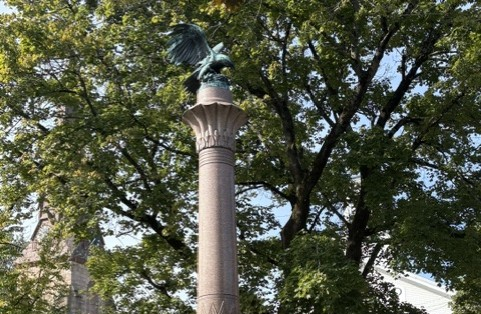
Walking through downtown Greenfield, I noticed a tall reddish stone column rising above an iron fence, with a bronze eagle poised at its summit. Its height drew my attention first, but the sculpture above it held a story that was less obvious from the ground. This is Greenfield’s Soldiers’ Monument, dedicated to the town’s men […]
The Leavitt-Hovey House
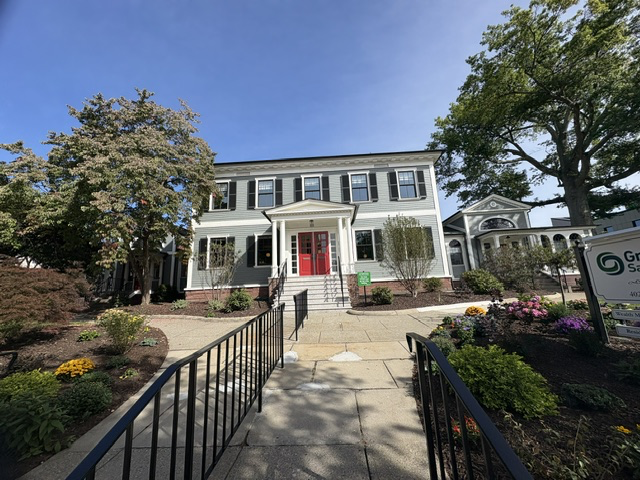
A sidewalk sign is always a reason to stop and explore. In Greenfield, one pointed me toward the Leavitt-Hovey House, a building whose story reaches back to 1797. Its white clapboards, dark shutters, and columned entrance caught my attention, but the name on the marker introduced something more: a connection to Asher Benjamin, an architect […]
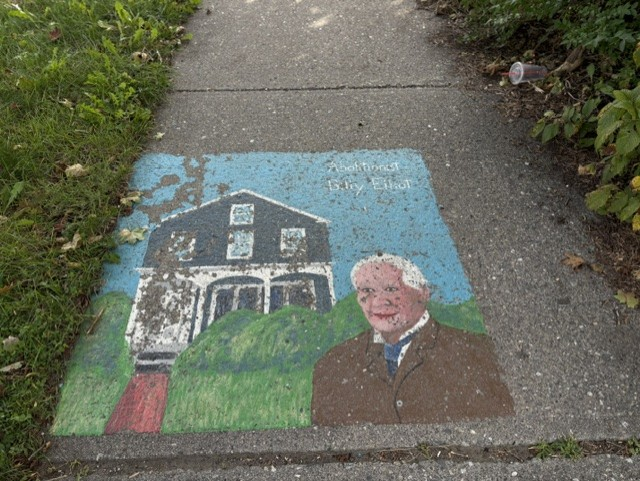
Billy Elliot’s House: A Place of Refuge
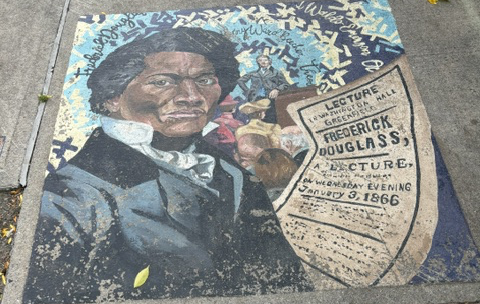
Following Greenfield’s sidewalk art led me to a portrait of a man standing before a house. The lettering identified him as abolitionist Billy Elliot. Here was another person whose name I had not known, but whose story connected an ordinary Main Street home with the struggle for freedom. Artist Robert Markey created this mural for […]

