Franklin County Courthouse
Walking along Main Street in Greenfield, I stopped to look at the Franklin County Courthouse. Its red brick walls and tall, pale columns gave it a commanding presence, but its most interesting story was how the community had preserved this historic building while adapting it to the demands of a modern justice system.
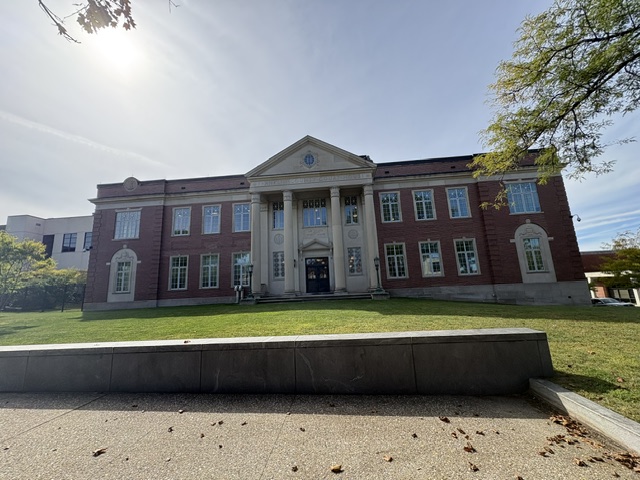
Built in 1931–1932, the courthouse was Greenfield’s third county courthouse. Franklin County had been established in 1811, with Greenfield chosen as its county seat. The first courthouse stood on Bank Row; its successor occupied the building that later became City Hall. Each reflected the town’s growing responsibility as a place where residents from surrounding communities came to conduct legal and public business.
The Main Street courthouse expressed that responsibility through Classical Revival architecture. Two-story Corinthian columns frame the entrance beneath a triangular pediment, while ornamental details and balanced rows of windows extend across the façade. These forms linked a twentieth-century public building with a much older architectural tradition associated with civic authority.
Its location carries another connection to Greenfield’s past. The courthouse occupies the site of the former Methodist Episcopal Church, where the Franklin County Anti-Slavery Society held its founding convention in December 1836. Delegates gathered there to organize opposition to slavery and racial prejudice. Long before this became a courthouse, the ground had been a meeting place for people debating freedom and the obligations of society.
Decades later, the courthouse faced a practical challenge: its original spaces could no longer adequately accommodate contemporary court operations. Rather than replace the historic building entirely, Massachusetts undertook a substantial renovation and expansion. Court services moved to temporary quarters in 2014, and the completed Franklin County Justice Center opened in 2017.
Designed by Leers Weinzapfel Associates, the project preserved the courthouse’s historic front while adding modern courtrooms and public spaces. The older building was carefully renovated and reorganized, creating a connection between the familiar Main Street landmark and a contemporary addition. The completed facility brought five court departments, the law library, and the Registry of Deeds together.
That combination gives the courthouse a story worth stopping for. Its significance reaches beyond its columns and brickwork: the site connects nineteenth-century anti-slavery organizing, twentieth-century civic architecture, and the continuing work of the courts. From the sidewalk, those layers are not immediately apparent. Learning about them made the building—and the ground beneath it—far more interesting to me.
Read More From Nancy
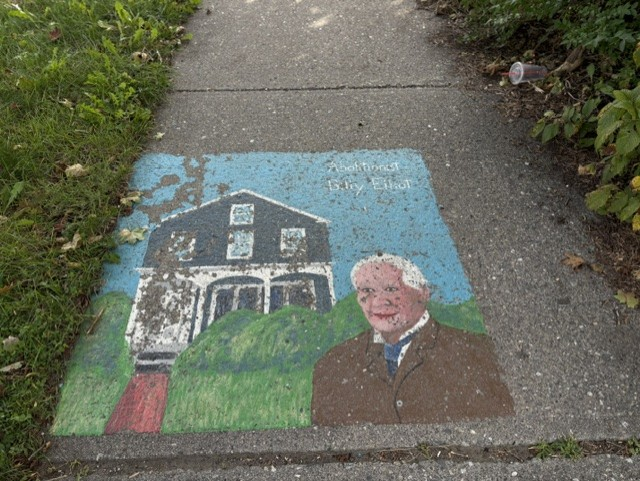
Billy Elliot’s House: A Place of Refuge
Following Greenfield’s sidewalk art led me to a portrait of a man standing before a house. The lettering identified him as abolitionist Billy Elliot. Here was another person whose name I had not known, but whose story connected an ordinary Main Street home with the struggle for freedom. Artist Robert Markey created this mural for […]
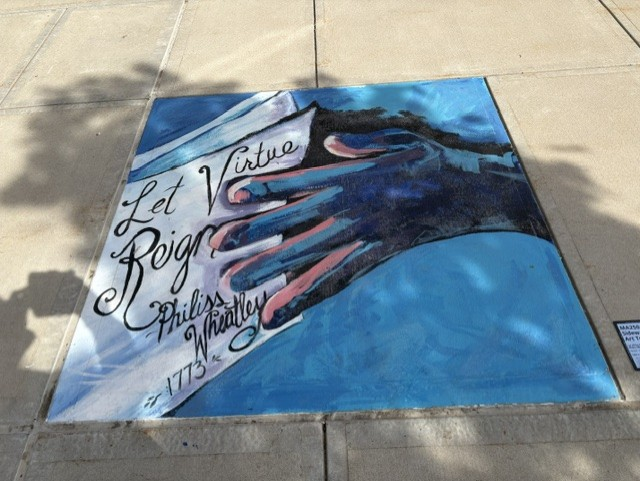
Let Virtue Reign: Two Women Who Claimed Freedom
Continuing my search for Greenfield’s sidewalk art, I found a mural with a dark hand resting across papers bearing the words “Let Virtue Reign” and the name Phillis Wheatley. Its simple arrangement brought together two remarkable women whose lives challenged the boundaries of freedom in Massachusetts. Created by artist Youme Nguyen Ly outside the Greenfield […]
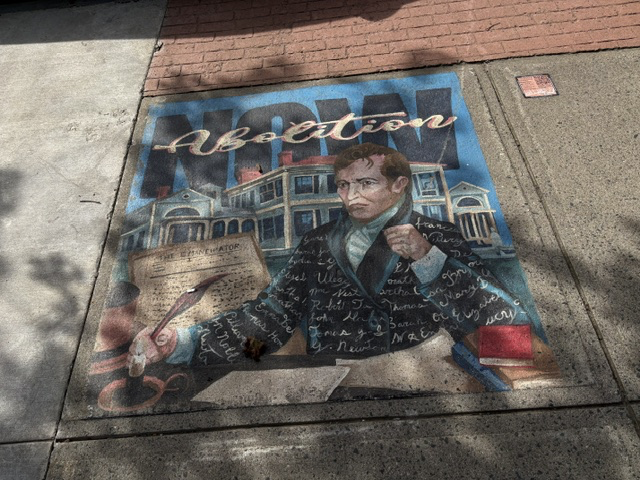
The Leavitt Family and the Fight Against Slavery
Continuing my search for Greenfield’s sidewalk art, I found a mural with the words “New Abolition” above a man writing with a quill. Behind him stood a familiar building: the Leavitt-Hovey House, which I had already stopped to learn about. A newspaper titled The Emancipator offered another clue. This artwork connected the house and the […]

