Liberty Is Unfinished Work
As I continued looking for Greenfield’s sidewalk murals, this one brought the past and present together in an unexpected way. A young Revolutionary War drummer stands among signs carrying messages familiar today: “Love Thy Neighbor,” “Support Artists,” “Build Kindness,” and “Liberty & Justice for All.” Above them, an American flag frames the words “Liberty Is Unfinished Work.”
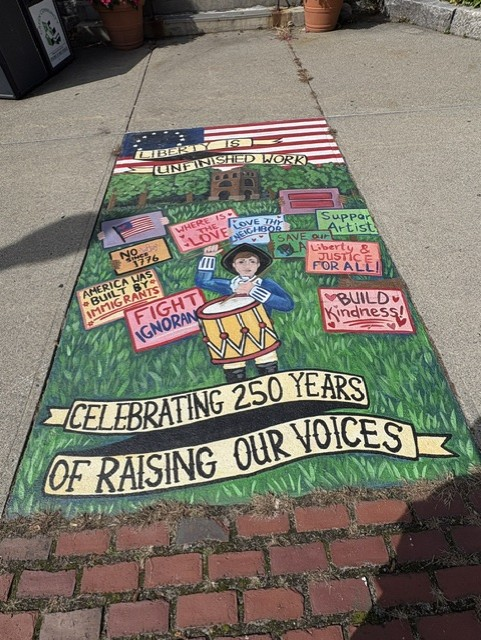
Artist Danielle Lucier created the mural outside City Hall at 14 Court Square for Greenfield’s MA250 Sidewalk Art Tour, commemorating the 250th anniversary of American independence. Her design places a figure from the Revolutionary era alongside contemporary expressions of civic participation. The wooded landscape and Poet’s Seat Tower anchor the scene in Greenfield.The drummer offers a connection to the practical work of the Revolution. Military drummers helped communicate orders before electronic communication existed. Particular drumbeats signaled soldiers to assemble, march, take up weapons, or begin and end their daily routines. Their sound helped turn a gathering of individuals into an organized force. Although familiar images often depict drummer boys, Revolutionary War musicians also included older teenagers and adult men
Here, the drum also suggests the act of making oneself heard. Around it, the painted signs address education, immigration, the environment, artistic expression, equality, and care for others. Their variety invites a broader reading of liberty—one that reaches into ordinary community life. These are my impressions of the scene, where the historical figure and present-day messages appear to share the same ground.
The Revolution established an independent nation, but the rights associated with that independence did not initially extend equally to everyone. Enslaved people remained in bondage, and women were largely excluded from formal political power. The Declaration of Independence’s assertion that “all men are created equal” became a principle that later generations would invoke when challenging those exclusions.
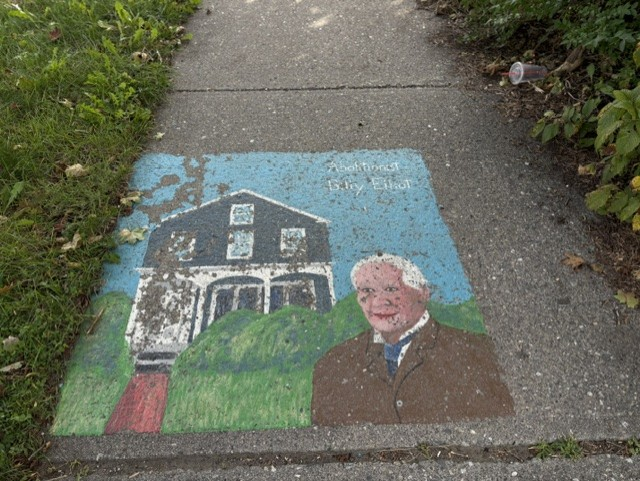
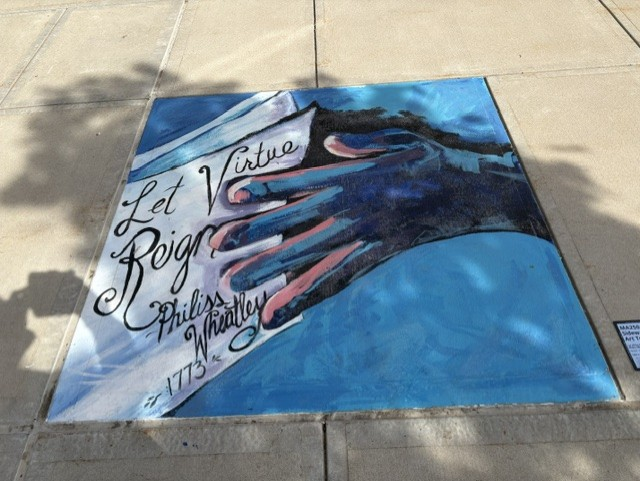
Greenfield’s other sidewalk murals tell some of those stories through abolitionists, writers, and people who sought their own freedom. This mural carries that conversation forward. Its lower banner, “Celebrating 250 Years of Raising Our Voices,” asks us to consider participation as something that continues across generations.
I stopped because of the color and the drummer, but the words gave me more to think about. Outside City Hall, where local decisions are made, the mural poses a useful question: what do we do with the freedoms we inherit? Its answer seems to begin with paying attention, caring about our neighbors, and taking part in the life of our community.
Read More From Nancy
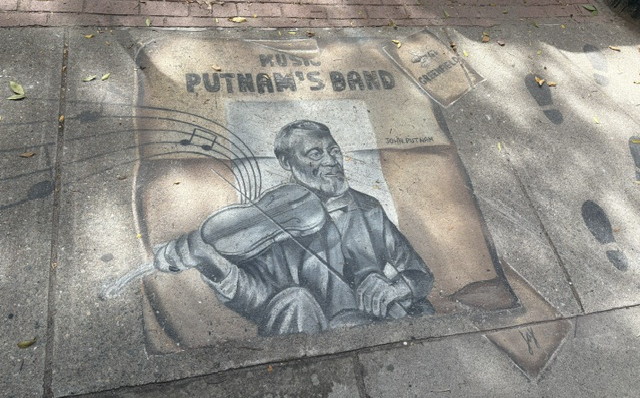
Music and the Road to Freedom
Once I knew Greenfield’s sidewalk art existed, I went looking for more. The next mural introduced me to John Putnam, shown holding a violin beneath the words “Putnam’s Band.” Musical notes curve through the artwork, inviting a closer look at a man whose story connects the town’s musical life with its history of resistance to […]
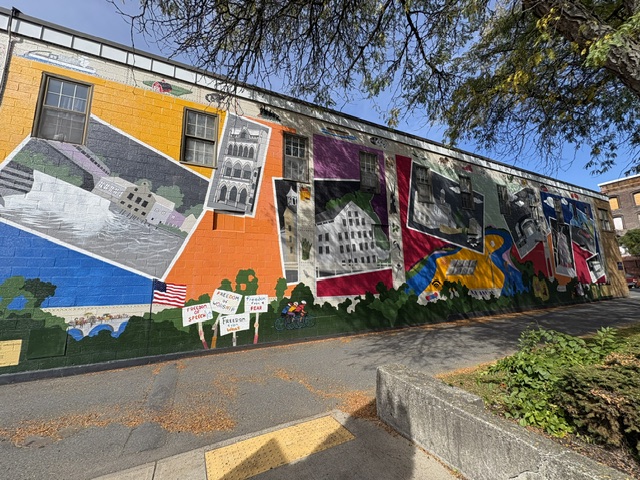
A Place for Remembrance
While walking through downtown Greenfield, I discovered a place where the activity of Main Street gives way to remembrance. Between the buildings, Veterans Mall brings together bronze sculpture, memorial plaques, benches, and a colorful mural. My curiosity drew me toward the details: the figures worked into the bronze, the names of local people who died […]
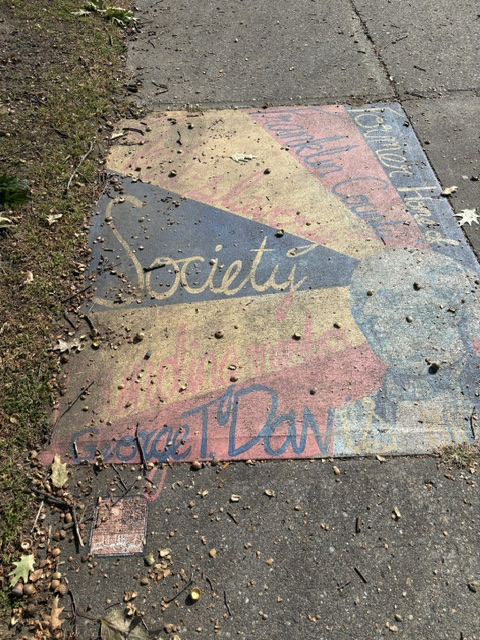
George T. Davis: Working for Freedom
Once I discovered Greenfield’s sidewalk art, I began looking for the next piece and the story it might reveal. This mural carried the name George T. Davis among colorful shapes and lettering referring to the anti-slavery movement. It introduced me to a man whose work connected Greenfield’s local history with the larger struggle to end […]

