Let Virtue Reign: Two Women Who Claimed Freedom
Continuing my search for Greenfield’s sidewalk art, I found a mural with a dark hand resting across papers bearing the words “Let Virtue Reign” and the name Phillis Wheatley. Its simple arrangement brought together two remarkable women whose lives challenged the boundaries of freedom in Massachusetts.
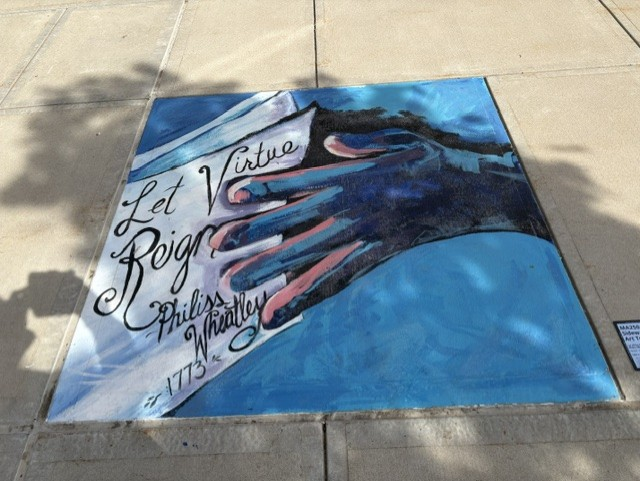
Created by artist Youme Nguyen Ly outside the Greenfield Public Library, the mural belongs to the city’s MA250 Sidewalk Art Tour. The hand represents Elizabeth Freeman, while the papers honor Wheatley. Together, they connect the written ideals of the Revolutionary era with women who insisted that freedom had meaning for them, too.
Phillis Wheatley arrived in Boston in 1761 as an enslaved child taken from West Africa. Purchased by John and Susanna Wheatley, she learned to read and write and pursued studies that included literature, history, Greek, and Latin. Her poetry attracted attention, but recognition came with extraordinary obstacles. Some readers refused to believe that a young enslaved Black woman could have written her poems. An examination by prominent Boston men produced an attestation of her authorship, which appeared in her first book.
In 1773, her collection, Poems on Various Subjects, Religious and Moral, was published in London. She became the first African American woman to publish a book of poetry and obtained her freedom shortly afterward. Her writing placed her within the public conversation about liberty at a time when many people discussing their own rights continued to enslave others
Elizabeth Freeman confronted that contradiction through the courts. Enslaved in the household of John Ashley in Sheffield, Massachusetts, she sought the assistance of attorney Theodore Sedgwick. The Massachusetts Constitution of 1780 declared that “all men are born free and equal.” Freeman challenged a system that denied her those rights.
In August 1781, she and another enslaved person, Brom, won their freedom in Brom and Bett v. Ashley. Their victory contributed to the legal decisions that established slavery’s incompatibility with the Massachusetts Constitution. Afterward, she took the name Elizabeth Freeman and built a life as a paid worker, healer, and midwife
The mural brings their different paths into one shared space: Wheatley’s command of language and Freeman’s determination to claim the protection of the law. Outside a library, where words and ideas remain available to anyone who enters, their stories have a fitting home. What began as another discovery along the sidewalk became a reminder that freedom advances through people willing to insist that its promises apply to their own lives.
Read More From Nancy
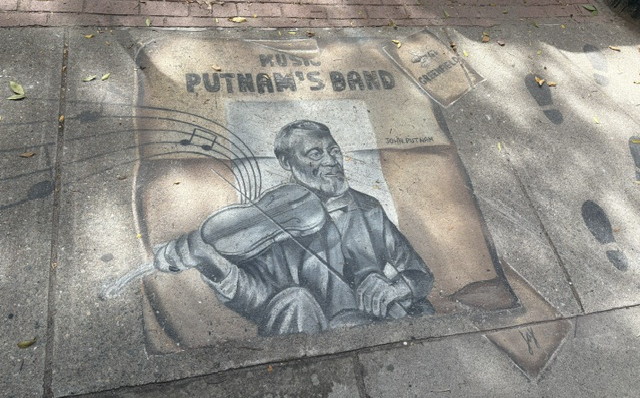
Music and the Road to Freedom
Once I knew Greenfield’s sidewalk art existed, I went looking for more. The next mural introduced me to John Putnam, shown holding a violin beneath the words “Putnam’s Band.” Musical notes curve through the artwork, inviting a closer look at a man whose story connects the town’s musical life with its history of resistance to […]
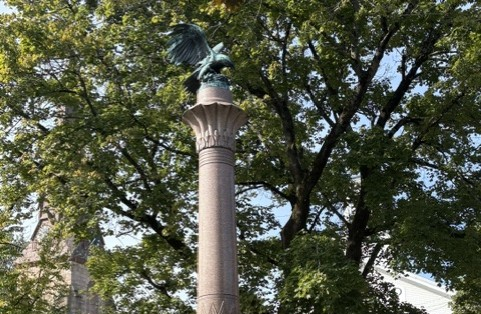
The Eagle Above the Common
Walking through downtown Greenfield, I noticed a tall reddish stone column rising above an iron fence, with a bronze eagle poised at its summit. Its height drew my attention first, but the sculpture above it held a story that was less obvious from the ground. This is Greenfield’s Soldiers’ Monument, dedicated to the town’s men […]
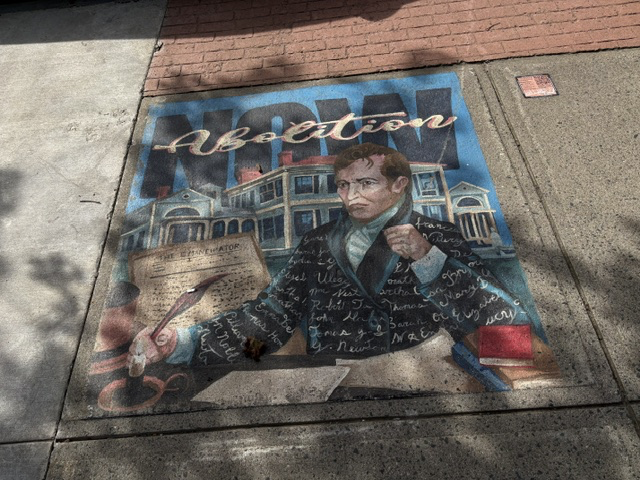
The Leavitt Family and the Fight Against Slavery
Continuing my search for Greenfield’s sidewalk art, I found a mural with the words “New Abolition” above a man writing with a quill. Behind him stood a familiar building: the Leavitt-Hovey House, which I had already stopped to learn about. A newspaper titled The Emancipator offered another clue. This artwork connected the house and the […]

