The Burial Hill Cannons
Near the summit of Burial Hill, a cannon and a series of bronze plaques mark the approximate location of Plymouth’s first fort. The settlers chose the hill because its height provided a broad view of the harbor and the settlement below. Their fort, completed in the early 1620s, had cannon mounted on its roof and also served as the community’s meetinghouse.
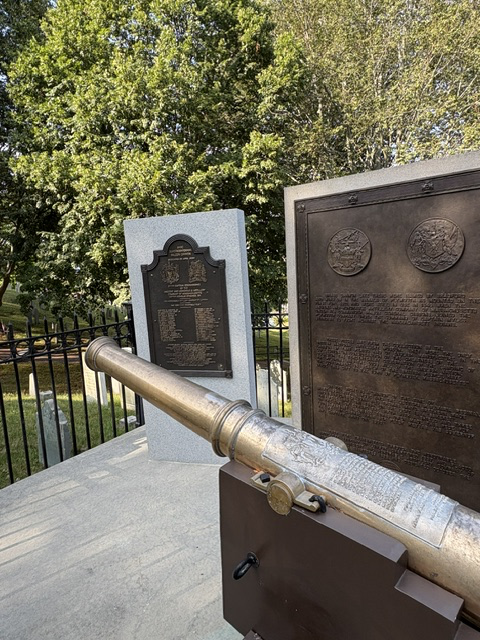
The memorial was created during Plymouth’s tercentenary celebration in 1921. Sponsored by the Ancient and Honorable Artillery Company of Massachusetts, it originally displayed two sixteenth-century English brass cannons presented to Plymouth by the British government. The gift was intended to commemorate the 300th anniversary of the colony and express the goodwill of the British people toward the United States.
The two weapons were considerably older than Plymouth Colony. One was a small cannon known as a minion, made in 1554 during the reign of Queen Mary I. The other, called a sakeret, was made in 1550 during the reign of Edward VI. Although neither cannon had been used at Plymouth, they were authentic English weapons from the period preceding the Mayflower voyage and resembled the type of artillery described in early accounts of the fort.
The plaques preserve the history of the fort, the cannons, and the organizations responsible for the memorial. After remaining outdoors for more than sixty years, the original cannons were removed in 1985 to protect them from further weathering. One was returned to Britain, while the other was placed in the collection of Pilgrim Hall Museum. The cannon now displayed at Burial Hill is a replica, installed in 2025 to restore the memorial’s connection to the fort that once stood on the hill.
The memorial links two very different moments in Plymouth’s history. It recalls the uncertainty faced by the small settlement in the 1620s, while also preserving the story of how that beginning was commemorated three centuries later through a gesture of friendship between Britain and the United States.
Read More From Nancy
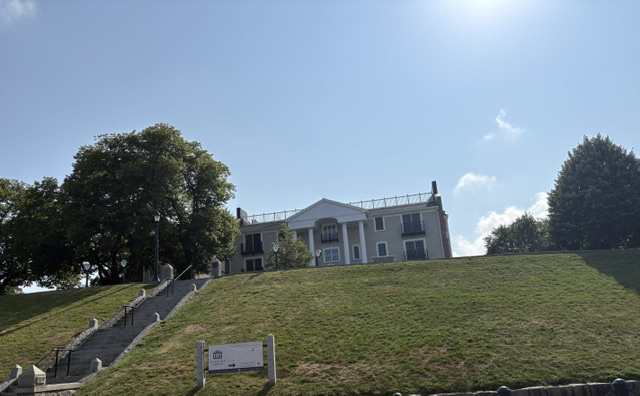
Cole’s Hill
Rising steeply above Plymouth’s waterfront, Cole’s Hill was the colony’s first burial ground. During the devastating winter of 1620–1621, nearly half of the Mayflower’s passengers died from disease, exposure, and the effects of their difficult voyage. Many were buried here in graves overlooking the harbor where their ship remained anchored. According to tradition, the settlers […]
The Eliot Bible
The 1685 Eliot Bible displayed at Pilgrim Hall Museum brings together the histories of religion, language, and printing in colonial Massachusetts. Printed in Cambridge by Samuel Green, it belongs to the second edition of a translation into the Massachusett language. The Reverend John Eliot undertook the project as part of his missionary work. His effort […]
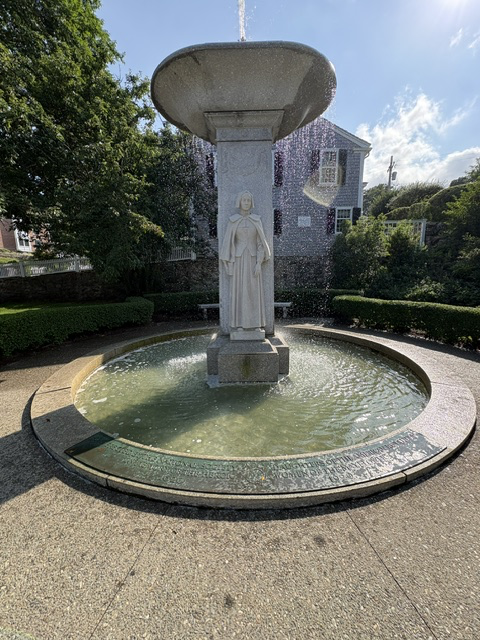
The Pilgrim Mother Fountain
Standing near Plymouth’s waterfront, the Pilgrim Mother Fountain honors the women who crossed the Atlantic aboard the Mayflower and helped establish Plymouth Colony. While the colony’s governors, ministers, and military leaders are frequently remembered by name, this monument turns attention toward the women whose courage and endurance were equally essential to the settlement’s survival. The […]

