Siena
While traveling in Italy, there was one town I particularly wanted to visit: Siena. My uncle had been the pastor of St. Catherine of Siena Parish, and because of that connection, the name Siena had been familiar to me long before I ever walked its streets. I wanted to see the place that had given St. Catherine her name and understand something of the world from which she came.
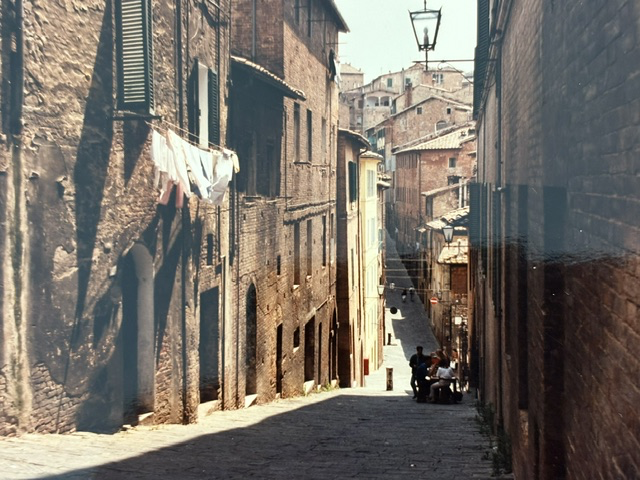
Siena is one of the great medieval cities of Tuscany. Unlike Florence, whose Renaissance identity often dominates our image of Tuscany, Siena still feels intensely medieval. Its narrow streets climb and descend the hills, passing between tall brick and stone buildings before unexpectedly opening into small squares and magnificent public spaces. This photograph captures some of that character: the steep street, old masonry walls, laundry hanging from a window and buildings seemingly piled one above another along the hillside.
Siena was also a rival of Florence. The two cities competed economically, politically and militarily for control of Tuscany. Siena achieved a celebrated victory over Florence at the Battle of Montaperti in 1260, but Florence eventually became the dominant power. Siena nevertheless developed its own extraordinary artistic tradition, particularly during the 13th and 14th centuries, producing painters such as Duccio and Simone Martini.
It was into this medieval Siena that Catherine Benincasa was born in 1347. One of a large family, Catherine became intensely religious while still young and eventually joined the Dominican Third Order. She never became a cloistered nun. Instead, she became increasingly involved in the world around her—caring for the sick and poor, corresponding with political and religious leaders, and becoming an influential voice within the Catholic Church.
Catherine lived during a turbulent period when the papacy had been based in Avignon, France, rather than Rome. She famously urged Pope Gregory XI to return the papacy to Rome, which he did in 1377. Her surviving letters reveal a woman of remarkable determination and influence at a time when few women had such a public voice. Catherine died in Rome in 1380 at only 33 years old. She was canonized in 1461 and later named a Doctor of the Church and one of the patron saints of Italy.
This visit was different for me. I wasn’t simply adding another beautiful Italian hill town to our travels. Because my uncle had served as pastor of a parish bearing Catherine of Siena’s name, I had a personal reason for wanting to understand who she was and where she came from.
And perhaps this ordinary street photograph captures Siena better than one of its grand monuments could. This was the landscape Catherine knew with steep streets, closely packed houses, churches and neighborhoods climbing over the hills. Visiting Siena allowed me to connect a familiar name from my own family history with the very real medieval city behind it.
Read More From Nancy
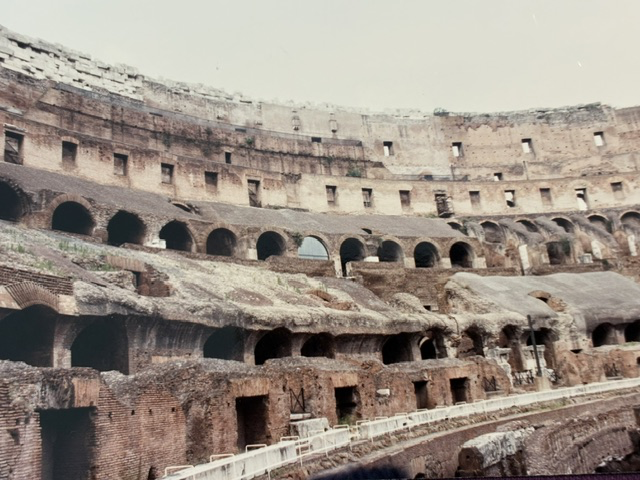
Inside the Colosseum
Touring the Colosseum was a high priority during our family trip to Italy. It was one of those historic places we had learned about long before we arrived in Rome, but entering the amphitheater allowed us to appreciate its enormous scale and understand how it once functioned. From inside, the remains of the seating levels […]
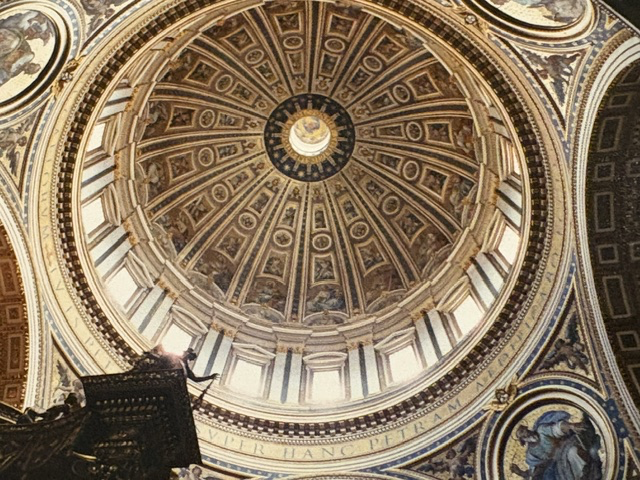
Dome of St. Peter’s Basilica
Looking upward inside St. Peter’s Basilica reveals one of the great architectural achievements of the Renaissance. The vast dome rises above the crossing of the church, directly over the papal altar and the traditional location of the tomb of Saint Peter. Michelangelo became the chief architect of St. Peter’s Basilica in 1546, when he was […]
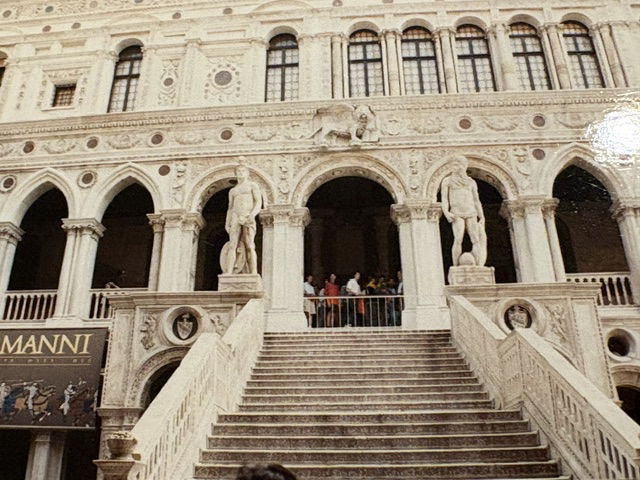
The Giants’ Staircase at the Doge’s Palace
The Giants’ Staircase stands within the courtyard of the Doge’s Palace, once the political and administrative center of the Republic of Venice. More than an entrance to the palace, the staircase formed part of a carefully designed ceremonial route leading from St. Mark’s Square into the heart of Venetian government. The staircase was designed by […]

