The Ether Dome
My first visit to Massachusetts General Hospital was for a consultation appointment. The hospital complex is enormous, a collection of buildings representing generations of growth and changes in medicine. Yet as I moved through the hospital, I kept noticing one building. Looking out from what seemed like almost every window was the magnificent Bulfinch Building, the original heart of Massachusetts General Hospital.
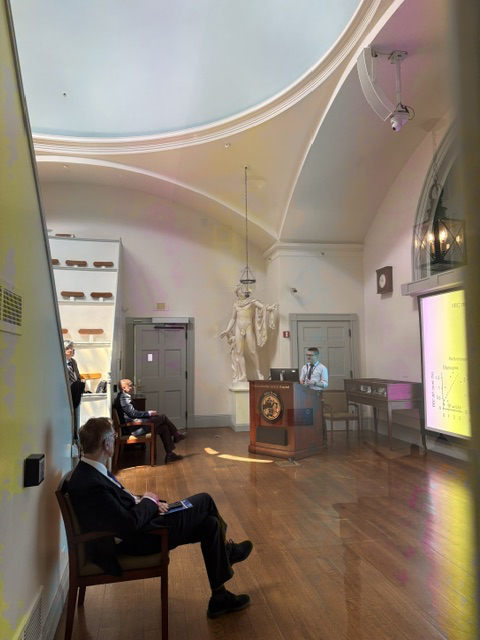
Designed by the prominent Boston architect Charles Bulfinch, the building opened with the hospital in 1821. Its classical façade and distinctive central dome now stand surrounded by a medical complex that would have been unimaginable when the first patients entered more than two centuries ago. I had heard about the Ether Dome and knew that it was somewhere inside that historic building. Since I was already at Mass General, I decided this was my opportunity to find it.
We made our way into the Bulfinch Building and climbed the old cement steps leading toward the surgical amphitheater beneath the dome. Unfortunately, when we arrived, a discussion was taking place inside, so we couldn’t enter. Instead, we stood outside the doorway and peered into the room where one of the great turning points in medical history occurred.
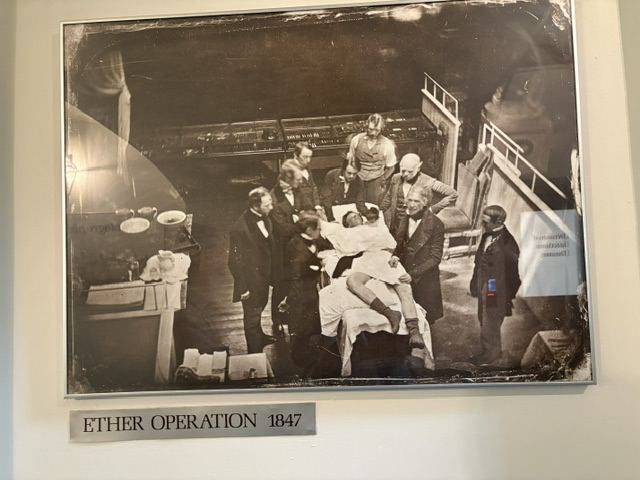
On October 16, 1846, this was the hospital’s operating theater. Boston dentist William T. G. Morton arrived to demonstrate the use of sulfuric ether to prevent surgical pain. The patient was Gilbert Abbott, who needed a tumor removed from his neck. Morton administered the ether, and surgeon Dr. John Collins Warren performed the operation before an audience of physicians and medical students.
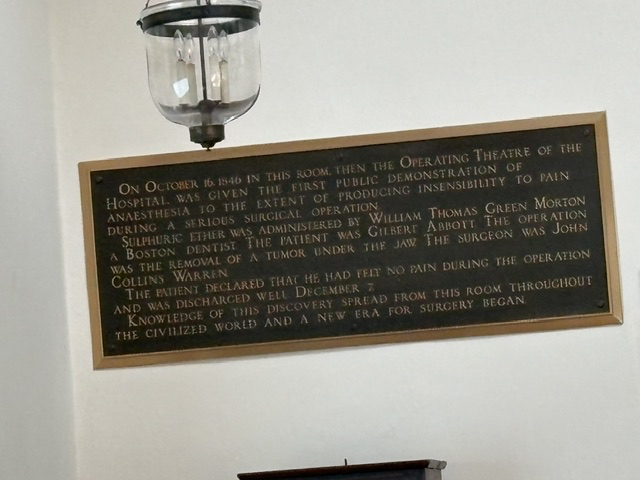
Until then, surgery and terrible pain were almost inseparable. Operations were performed as rapidly as possible while conscious patients endured the procedure. There had been previous experiments with anesthetic substances, but what happened at Massachusetts General that morning provided a highly visible and convincing public demonstration that ether could make surgery possible without the patient experiencing the same degree of pain.
After the operation, Warren reportedly turned toward those watching and declared, “Gentlemen, this is no humbug.”
The demonstration helped propel the use of surgical anesthesia around the world. There were other important figures in the development of anesthesia, and Morton’s claim to its discovery became the subject of considerable controversy. But the significance of what occurred in this room on October 16, 1846, remains undeniable. The operating theater eventually became known as the Ether Dome. Remarkably, it survives within the Bulfinch Building and remains part of Massachusetts General Hospital today.
We couldn’t walk into the Ether Dome that day. Instead, we stood at the entrance and looked inside while the discussion continued. In some ways, that was enough. Beyond that doorway was the room where physicians and students had gathered nearly 180 years earlier to witness something they could scarcely have imagined possible. I had come to the hospital for an appointment. Before leaving, I had also found the place where one of medicine’s most important chapters was written.


Read More From Nancy
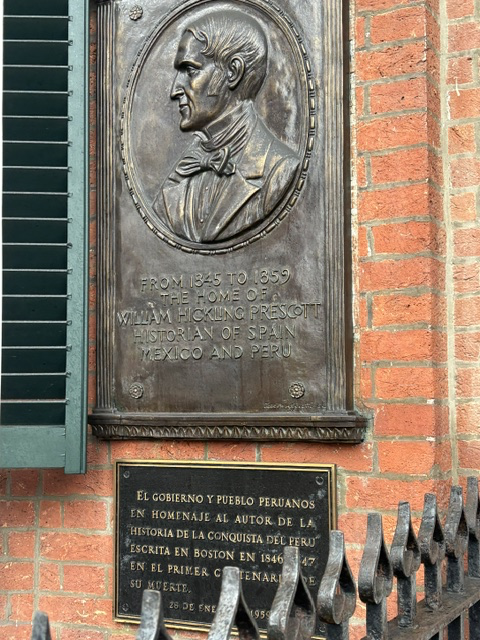
William Hickling Prescott
Walking through Boston’s Beacon Hill, it is easy to admire the elegant brick homes and historic streets without realizing how many remarkable people once lived behind these doors. One of those homes belonged to William Hickling Prescott, one of the nineteenth century’s most celebrated American historians. From 1845 until his death in 1859, Prescott lived […]
The Liberator Site
I had just stepped away from the busy Freedom Trail, when I came across the bronze plaque on a quiet Boston street. It read: “The Liberator Site – Boston uncompromising anti-slavery paper. The Liberator was founded on this site in 1831 by William Lloyd Garrison…..“ Standing at this spot, I realized that this was the birthplace […]
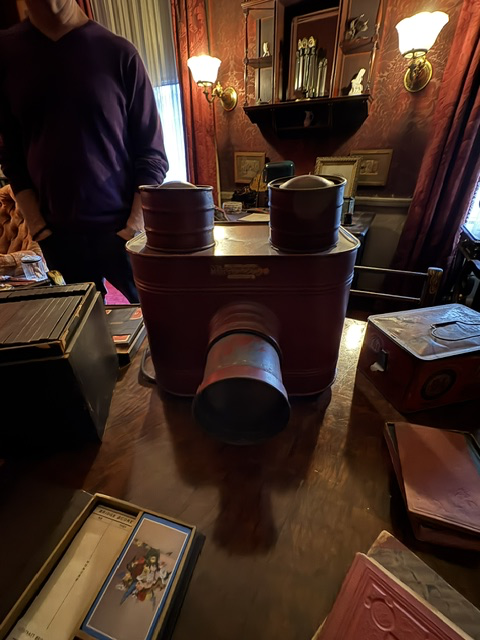
The Mirroscope
Among the objects that caught my attention while visiting the Gibson House Museum in Boston was this unusual piece of photographic equipment. At first glance, with its large projecting lens and boxlike body, I assumed it was an early camera. Looking more closely, however, I discovered that it worked in exactly the opposite direction. It […]

