Al Capp and Li’l Abner
Walking through the old mill area in downtown Amesbury, I came across this enormous comic strip painted directly onto the brick wall beneath the archway. It honors cartoonist Al Capp and the remarkable career he built while making Amesbury his home.
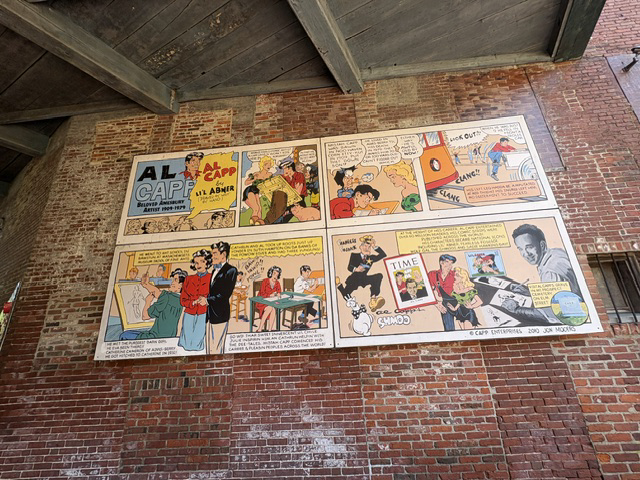
Al Capp was born Alfred Gerald Caplin in New Haven, Connecticut, in 1909. He became one of America’s best-known cartoonists through Li’l Abner, the comic strip he created in 1934. Set in the fictional Appalachian community of Dogpatch, the strip used its colorful characters to satirize American politics, popular culture, social customs, and human behavior. At the height of its popularity, Li’l Abner appeared in more than 900 newspapers and reached tens of millions of readers.
Amesbury became an important part of Capp’s life through his wife, Catherine Wingate Cameron, whose family was from the town. Capp lived and worked in Amesbury for decades, drawing his famous characters from studio space overlooking Market Square. He and Catherine remained closely associated with the community, and both are buried in Amesbury’s Mount Prospect Cemetery.
One of Capp’s most enduring creations was not actually a character at all. In Li’l Abner he invented “Sadie Hawkins Day,” when the unmarried women of Dogpatch pursued the bachelors. The fictional event escaped the pages of the comic strip and became a real American social tradition, inspiring Sadie Hawkins dances at schools and colleges around the country.
Capp continued with Li’l Abner until 1977, producing the strip for more than four decades. His work earned him the National Cartoonists Society’s Reuben Award as Cartoonist of the Year in 1947, and Li’l Abner became one of the defining American comic strips of the twentieth century.
Amesbury created this mural to preserve that connection. Painted by local artist Jon P. Mooers, it was unveiled in 2010 as part of the community’s commemoration of Capp’s centennial. The mural is deliberately designed like an oversized comic strip. Its panels combine Capp’s characters with scenes and words telling the story of his life, his career, and his relationship with Amesbury.
The location is particularly appropriate. This former industrial area along the Powwow River has been transformed into a public gathering space known as the Al Capp Amphitheater. Today concerts, community programs, fitness classes, and other events are held here, surrounded by the brick walls and remnants of Amesbury’s industrial past.
There is an interesting layering of Amesbury history in this photograph. The old brick walls remind us of the mills and industries that once defined the town, while the enormous comic strip remembers a completely different chapter of Amesbury’s story, a nationally famous cartoonist sitting in his studio overlooking the same downtown and creating characters that millions of Americans would recognize.
Today, walking beneath this old industrial archway, we encounter both stories at once. The mills may be gone and Li’l Abner no longer appears in the daily newspaper, but Amesbury has found a creative way to keep Al Capp and his connection to the town visible in the very landscape where he lived and worked.
Read More From Nancy
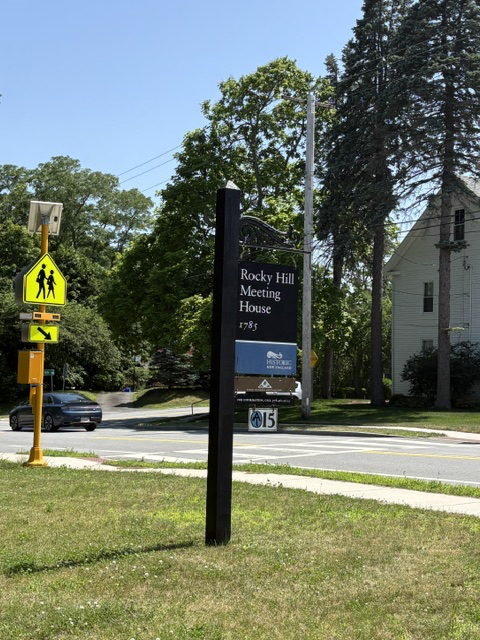
Rocky Hill Meeting House
Driving through Amesbury, it would be easy to pass the Rocky Hill Meeting House without realizing how special it is. Standing on a rise above the road, this simple white building has been part of the landscape since the eighteenth century and remains one of the best-preserved early meeting houses in New England. Built in […]
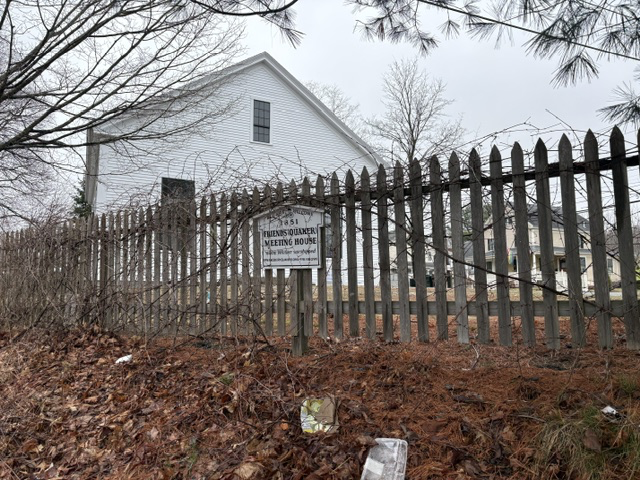
Quaker Meeting House
This is the old Friends Quaker Meeting House in Amesbury, closely connected to the life of ohn Greenleaf Whittier and the Quaker traditions that shaped both his beliefs and his writing. Whittier was raised in a Quaker family, and the values of the Society of Friends remained central to his life. The Quakers emphasized simplicity, equality, peace, personal […]
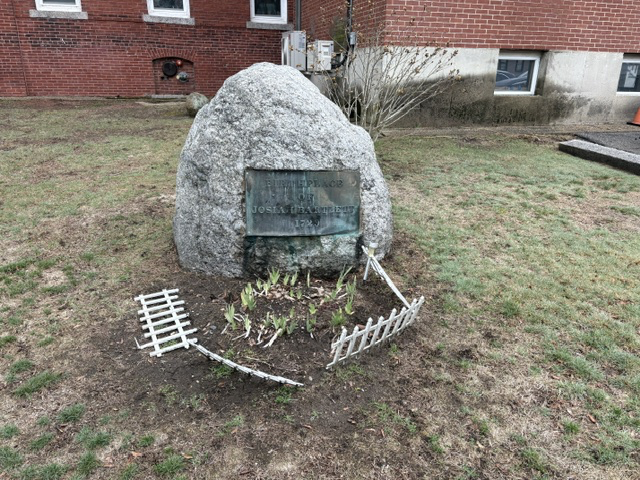
Birthplace of Josiah Bartlett
In the center of Amesbury is the large statue of Josiah Bartlett, and even though he went on to live in other towns and states, this town has the distinction of being the place of his birth. Though his birth house is no longer here, there is this small stone memorial that grounds him to this […]

