Amesbury Carriage Museum
Every town has a story that shaped its identity. For Amesbury, that story was built on wheels.
Long before automobiles transformed the American landscape, Amesbury was recognized around the world as one of the finest centers of carriage manufacturing. During the nineteenth century, the city’s factories produced elegant coaches, family wagons, commercial vehicles, and luxury carriages that earned an international reputation for their quality and craftsmanship. By the late 1800s, thousands of skilled workers were employed in the trade, and carriage building had become the economic heart of the community.
Today, that remarkable story is preserved at the Amesbury Carriage Museum. Rather than filling the galleries with dozens of vehicles, the museum uses two carefully selected carriages to tell the story of an industry that once made Amesbury famous.
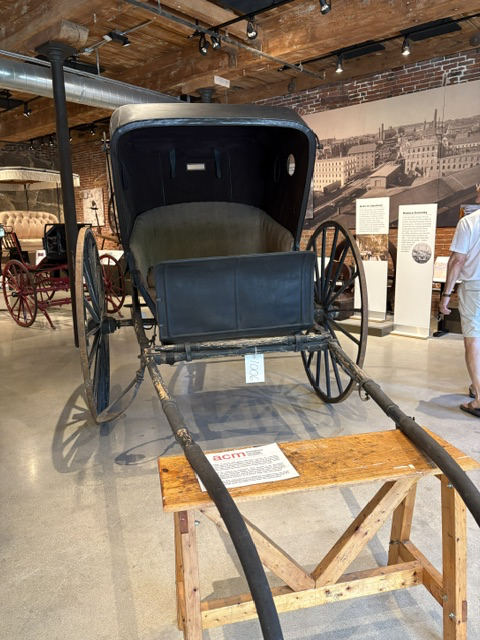
One of the featured vehicles is an Amesbury carriage built around 1900. Its graceful proportions and meticulous craftsmanship reflect the high standards that distinguished the city’s manufacturers. Every element, from the carefully shaped wooden body to the forged iron hardware and finely balanced wheels, demonstrates the work of skilled craftsmen. A carriage like this was never the product of a single artisan. It represented the combined talents of woodworkers, blacksmiths, wheelwrights, painters, upholsterers, and harness makers, each contributing their expertise to create a finished vehicle that was both functional and beautiful.
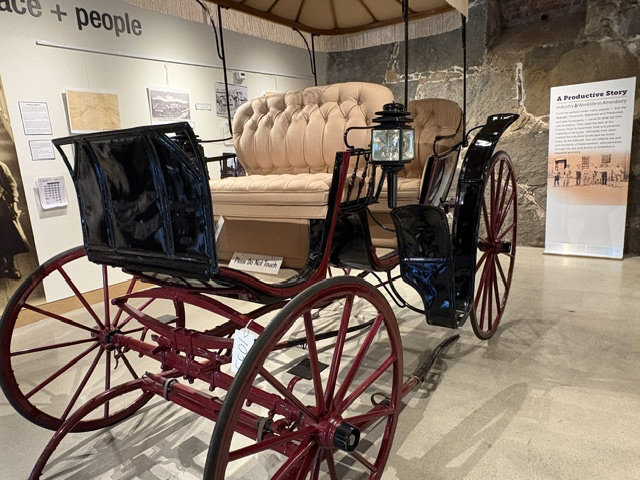
The museum also displays a Bird & Scofield Beach Wagon, one of the most recognizable products of one of Amesbury’s leading carriage manufacturers. Built around 1900, this elegant vehicle was designed for comfortable family outings and leisurely drives. At the turn of the twentieth century, owning a carriage like this was both a practical necessity and a symbol of prosperity. Bird & Scofield became one of the city’s most successful companies, producing a wide variety of vehicles that were shipped throughout the country.
Like so many American industries, however, Amesbury’s success was eventually overtaken by innovation. As the automobile gained popularity during the early twentieth century, the demand for horse-drawn vehicles declined rapidly. Some carriage companies adapted by manufacturing automobile bodies and components, while many others closed their doors. Within a remarkably short period, an industry that had defined Amesbury for generations became part of history.
What makes this museum so compelling is that it tells a much larger story through just two artifacts. These carriages are not famous because they carried presidents or appeared in historic events. They are important because they represent the extraordinary skill of ordinary craftsmen whose work helped build an industry that placed Amesbury on the world stage.
Today, only a few reminders remain of the bustling carriage factories that once lined Amesbury’s streets. Yet these two beautifully preserved vehicles continue to tell the story of a city that helped move America long before the automobile ever took the wheel.

Read More From Nancy

Glass Museum
In December 2020, I was searching for something meaningful to do for my birthday. COVID-19 had brought much of the MetroWest Boston area to a standstill, and nearly everything was closed. After months of restrictions and canceled plans, even a simple day trip felt like a welcome escape. When I learned that the Sandwich Glass […]
The Concord School of Philosophy
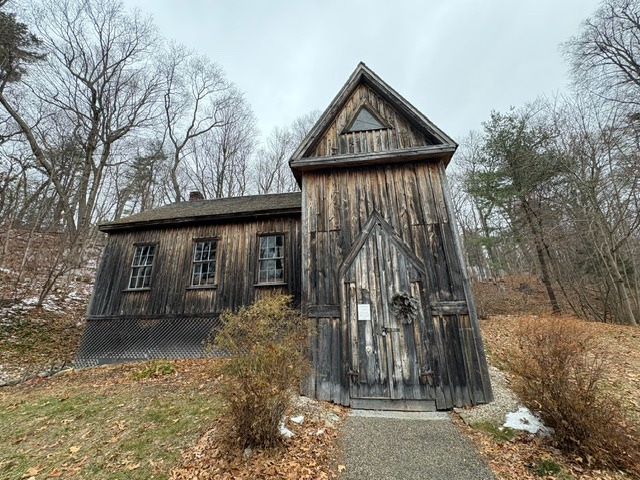
Beside Orchard House stands a small wooden building that preserves another chapter of the Alcott family’s history. Known as Hillside Chapel, it was built for the Concord School of Philosophy, a gathering devoted to the discussion of ideas. While Orchard House is closely associated with Louisa May Alcott’s writing, the school reflects the educational ambitions […]

Heritage Museums & Gardens
One of the things I enjoy about exploring museums is discovering that the museum itself often has a story that is just as interesting as the collections inside. Heritage Museums & Gardens in Sandwich is a perfect example. Spread across 100 acres, it brings together Cape Cod history, gardens, art, automobiles and the stories of […]

