1884 Coal Range
Installed in 1884, the Gibson House kitchen range was manufactured by the Smith & Anthony Stove Company of Boston. Its cast-iron front bears the name “Hub”, a fitting designation for a Boston-made appliance. The date cast into the front reads 1881; the museum records its installation three years later, distinguishing the stove’s marked date from its arrival in the household.
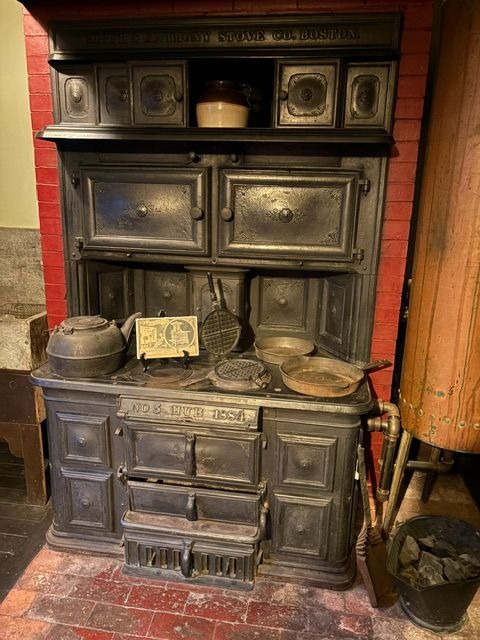
The range burned coal and provided five cooking surfaces. It remained lit throughout much of the day, supplying heat for preparing meals and heating water for use around the house. The museum notes that it likely continued in service well into the twentieth century. This was a substantial piece of household equipment whose usefulness extended far beyond the preparation of dinner.
Operating it required attention to the fire, fuel, and airflow. Rather than selecting a temperature with a dial, the cook managed the heat and positioned cookware accordingly. Maintaining the household’s fires was shared work: the museum identifies the cook, chambermaids, and man-of-all-work as participants in keeping them supplied and burning.
A waffle iron occupies one of the cooking surfaces. The museum singles it out as an example of the specialized kitchen gadgets popular during the Victorian period. Its hinged plates allowed batter to cook against the hot iron, bringing a familiar food into a kitchen whose source of heat required considerably more labor than a modern stove.
The range’s survival makes it especially valuable to the history of the Gibson House. It preserves the actual equipment around which the cook organized the working day. Its doors, cooking plates, and firebox give a concrete sense of the skill and physical effort behind the meals and hot water that sustained life throughout the house.
Read More From Nancy
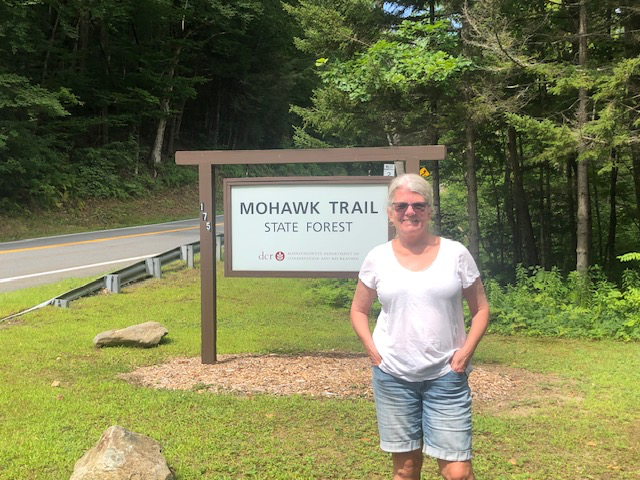
Mohawk Trail State Forest
While driving the Mohawk Trail across Massachusetts, we stopped at Mohawk Trail State Forest. The forest was not our final destination, but it offered us an opportunity to pause within the landscape through which this historic route passes. Long before automobiles crossed the Berkshire Hills, Indigenous peoples traveled through this region along pathways connecting the […]
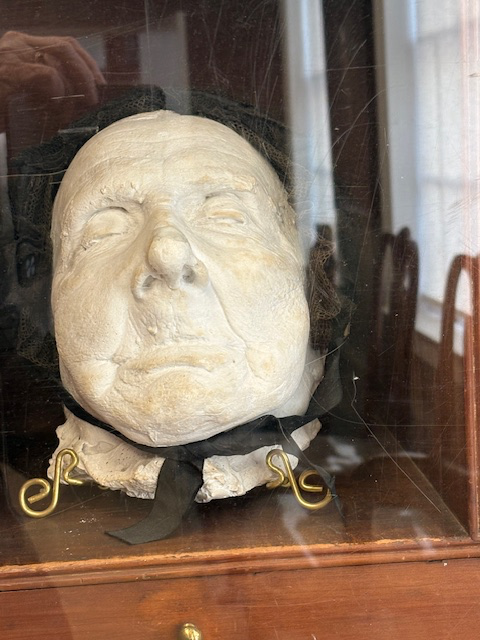
Death Mask
In the Dedham History Museum, is this death mask. An intimate impression of a person’s face taken shortly after death. The practice of creating death masks has a long history. In ancient Egypt, masks were place with the dead, though they were often idealized. In ancient Rome, families preserved wax masks of ancestors as a way to honor lineage […]
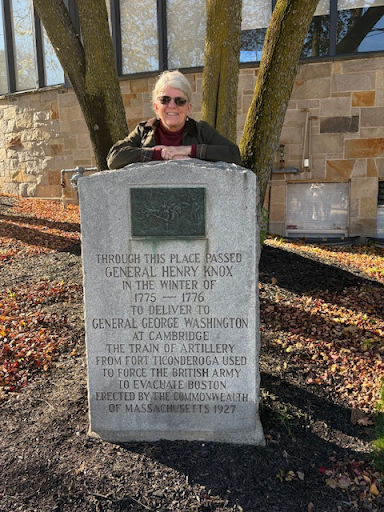
Henry Knox in Framingham
In Framingham, Massachusetts, there stands a granite block bearing an inscription that is easy to pass by without a second glance. Yet the words carved into this stone marks one of the most daring feats of the American Revolution: “Through this place passed Henry Knox in the winter of 1775–1776 to deliver to General George Washington […]

