Henry Knox in Framingham
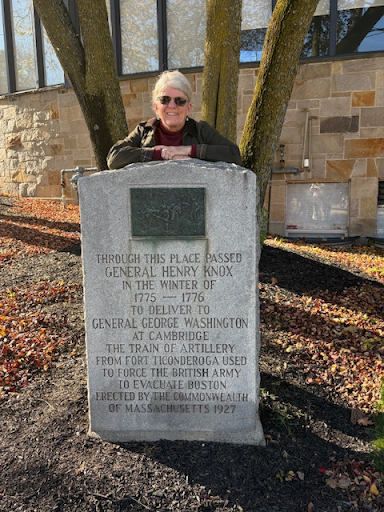
In Framingham, Massachusetts, there stands a granite block bearing an inscription that is easy to pass by without a second glance. Yet the words carved into this stone marks one of the most daring feats of the American Revolution:
“Through this place passed Henry Knox in the winter of 1775–1776 to deliver to General George Washington at Cambridge the train of artillery from Fort Ticonderoga used to force the British army to evacuate Boston.” Erected 1927.
This marker commemorates a moment when the outcome of the Revolutionary Was hung in the balance,
In the winter of 1775, George Washington had taken command of the Continental Army, but his forces were poorly supplied. British troops occupied the city with warships in the Boston harbor and fortified positions in the surrounding heights. Washington knew that he needed heavy artillery
Henry Knox was a 25-year-old bookseller by trade and self-taught in military science. He proposed a plan to retrieve the heavy cannons captured at Fort Ticonderoga, nearly 300 miles away. He would transport them to Cambridge in the dead of Winter. Washington approved this plan and Knox set out on what became known as the “Noble Train of Artillery.”
The journey began in late 1775 and stretched into 1776. Using oxen and sleds, Knox transported 59 cannons and mortars weighing more than two tons. The route wound through upstate New York, across the Berkshires and into eastern Massachusetts through Framingham.
When the cannons arrived in Cambridge, Washington, under cover of night in March 1776, hauled the artillery onto Dorchester Heights When the British saw the American cannons trained on their ships in the harbor, the balance of power shifted. Within weeks, the British evacuated Boston without a major battle.
This achievement forced the first major British withdrawal of the war and secured New England for the patriot cause. Know would go on to become the nation’s first Secretary of War.
This granite marker erected in 1927 serves to remind us that history happens not where we expect, but along the way.
Read More From Nancy
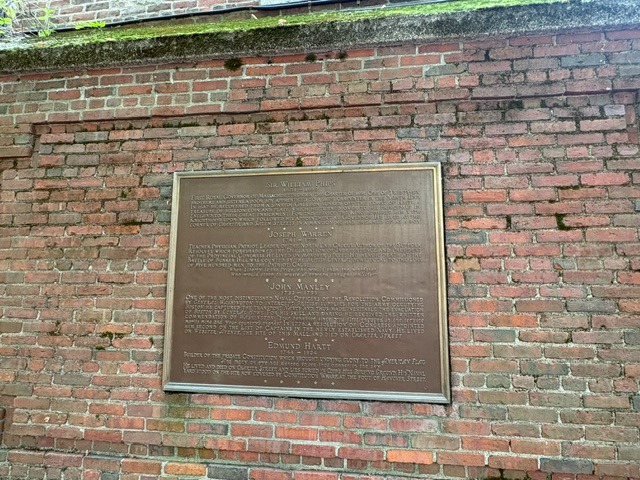
Dr. Joseph Warren
Among the memorial plaques along Paul Revere Mall is one honoring Dr. Joseph Warren, a physician whose work placed him at the center of Boston’s growing resistance to British rule. His name may be less familiar than those of Paul Revere or Samuel Adams, but his leadership helped shape the events that brought Massachusetts into […]
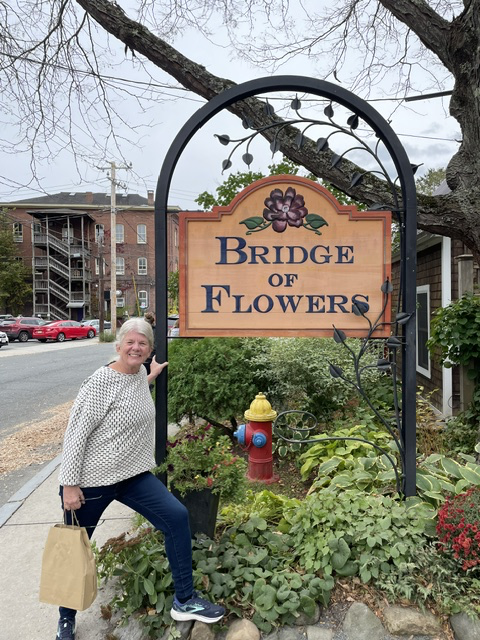
Bridge of Flowers
Some places are created to solve practical problems. Others become places that simply make people smile. The Bridge of Flowers in Shelburne Falls manages to do both. The bridge was originally built in 1908 as the Deerfield River trolley bridge, carrying electric streetcars between Shelburne and Buckland. For years it served as an important transportation link, […]
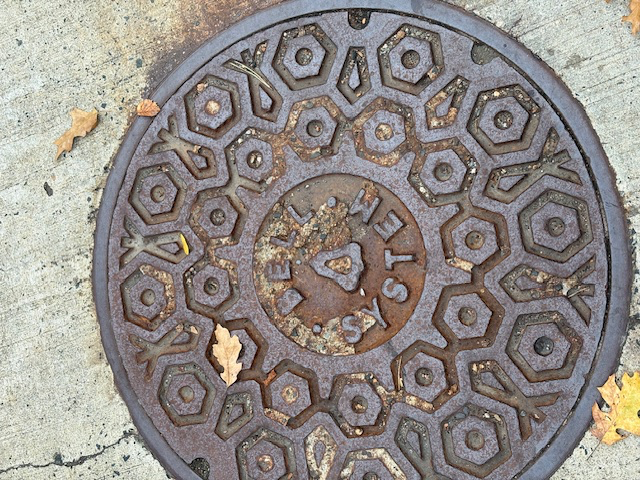
Bell System Icon
Walking through Wellesley, with my eyes turned to the ground, I took a moment to notice the iron cover in the sidewalk labeled: “Bell System”, this little iron circle tells a story of a different kind of infrastructure, one that once revolutionized the world. The Bell System was more than just a telephone company it was a […]

