The Leonard P. Zakim Bunker Hill Memorial Bridge
During our walk through Boston’s North End, the towers and cables of the Zakim Bridge appeared between the surrounding buildings. Its shape is immediately recognizable, but the design and name carry connections to Boston’s history that are easy to miss when simply driving across it.
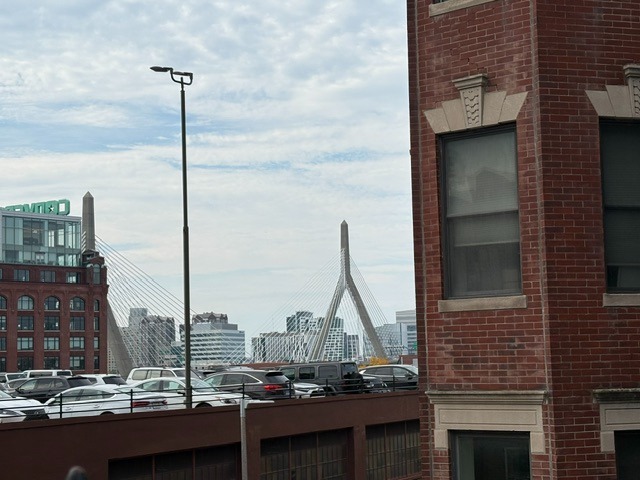
The bridge opened to traffic in 2003 as part of the Central Artery/Tunnel Project, better known as the Big Dig. It provided a new crossing of the Charles River within the enormous undertaking to rebuild Boston’s highway system.
Swiss engineer Christian Menn conceived its distinctive inverted Y-shaped towers, with architect Miguel Rosales contributing to the bridge’s design. The towers deliberately recall the nearby Bunker Hill Monument. The spreading cables and overall form evoke sailboats, connecting a modern highway crossing with the maritime landscape around it.
Those cables also reveal how the bridge works: they support the roadway directly from the towers. Eight traffic lanes pass between the towers, while two additional lanes extend along the eastern side. That unusual arrangement gives the bridge its asymmetrical structure and makes its engineering part of its visual identity.
Its full name honors both the people who fought at Bunker Hill and civil rights leader Leonard “Lenny” Zakim. Zakim worked against racism and antisemitism and brought people from different religious and racial backgrounds together. Among his efforts were interfaith gatherings that encouraged relationships across communities. In 1995, he helped establish the Lenny Zakim Fund to support grassroots organizations addressing injustice.
Naming a bridge for him gives the structure another meaning. A crossing that physically connects parts of Boston also remembers a man whose work connected people. Its towers acknowledge the Revolutionary past, its cables suggest the waterfront, and its name preserves a more recent history of community building.
Seeing it from the neighborhood allows time to notice those connections. The Zakim Bridge belongs to modern Boston, while its design and dedication draw upon the histories of the city around it.
Read More From Nancy
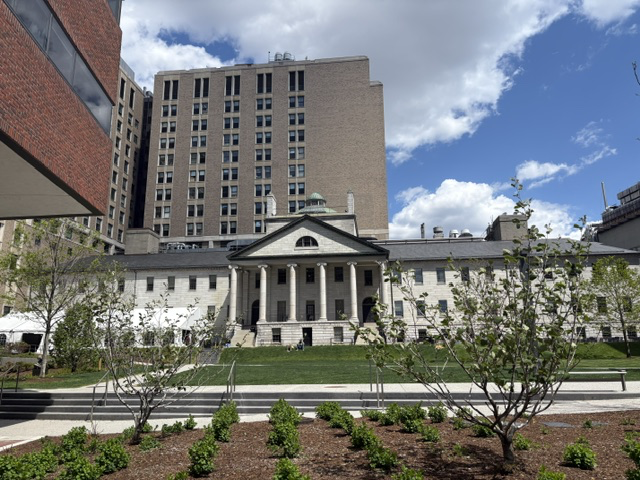
The Bulfinch Building
Standing within the enormous Massachusetts General Hospital campus is a building that looks almost modest compared with the medical complex that now surrounds it. The Bulfinch Building is the original home of Massachusetts General Hospital and has stood here for more than two centuries. Its classical façade, columned portico and triangular pediment provide a striking […]
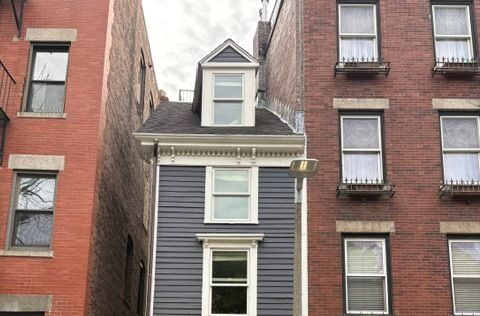
The Skinny House
Across from Copp’s Hill Burying Ground, a remarkably narrow wooden house stands among the larger brick buildings of Boston’s North End. At 44 Hull Street, the Skinny House rises four stories while measuring only about ten feet across its street-facing exterior. Its entrance is tucked into the alley beside it, allowing the slender front to […]
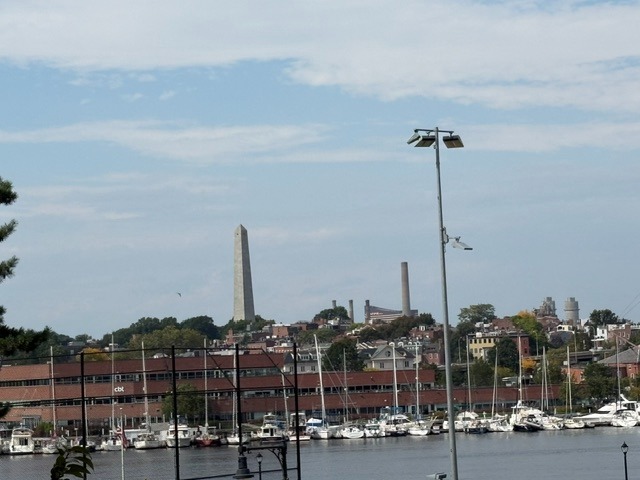
Bunker Hill Monument
Looking across the water from Boston’s North End, we could see the Bunker Hill Monument rising above Charlestown. Its granite obelisk marks a battlefield that helped demonstrate the determination of the colonial forces during the opening months of the American Revolution. Despite its name, the monument stands on Breed’s Hill, where much of the Battle […]

