The Mather Family Tomb at Copp’s Hill
The Mather family tomb at Copp’s Hill Burying Ground holds three generations of ministers: Increase Mather, his son Cotton, and Cotton’s son Samuel. Their lives span a period when religious leadership carried considerable influence over education, government, and everyday life in Boston. The monument brings together a family whose writings and sermons helped shape colonial New England—and whose legacy remains closely connected to its controversies.
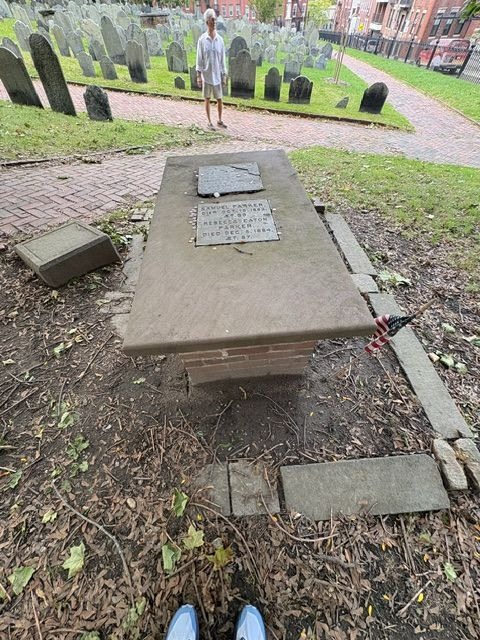
Increase Mather became minister of Boston’s Second Church in 1664 and remained associated with the congregation until his death in 1723. He also led Harvard College from 1685 to 1701, serving successively as acting president, rector, and president. His responsibilities extended beyond the pulpit and college. During a period of conflict over Massachusetts’s government, he traveled to England to represent the colony’s interests and helped obtain a new charter in 1691.
Cotton Mather joined his father in the ministry at Second Church in 1685. This congregation was also called the North Church or Old North Meeting House, but it was separate from the Episcopal Old North Church associated with the lantern signal of 1775. Cotton became a prolific writer, addressing theology, New England history, and scientific subjects. His publications gave his ideas an audience far beyond his own congregation.
Both Increase and Cotton are associated with the Salem witch trials, although their positions and actions differed. Neither served as a trial judge. Increase argued against reliance on spectral evidence—claims that an accused person’s apparition had harmed someone. Cotton also expressed caution about such evidence, yet supported the prosecutions and defended the court’s conduct in his 1693 book, The Wonders of the Invisible World. Their influence illustrates how religious authority could shape judgments about guilt, evidence, and the supernatural.
Cotton’s interests also included efforts to prevent disease. During Boston’s smallpox epidemic of 1721, he advocated inoculation, a practice he had learned about from Onesimus, an African man he enslaved, as well as from published accounts. Onesimus’s knowledge helped introduce an approach that became an important development in Boston’s medical history.
Samuel Mather continued the family’s ministerial tradition. A Harvard graduate, he served Boston’s North Church before leading a separate congregation following a dispute in the 1740s. He also wrote a biography of his father, helping preserve Cotton’s life and work for later readers. Samuel died in 1785, carrying the family’s story into the era of American independence.
At Copp’s Hill, these generations share one tomb. Their memorial offers a place to consider the reach of a prominent colonial family: its contributions to learning, its exercise of religious authority, and the consequences of beliefs that influenced the lives of others.
Read More From Nancy
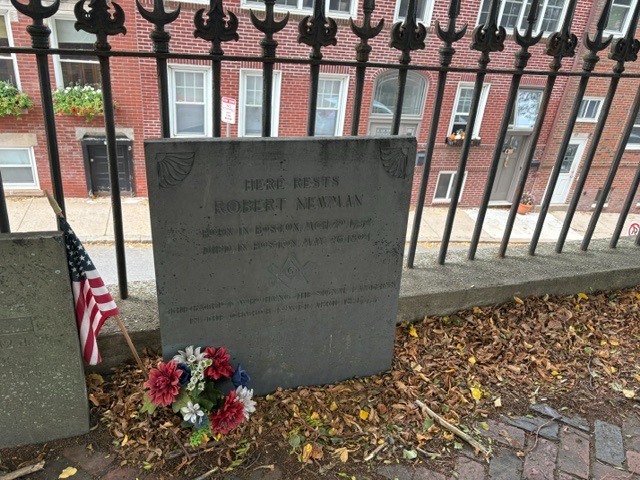
Robert Newman at Copp’s Hill Burying Ground
At Copp’s Hill Burying Ground, Robert Newman’s grave brings us close to one of the people who helped send a warning out of Boston on the eve of the American Revolution. As sexton of Christ Church, now known as Old North Church, Newman participated in displaying the two lanterns that signaled British troops were leaving […]
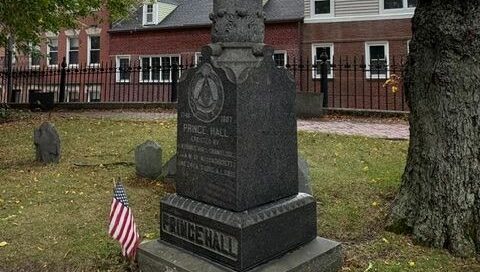
Prince Hall at Copp’s Hill Burying Ground
Among the graves at Copp’s Hill Burying Ground is the monument to Prince Hall, a leader in Boston’s Black community whose work connected abolition, education, and the establishment of Black Freemasonry. His life unfolded during the American Revolution and the early republic, when declarations of liberty existed alongside slavery and racial exclusion. Hall helped bring […]
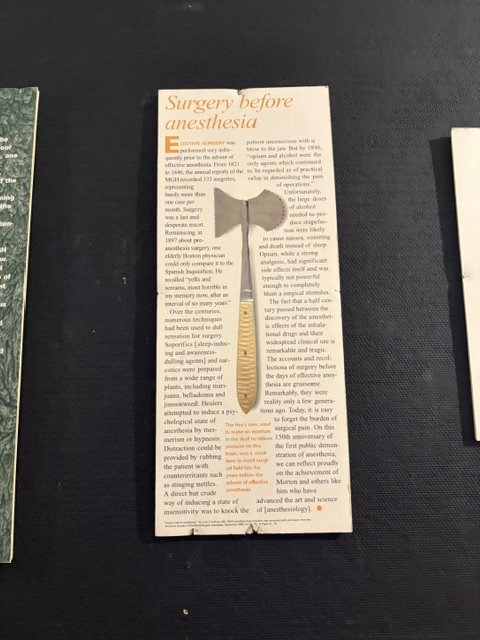
Surgery Before Anesthesia
Among the small historical displays in Massachusetts General Hospital’s Bulfinch Building, this one caught my attention because it asks us to imagine something that is almost incomprehensible today: undergoing surgery while fully conscious and able to feel what was happening. Before reliable surgical anesthesia became available in the nineteenth century, physicians had surprisingly few ways […]

