Prince Hall at Copp’s Hill Burying Ground
Among the graves at Copp’s Hill Burying Ground is the monument to Prince Hall, a leader in Boston’s Black community whose work connected abolition, education, and the establishment of Black Freemasonry. His life unfolded during the American Revolution and the early republic, when declarations of liberty existed alongside slavery and racial exclusion. Hall helped bring those contradictions before the government, asking that the rights claimed by others extend to Black Americans.
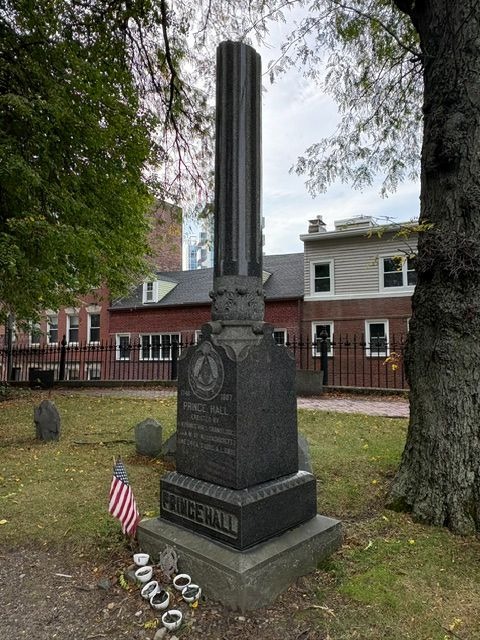
Hall had experienced enslavement himself. He gained his freedom in 1770 and became an influential member of Boston’s free Black community. In 1777, he joined other petitioners in asking the Massachusetts government to abolish slavery. Their appeal placed Black demands for freedom within the same Revolutionary debate about natural rights and human liberty that was reshaping the colonies.
Freemasonry became another important part of his work. In March 1775, Hall and fourteen other Black men were initiated into a Masonic lodge attached to a British military regiment in Boston Harbor. They subsequently organized African Lodge, with Hall serving as its leader. A charter granted by the Grand Lodge of England in 1784 established formal recognition for the lodge. From these beginnings grew the tradition now known as Prince Hall Freemasonry, creating an enduring institution for fellowship, charitable work, and community leadership.
Hall’s advocacy also addressed the practical conditions of everyday life. In 1788, he, his son Primus, and other Black men petitioned the Massachusetts legislature to end the slave trade and protect people from kidnapping into slavery. He also joined efforts to secure public education for Black children. When those requests failed, community members pursued their own arrangements for schooling. Primus eventually opened his Beacon Hill home for a school, continuing a commitment to education that father and son shared.
Hall died in 1807 and was buried at Copp’s Hill. His memorial places this history within a cemetery often associated with colonial ministers, craftsmen, and Revolutionary figures. It also reminds us that Boston’s Black residents were active participants in shaping the city’s institutions and challenging the limits of its promises. Hall’s petitions and the organization he helped establish left a record of sustained effort to make freedom, education, and civic participation available to his community.
Read More From Nancy
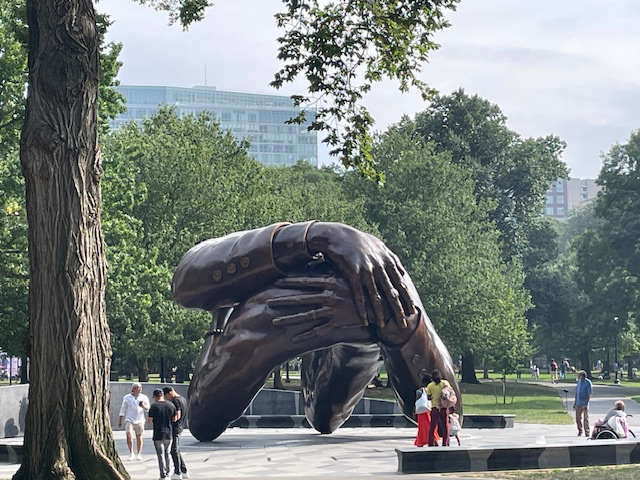
The Embrace
On Boston Common stands a powerful and modern tribute to Dr Martin Luther King, Jr and Coretta Scott King. The memorial is called: The Embrace. Unveiled in 2023, the sculpture does not depict faces in full figures. Instead, it focuses on a moment, an embrace. Two sets of arms, joined together, rising in bronze. The design […]
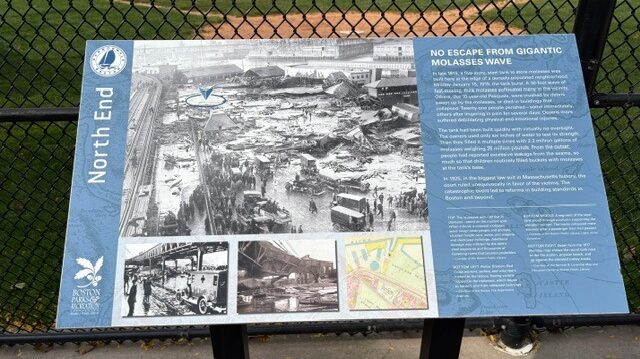
The Great Molasses Flood
Along Commercial Street in Boston’s North End, a waterfront marker recalls a disaster that can be difficult to imagine amid the neighborhood’s activity today. On January 15, 1919, a massive steel storage tank burst, releasing approximately 2.3 million gallons of molasses into the surrounding streets. Twenty-one people died, and roughly 150 were injured. The tank […]
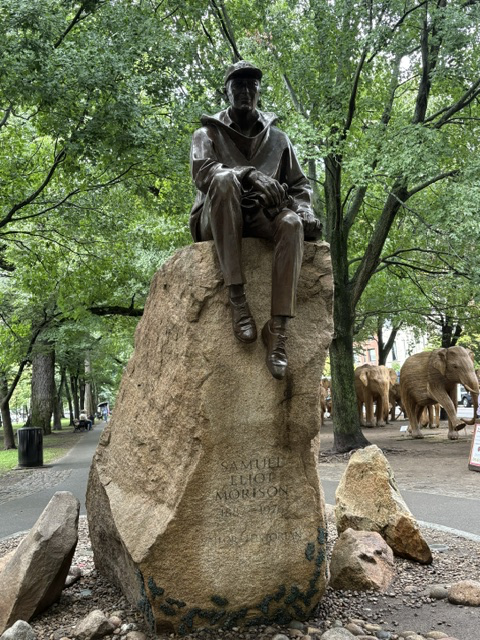
Samuel Eliot Morison Memorial
Walking along the Commonwealth Avenue Mall reveals a series of monuments honoring people connected to Boston and the wider world. Among them is a particularly distinctive sculpture of Samuel Eliot Morison. Rather than placing him formally on his feet or astride a horse, sculptor Penelope Jencks portrayed him as a sailor seated on an enormous […]

