The Holy Door of St. Peter’s Basilica
On one of our family trips to Rome, we visited St. Peter’s Basilica, where this photograph of Erin was taken standing in front of the enormous bronze Holy Door. Known as the Porta Santa, it is one of the most significant entrances to St. Peter’s Basilica and has been associated with the Catholic Church’s Jubilee tradition for centuries. The door is normally closed and is opened during a Jubilee, when pilgrims from around the world pass through it as a symbol of faith, forgiveness and spiritual renewal.
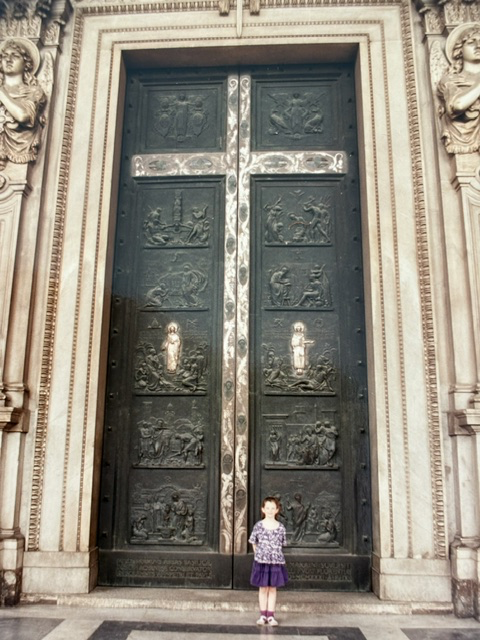
The tradition of the Holy Door at St. Peter’s dates to the Jubilee of 1500, when Pope Alexander VI opened a special entrance to the basilica on Christmas Eve 1499. The concept of a Holy Door had appeared earlier at other churches, but over the centuries the ceremony at St. Peter’s became one of the defining rituals marking the beginning of a Catholic Holy Year.
For centuries, the entrance was actually sealed with a masonry wall between Jubilees. At the beginning of a Holy Year, the Pope ceremonially began the process of opening the wall so that the doorway could once again be used by pilgrims. At the conclusion of the Jubilee, it was sealed again. The ceremony has changed over time, and today the bronze doors themselves are ceremonially opened and closed, with the masonry wall constructed behind them when the Holy Door is not in use.
The bronze doors were created by Italian sculptor Vico Consorti for the Holy Year of 1950 and were installed in 1949 during the pontificate of Pope Pius XII. Across the doors are sixteen sculpted panels depicting biblical scenes centered on sin, forgiveness, conversion and redemption. Among them are Adam and Eve, the Annunciation, the baptism of Jesus, the Lost Sheep, the Prodigal Son, Peter’s denial of Christ, the Good Thief, Doubting Thomas and the conversion of Saul. The images turn the doorway itself into a visual narrative of the Christian journey toward reconciliation.
That symbolism is central to the meaning of the Holy Door. Passing through it during a Jubilee is intended to represent more than physically entering St. Peter’s Basilica. For Catholic pilgrims, crossing its threshold represents a spiritual passage toward Christ, reconciliation and renewal.
The scale of the doorway is particularly apparent in this photograph. Erin looks very small standing beneath it, surrounded not only by the massive bronze panels but also by the elaborate marble and sculptural decoration of St. Peter’s Basilica. It is a work of art, an entrance to one of the world’s great churches, and a physical part of a Catholic tradition that reaches back more than five centuries.
Read More From Nancy
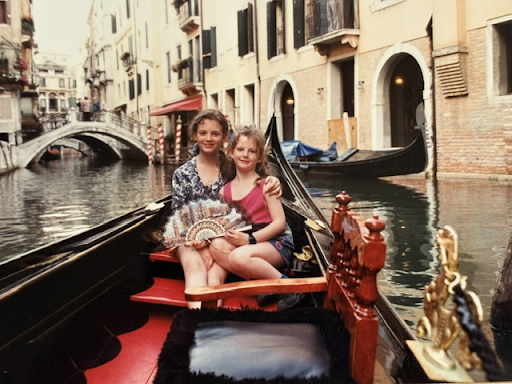
Gondola Ride
First trips to Italy almost must include Venice, and for us that meant experiencing the city the way generations of Venetians have done for centuries, by boat. A gondola ride through the canals quickly became one of the highlights of our journey and remains one of those family memories that has not fad. Venice itself […]
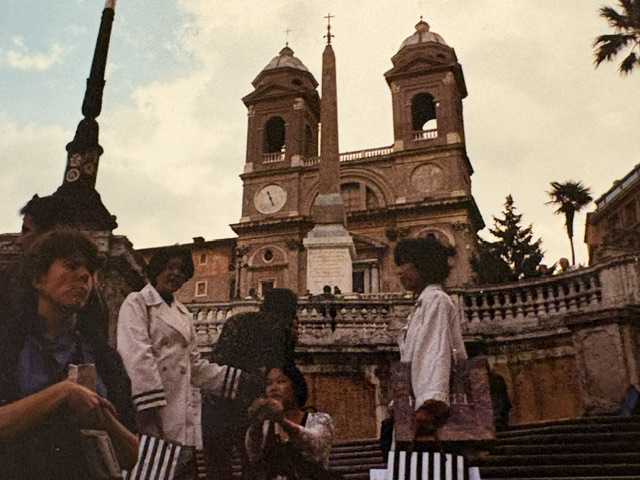
Trinità dei Monti and the Spanish Steps
The Church of Santissima Trinità dei Monti rises above the Spanish Steps on Rome’s Pincian Hill. Its twin bell towers create one of the city’s most recognizable views, forming a dramatic background to the broad stairway descending toward the Piazza di Spagna. Construction of the church began in the early sixteenth century under the patronage […]
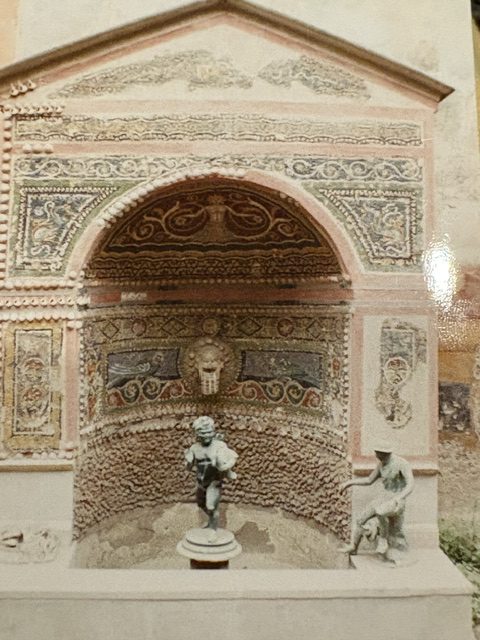
Mosaic Fountain at the House of the Small Fountain
The elaborate fountain at Pompeii’s House of the Small Fountain transformed an ordinary garden wall into a richly decorated water display. Constructed within an arched niche, it combined flowing water, colorful mosaics and small sculptures to create an artistic focal point within the private residence. The surface was decorated with glass tesserae, shells, pieces of […]

