The First Pugwash Conference — July 1957
This photograph takes us into the room where the event that gave Pugwash its international significance happened. The date printed on the display, July 5–11, 1957, marks the period surrounding the first Pugwash Conference on Science and World Affairs.
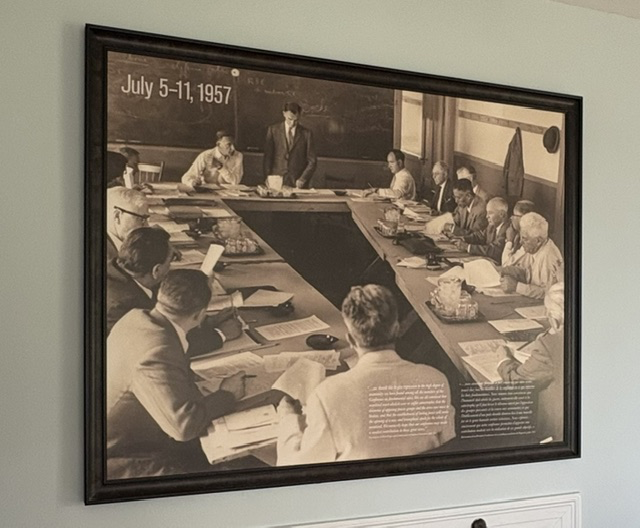
Twenty-two scientists from ten countries came to Pugwash following the call issued by the 1955 Russell-Einstein Manifesto, which warned humanity about the consequences of nuclear warfare. Cyrus Eaton provided the setting and financial support, while Joseph Rotblat was among the principal organizers.
What makes this photograph so powerful is its ordinariness. The participants sit close together around simple tables covered with papers, notebooks, glasses and pitchers of water. There are no national flags separating them and no elaborate diplomatic setting. These were scientists from countries on opposing sides of the Cold War, including the United States and Soviet Union, meeting privately as individuals rather than as official government representatives.
The arrangement of the tables is significant as well. Everyone faces inward. They could see one another, question one another and respond directly. The purpose was not to negotiate a treaty but to determine whether scientists could establish a dialogue across the political divisions of the Cold War and confront together the dangers created by nuclear weapons.
Among the documented participants were Joseph Rotblat of Britain, Eugene Rabinowitch of the United States, Dmitri Skobeltsyn and Alexander Topchiev of the Soviet Union, and Hideki Yukawa of Japan, who had received the 1949 Nobel Prize in Physics. China, Poland, France, Australia, Austria and Canada were also represented.
Here we see scientists who came from nations deeply divided by the Cold War sitting around the same table in a small Nova Scotia village and talking to one another. From this meeting came the Pugwash Conferences on Science and World Affairs, a movement that would continue for decades and eventually share the 1995 Nobel Peace Prize with Joseph Rotblat.
Read More From Nancy
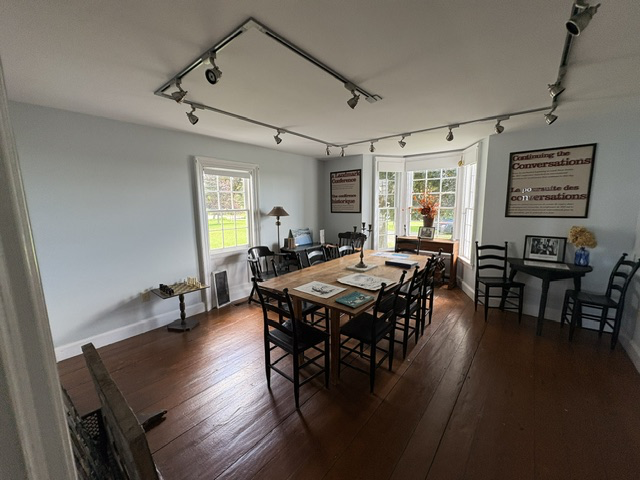
The Conference Room
This is the conference room at Thinkers’ Lodge, a space that represents the kind of face-to-face conversation at the heart of the Pugwash idea. Its simplicity is striking: a long wooden table, closely arranged chairs, wooden floors and windows looking out over the grounds. There is little here to suggest the formality of international diplomacy. […]
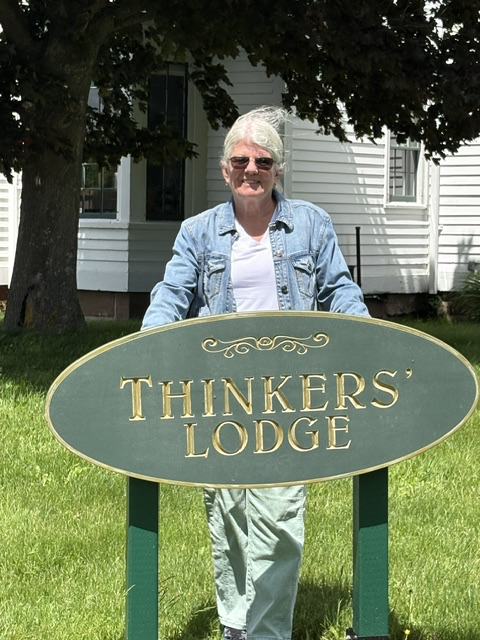
Thinkers’ Lodge
As we started our road trip home from Halifax, Marty and I decided to get off the main road and make our way to the small village of Pugwash, Nova Scotia. We had never heard of Pugwash, nor did we know anything about the remarkable events that had taken place there. What we found was […]
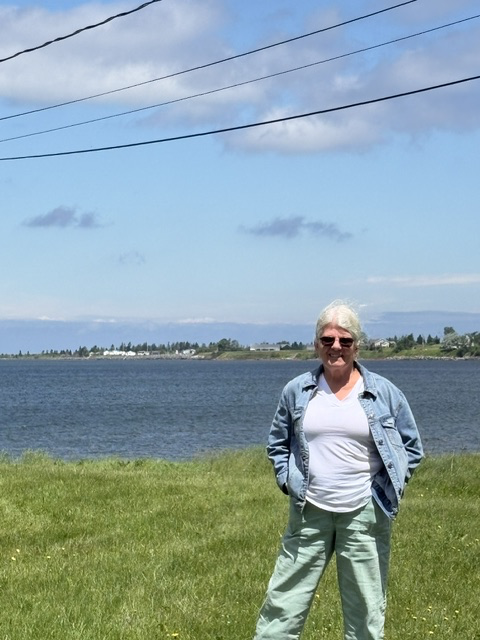
Where the Land Meets the Sea
Standing along the waterfront in Pugwash, it is easy to understand why a community developed here. The water behind me is part of a landscape that has shaped life in this part of Nova Scotia for thousands of years. Long before Europeans arrived, the Mi’kmaq knew this area as Pagweak, a name associated with the shallow […]

