Cyrus Eaton and the International Lenin Peace Prize
I had never heard of the International Lenin Peace Prize before seeing Cyrus Eaton’s medal and certificate at Thinkers’ Lodge, but understanding what the award was makes this display much more interesting.
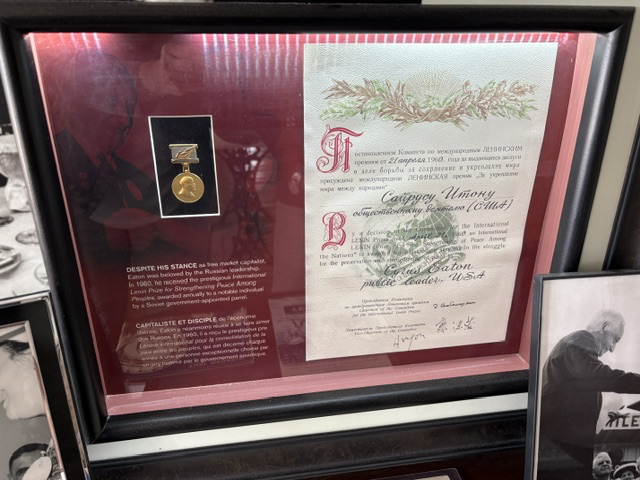
The award was created by the Soviet Union in 1949, originally as the International Stalin Prize for Strengthening Peace Among Peoples. Following Stalin’s death and Nikita Khrushchev’s campaign of de-Stalinization, it was renamed in 1956 as the International Lenin Prize for Strengthening Peace Among Peoples. Unlike the Nobel Peace Prize, which was awarded independently in Norway, this was a Soviet state-sponsored prize. Recipients were selected by a committee appointed within the Soviet system, and the award inevitably carried political meaning during the Cold War.
Yet the recipients were an extraordinarily varied international group. They included artists Pablo Picasso and Pablo Neruda; American civil-rights scholar and activist W. E. B. Du Bois; Indian physicist and Nobel laureate C. V. Raman; Ghanaian independence leader Kwame Nkrumah; Cuban leader Fidel Castro; architect Oscar Niemeyer; anti-apartheid leader Nelson Mandela; American activist Angela Davis; and others from countries around the world. Mandela was ultimately the last recipient of the prize.
Cyrus Eaton received the prize in 1960. He shared that year’s honors with Laurent Casanova of France, Aziz Sharif of Iraq and Indonesian president Sukarno. The Soviet announcement recognized Eaton, a Canadian-born American industrialist and committed capitalist, for his work promoting peaceful coexistence and friendship among nations. That seems almost contradictory, a wealthy North American capitalist receiving one of the Soviet Union’s most prominent international awards at the height of the Cold War. But that contradiction is exactly what makes Eaton’s story so interesting.
Eaton believed that the ideological struggle between the Soviet Union and the West should not prevent people from communicating with one another. His willingness to engage with Soviet leaders was controversial in the United States, particularly during an era of intense suspicion of communism. He developed relationships with Soviet officials, including Nikita Khrushchev, and continued arguing for greater communication between East and West.
The location where Eaton accepted the prize makes the medal displayed here even more significant. On July 1, 1960, a Soviet delegation came to Pugwash and presented the International Lenin Peace Prize to Eaton here at Thinkers’ Lodge. In his acceptance address, Eaton emphasized that he viewed the award not simply as recognition of himself but as encouragement for greater understanding between nations.
So this medal is connected directly to this house. Three years after Eaton brought scientists from opposing sides of the Cold War together here for the first Pugwash Conference, representatives of the Soviet Union traveled to this small Nova Scotia village to honor him for that work.
The International Lenin Peace Prize was certainly a product of Soviet politics and should not be confused with the independent Nobel Peace Prize. But seeing the original medal and certificate at Thinkers’ Lodge provides a fascinating artifact of the Cold War and of Cyrus Eaton’s unusual determination to keep people talking across the divide between East and West.
Read More From Nancy
The Russell-Einstein Manifesto
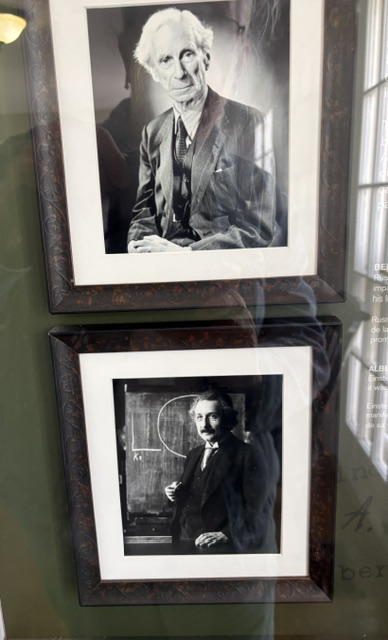
Before there was a meeting at Thinkers’ Lodge, there was a warning. In the years following World War II, scientists who had witnessed the development of nuclear weapons increasingly understood that humanity had entered a fundamentally different age. Among those most concerned were philosopher and mathematician Bertrand Russell and physicist Albert Einstein. In 1955, Russell […]
The Living Room at Thinkers’ Lodge
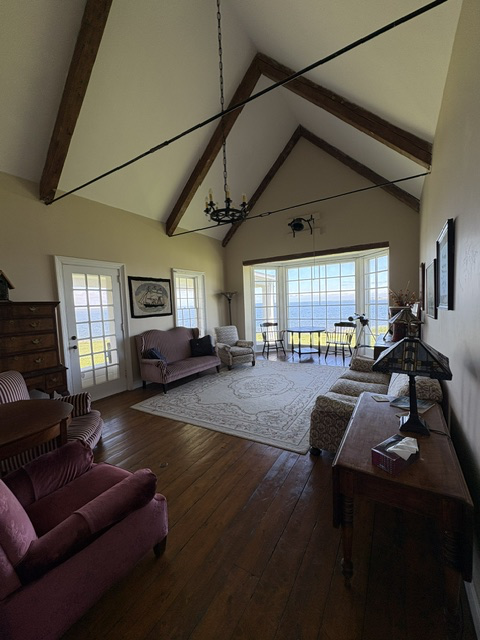
This room helps explain why Thinkers’ Lodge was such an unusual setting for an international gathering. Rather than meeting in a formal conference center, the scientists who came to Pugwash lived and spent time together in a house overlooking the Northumberland Strait. Rooms like this provided informal spaces where conversations could continue beyond the scheduled […]
The Conference Room
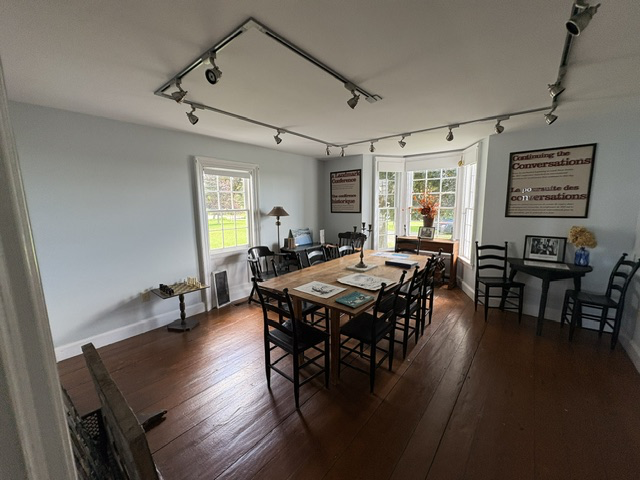
This is the conference room at Thinkers’ Lodge, a space that represents the kind of face-to-face conversation at the heart of the Pugwash idea. Its simplicity is striking: a long wooden table, closely arranged chairs, wooden floors and windows looking out over the grounds. There is little here to suggest the formality of international diplomacy. […]

