The Russell-Einstein Manifesto
Before there was a meeting at Thinkers’ Lodge, there was a warning. In the years following World War II, scientists who had witnessed the development of nuclear weapons increasingly understood that humanity had entered a fundamentally different age. Among those most concerned were philosopher and mathematician Bertrand Russell and physicist Albert Einstein.
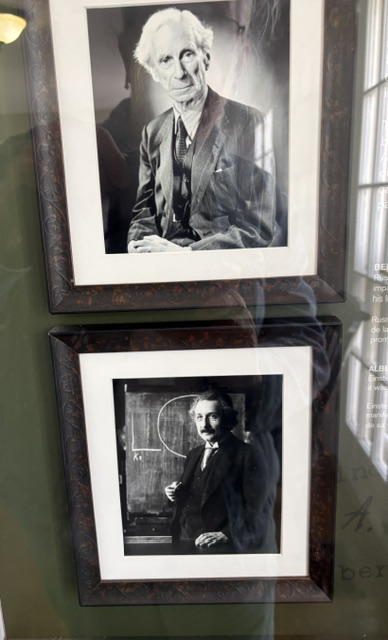
In 1955, Russell prepared what became known as the Russell-Einstein Manifesto. Einstein agreed to add his name and support. The timing was extraordinary: Einstein signed the document only days before his death on April 18, 1955. It was one of the final public acts of his life.
The manifesto was publicly presented by Russell in London on July 9, 1955. Its message went beyond politics or nationality. Nuclear weapons had become so destructive that another world war could threaten humanity itself. The scientists called upon governments to find peaceful ways of resolving international disputes and urged scientists from opposing political systems to meet and confront the dangers together.
The exhibit reproduces one of its most important passages:
“In view of the fact that in any future world war nuclear weapons will certainly be employed… we urge the governments of the world to realize… that their purposes cannot be furthered by a world war.”
Russell and Einstein were not alone. Eleven prominent scientists ultimately signed the manifesto, including Max Born, Percy Bridgman, Leopold Infeld, Frédéric Joliot-Curie, Hermann Muller, Linus Pauling, Cecil Powell, Joseph Rotblat and Hideki Yukawa. Ten of the eleven signatories either already were or would become Nobel laureates.
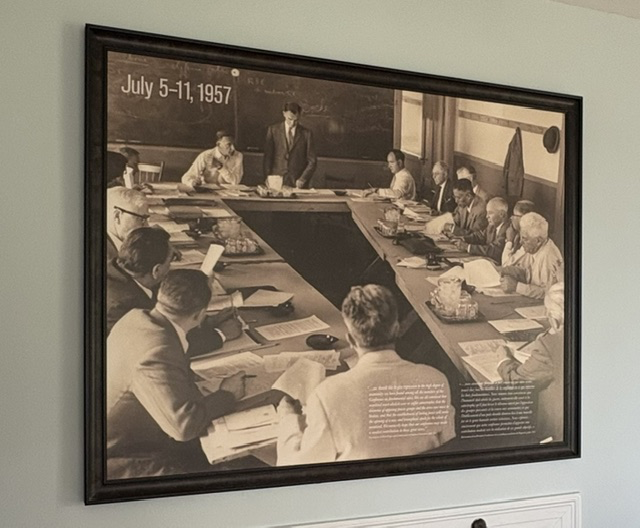
The manifesto specifically called for a conference of scientists to examine the dangers created by weapons of mass destruction. Canadian American industrialist Cyrus Eaton offered to finance such a meeting and suggested that it be held in his birthplace of Pugwash, Nova Scotia. Two years after the manifesto was issued, that idea became reality. In July 1957, 22 scientists from ten countries arrived in this small Nova Scotia village for the first Pugwash Conference on Science and World Affairs. Einstein never lived to see the Pugwash Conference his signature helped inspire. Russell did, and he remained closely associated with the movement that followed.
The history of Pugwash therefore did not really begin around the table at Thinkers’ Lodge in 1957. It began with scientists recognizing that the knowledge they had helped create also gave them a responsibility to speak about how that knowledge might be used. The Russell-Einstein Manifesto transformed that concern into a public call for action and Pugwash became one of its most important answers.

Read More From Nancy
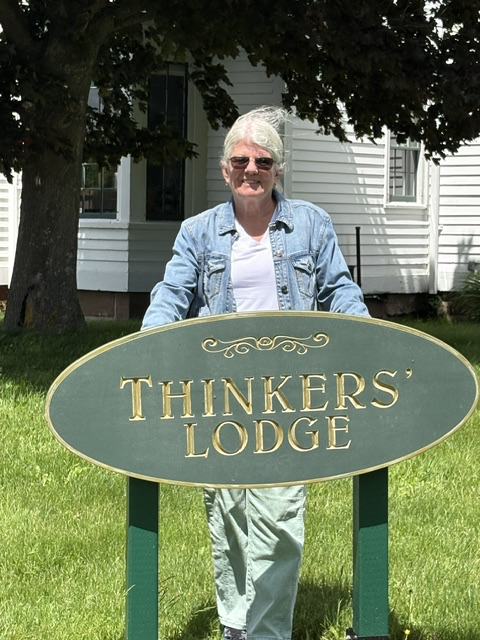
Thinkers’ Lodge
As we started our road trip home from Halifax, Marty and I decided to get off the main road and make our way to the small village of Pugwash, Nova Scotia. We had never heard of Pugwash, nor did we know anything about the remarkable events that had taken place there. What we found was […]
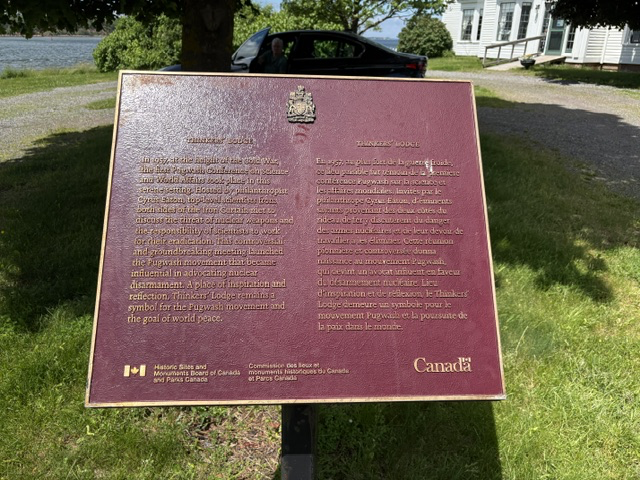
Thinkers’ Lodge National Historic Site Plaque
Standing in front of this plaque, I was struck by how long it took for Thinkers’ Lodge to receive formal recognition for what happened here. The first Pugwash Conference took place in 1957, when 22 scientists from ten countries gathered here at the height of the Cold War to discuss nuclear weapons and the responsibility […]
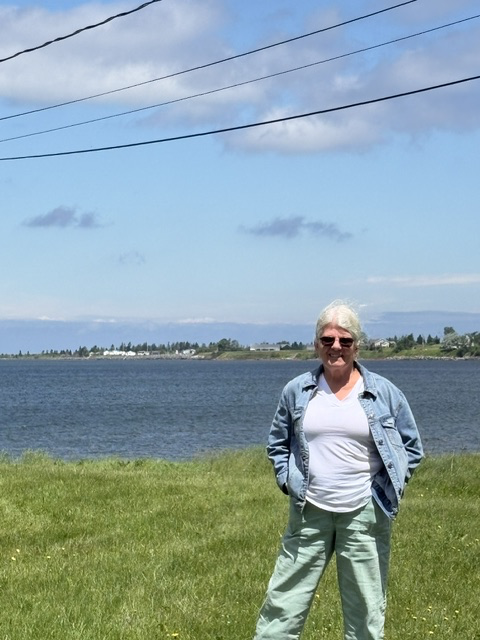
Where the Land Meets the Sea
Standing along the waterfront in Pugwash, it is easy to understand why a community developed here. The water behind me is part of a landscape that has shaped life in this part of Nova Scotia for thousands of years. Long before Europeans arrived, the Mi’kmaq knew this area as Pagweak, a name associated with the shallow […]

