The Beacon Hill Monument
A gilded eagle spreads its wings above a slender column in Ashburton Park, beside the Massachusetts State House. Surrounded by trees and lawn, the Beacon Hill Monument preserves the memory of an earlier Boston—both its Revolutionary history and a landscape that has changed considerably.
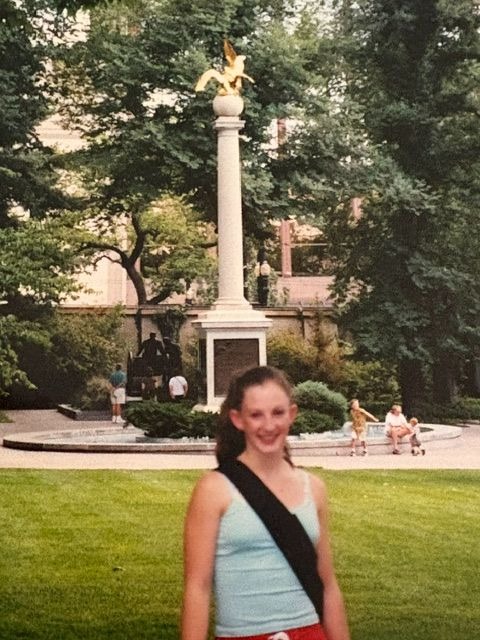
The monument follows a design by Charles Bulfinch, the architect of the State House. His original column, erected in 1790, commemorated the events leading to American independence. It stood on Beacon Hill, where a warning beacon had once given the hill its name. The eagle above the column provided a fitting symbol for the young nation.
That first monument was removed in 1811 as the summit of Beacon Hill was cut down. Boston’s hills supplied earth for filling low-lying areas, altering the city’s contours and creating land for development. The loss of the column was therefore part of a much larger transformation: the physical landscape of the early city was being reshaped around its growing population.
The present monument was dedicated on June 17, 1898—Bunker Hill Day. Four original inscribed slate tablets, preserved inside the State House for roughly a century, were incorporated into the replacement. Those surviving pieces connect the later memorial directly to Bulfinch’s original monument and the generation that first commemorated the Revolution.
Its quiet garden setting makes this an easily overlooked piece of Boston history. Yet the column tells two related stories: how the city chose to remember independence, and how it later recovered a landmark lost during its own expansion. Above the surrounding greenery, the golden eagle makes that act of remembrance visible.
Read More From Nancy
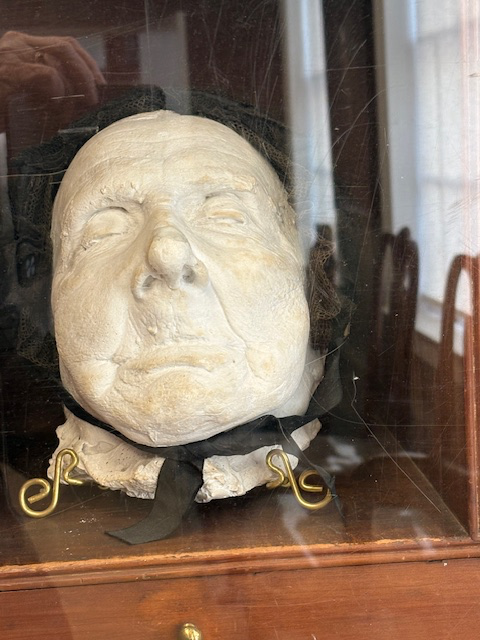
Death Mask
In the Dedham History Museum, is this death mask. An intimate impression of a person’s face taken shortly after death. The practice of creating death masks has a long history. In ancient Egypt, masks were place with the dead, though they were often idealized. In ancient Rome, families preserved wax masks of ancestors as a way to honor lineage […]
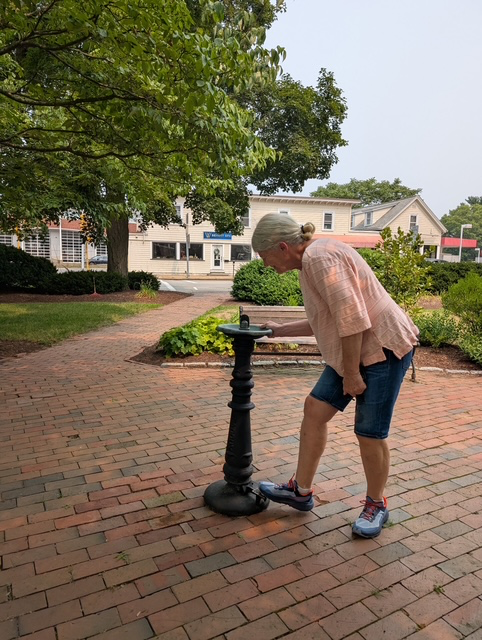
Water Fountain in Wellesley
Though I have walked the parks and paths of Wellesley, Massachusetts for years, I had not paused at this water fountain before. Growing up, I often drank from fountains because they were everywhere. The label on the base read: Murdock Manufacturing, Cincinnati, OH, a company founded in 1853. I learned that Murdock became one of […]
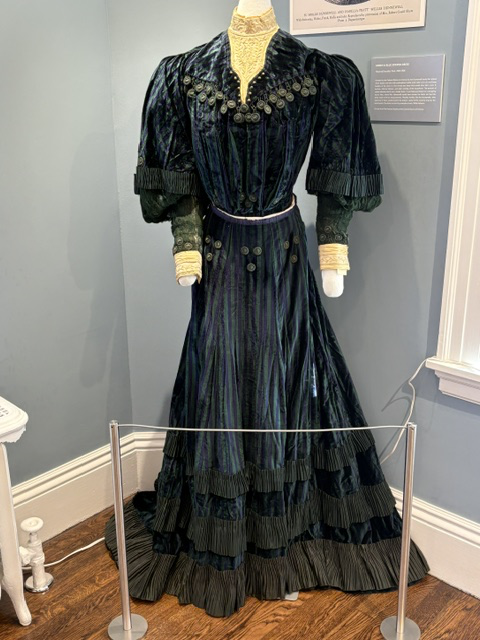
A Dress from Paris
One of the exhibits that caught my attention at the Wellesley Historical Society was this elegant green and blue striped dress, a reminder that fashion can tell us as much about history as letters, photographs, or documents. Created by the House of Doeuillet in Paris between 1905 and 1906, the dress was worn by a […]

